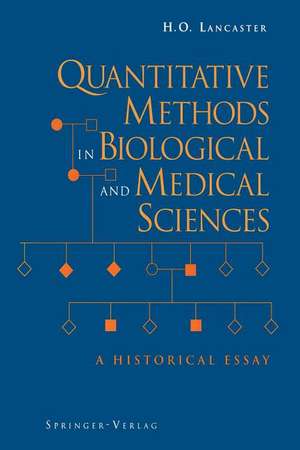
Quantitative Methods in Biological and Medical Sciences
Autor H. O. Lancasteren Limba Engleză Paperback – 26 sep 2011
Preț: 377.49 lei
Puncte Express: 566
Carte tipărită la comandă
Livrare economică 05-19 decembrie
Livrare prin curier în România Termenul estimat este afișat lângă disponibilitate.
Transport gratuit de la 400.00 lei Plată online sau ramburs, în funcție de opțiunile comenzii.
Retur gratuit în 14 zile Comandă securizată și suport în română.
Specificații
ISBN-13: 9781461276241
ISBN-10: 1461276241
Pagini: 316
Ilustrații: XVII, 297 p.
Dimensiuni: 155 x 235 x 18 mm
Greutate: 0.48 kg
Ediția:Softcover reprint of the original 1st ed. 1994
Editura: Springer
Locul publicării:New York, NY, United States
ISBN-10: 1461276241
Pagini: 316
Ilustrații: XVII, 297 p.
Dimensiuni: 155 x 235 x 18 mm
Greutate: 0.48 kg
Ediția:Softcover reprint of the original 1st ed. 1994
Editura: Springer
Locul publicării:New York, NY, United States
V-ar putea interesa
-
 Bayesian Statistics 9José M. Bernardo-32%Preț: 1383.60 lei2019.93 lei
 -
 Spatial Statistics and ModelingCarlo Gaetan-18%Preț: 1156.33 lei1410.17 lei
 -
 Statistical DistributionsCatherine Forbes-8%Preț: 532.10 lei578.37 lei
 -
 -9%Preț: 780.19 lei857.35 lei
 -
 Typical Dynamics of Volume Preserving HomeomorphismsAlpern StevePreț: 336.74 lei
 -
 Practical Statistics for AstronomersJ. V. WallPreț: 408.30 lei
 -
 Classic Problems of ProbabilityPrakash Gorroochurn-8%Preț: 441.89 lei480.32 lei
 -
 Modern Applied Statistics with SW. N. Venables-18%Preț: 1123.42 lei1370.02 lei
 -
 S ProgrammingWilliam Venables-15%Preț: 699.21 lei822.60 lei
 -
 Biostatistics with RBabak Shahbaba-5%Preț: 597.09 lei628.52 lei
 -
 Excel 2010 for Educational and Psychological StatisticsThomas J. QuirkPreț: 404.26 lei
 -
 -18%Preț: 788.11 lei961.10 lei
 -
 Laws of Small Numbers: Extremes and Rare EventsMichael Falk-18%Preț: 799.54 lei975.06 lei
 -
 -18%Preț: 846.49 lei1032.30 lei
Public țintă
GraduateCuprins
1. Greek Science.- 1. Atomism.- 2. Forms and Ideas.- 3. Aristotle.- 4. Canons of Experimentation.- 2. Later Influences of the Greek Authors.- 1. Atomism and Modern Biology.- 2. Solids and Liquids in Living Beings.- 3. Platonic Science in Modern Biology.- 4. Classification and Comparative Method.- 5. Canonical or Stratonic Science.- 6. Mathematization of Other Sciences.- 3. Microscopic World and the Structure of Living Organisms.- 1. Biodiversity.- 2. From Microbes to Cells.- 3. Size and Structure of Living Organisms.- 4. Applied Mathematics.- 5. Biologists’ Views on the Use of Mathematics.- 6. Francis Galton.- 4. Genetics.- 1. Genetics Before Mendel and Galton.- 2. Mendel.- 3. Stability of the Gene Frequencies.- 4. Evolution and Genetics.- 5. Rediscovery of Mendel’s Work.- 6. Pure Lines.- 7. Major Genes and Polygenes.- 8. Wilhelm Weinberg as a Medical Statistician.- 9. Anatomical Basis of Heredity.- 10. Genetic Linkage.- 11. Biometrical Genetics.- 12. Karl Pearson as a Geneticist.- 13. R.A. Fisher as a Geneticist.- 5. Human Genetics.- 1. Autosomal Dominant Inheritance.- 2. Autosomal Recessive Inheritance.- 3. Sex-Linked Inheritance.- 4. Inheritance of the Sex Ratio.- 5. Human Mutation Rates: Penrose.- 6. Polymorphisms and Human Hemoglobinopathies.- 7. Human Blood Groups.- 8. Extinction of Families or Genes.- 9. Human Pedigrees.- 6. Death Rates and Life Tables.- 1. Halley’s Life Table.- 2. Age-Specific Death Rates.- 3. Life Tables.- 4. Laws of Mortality.- 5. Fertility.- 6. Fibonacci Speculations.- 7. Euler’s Stable Populations.- 8. Logistic Theory of Population Growth.- 9. Integral Equation of Population Growth.- 10. Human Population Statistics.- 7. Evolution.- 1. Introduction.- 2. Establishment of a Biological Time Scale.- 3. Static Nonhuman Populations:Weldon.- 4. Numerical Results of Selection.- 5. Russian Naturalists: ?etverikov.- 6. Speciation.- 7. Evolutionary Synthesis.- 8. Infectious Diseases and Microbiology.- 1. Introduction.- 2. Ancient Doctrines on Contagion and Epidemics.- 3. New Approaches to Contagionism.- 4. Inoculation, Variolation, and Vaccination.- 5. Liebig’s Chemical Theory of Infection.- 6. Specificity of Infectious Diseases.- 7. Microbial Causes of Disease.- 8. Koch’s Postulates.- 9. Contagion and the Bowel Infections.- 10. Contagion by Air, Direct Contact.- 11. Vector-Borne Infections.- 12. Zoonoses and Anthropozoonoses.- 9. Puerperal Sepsis.- 1. Early Incidents and Opinions on Puerperal Sepsis.- 2. Puerperal Sepsis in the Great Hospitals.- 3. Maternal Mortality in England and Wales.- 4. Puerperal Sepsis: Bacteriology.- 5. Medical Statistics and Maternal Mortality.- 6. Analysis of Contagion.- 10. Wounds and Hospital Infections.- 1. Wounds and Hospitals.- 2. Cold Water and Cleanliness.- 3. Military Wounds and Illness.- 4. Statistics of Amputations.- 5. Hospitalism.- 11. Epidemiologic Observations.- 1. Perpetuation and Fadeout of Epidemics.- 2. Island Epidemics.- 3. Epidemics in Australia.- 4. Epidemics in Wensleydale.- 5. Epidemics in Schools and Closed Communities.- 6. Urbanization and Other Geographic and Social Factors.- 7. Topley’s School.- 8. Webster’s School.- 9. Rise and Fall of Epidemics.- 10. Myxomatosis in Rabbits.- 11. Epidemiology after Topley and Webster.- 12. Mathematics and Epidemiology.- 1. Farr’s Epidemiology.- 2. Measles in London.- 3. Hamer, Soper, and Brownlee.- 4. Deterministic Models.- 5. Stochastic Models.- 6. Diseases to be Modelled.- 7. Periodicity of Infectious Disease.- 8. Critique of Mathematical Epidemiology.- 13. Epidemiology of Noninfectious Diseases.- 1.Avitaminoses.- 2. Genetic Diseases.- 3. Neoplastic Diseases.- 4. Sunlight and Cancers.- 5. Ionizing Radiation.- 6. Tobacco.- 7. Tobacco and Lung Cancer.- 8. Etiology and Statistics.- 14. Metrical Characterizations of Individuals and Populations.- 1. Human Growth.- 2. Mathematics of Growth.- 3. Craniology and Craniometry.- 4. Adolphe Quetelet.- 5. Correlation in Biology.- 6. Characterizations of Human Populations.- 7. Identification of the Individual.- 15. Quantitative Diagnostic and Physiological Methods.- 1. Introduction and Vision.- 2. Pulse and Circulation.- 3. Blood Pressure and the Work of the Heart.- 4. Thermometry.- 5. Percussion and Auscultation: Josef Škoda.- 6. Cell Counting.- 7. Mechanical Aids in Diagnosis and in Physiology.- 8. Electronic Devices.- 9. Hearing.- 10. Nutrition.- 16. Classification of Diseases.- 1. Clinical Observation.- 2. Diseases in the Hospitals.- 3. latrochemistry.- 4. Physical Methods.- 5. Pathology.- 6. Bacteriology and Parasitology.- 7. Nosology.- 8. Farr and his Eclectic Classification of Diseases.- 9. International Statistical Classification of Diseases.- 10. Biological Classifications Before Linnaeus.- 11. Linnean System.- 12. Biological Classification and Mathematics.- 17. Numerical Analysis of Clinical Experience.- 1. Early Difficulties.- 2. Gavarret as a Modern Medical Statistician.- 3. The First Clinical Trial and Scurvy.- 4. Quinine.- 5. Jennerian Vaccination.- 6. Early Tests of the Efficacy of Therapy.- 7. Rejection of Venesection.- 8. Medical Theories of Therapy.- 9. Immunological Control of an Endemic Bacterial Disease.- 10. Individuality of Patients.- 11. Reference Set.- 18. Modern Clinical Trials.- 1. Conduct of a Clinical Trial.- 2. Choice of Hypothesis.- 3. Choice of Cases.- 4. Statistical Tests of the Hypothesis.- 5.Size of Trial.- 6. Choice of Treated and Controls.- 7. Further Testing of the Hypothesis and Interpretation of the Results of Experiment and Observation.- 8. Failure to Develop the Theory and Practice of Clinical Trials.- 19. Applications of Mathematics to Biology and Medicine.- 1. The Development of Mathematics.- 2. The Necessity of Mathematics in Biology.- 3. Normal Distributions.- 4. Normal Distribution and Theory of Errors.- 5. Some Normal Distributions in Biology.- 6. History and Philosophy of Science.- Epilogue.- References.- Person Index.
Recenzii
"..an intriguing, interesting, and innovative....readers with a historical bent...will treasure this volume as a veritable goldmine as they absorb its seemingly limitless nuggets...it is terse, compact, and (of necessity, selectively) comprehensive; the reference list alone is worth the price." Jnl of the Am Statistical Assoc.