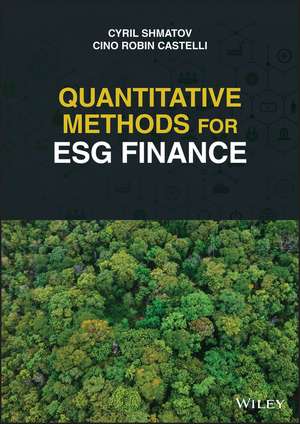
Quantitative Methods for Esg Finance
Autor Cyril Shmatov, Cino Robin Castellien Limba Engleză Hardback – dec 2022
Credem că simpla raportare a scorurilor ESG fără un fundament matematic riguros este o practică riscantă, care oferă o iluzie a sustenabilității în loc de o strategie reală de gestionare a activelor. Observăm adesea cum investitorii se bazează pe date calitative subiective, ignorând necesitatea unor modele cantitative care să traducă indicatorii de mediu, sociali și de guvernanță în metrici financiare concrete. Quantitative Methods for Esg Finance, publicată de Wiley, vine să corecteze această abordare, oferind un set de instrumente analitice pentru profesioniștii care doresc să treacă dincolo de retorică. Dacă Valuation and Sustainability de Dejan Glavas v-a oferit cadrul teoretic pentru integrarea datelor în evaluarea afacerii, această carte oferă instrumentele practice și modelele matematice necesare pentru execuție. Suntem de părere că rigoarea celor 240 de pagini transformă incertitudinea factorilor non-financiari în variabile controlabile. Cartea analizează structuri de risc și optimizări de portofoliu, fiind esențială într-un peisaj economic unde reglementările forțează instituțiile financiare să demonstreze impactul real al deciziilor lor.
Preț: 292.02 lei
Carte disponibilă
Livrare economică 09-23 noiembrie
Livrare express 23-29 octombrie pentru 48.44 lei
Specificații
ISBN-10: 1119903807
Pagini: 240
Dimensiuni: 179 x 255 x 20 mm
Greutate: 0.67 kg
Editura: Wiley
Locul publicării:Hoboken, United States
V-ar putea interesa
-
 Quantitative Investment Analysis, Fourth EditionCfa Institute-23%Preț: 658.86 lei855.67 lei
 -
 Preț: 295.30 lei
 -
 The Financial Times Guide to Business EthicsPablo Hepworth LloydPreț: 210.15 lei
 -
 Measuring Esg Effects in Systematic InvestingArik Ben Dor-19%Preț: 521.41 lei643.71 lei
 -
 Advanced Analytical Methods for Climate Risk and ESG Risk ManagementJorge R. US Los Alamos National Laboratory Moody's Investors Service CASA) Sobehart-19%Preț: 552.00 lei681.48 lei
 -
 The Elements of Quantitative InvestingGiuseppe A. Paleologo-8%Preț: 450.09 lei489.23 lei
 -
 Preț: 111.22 lei
 -
 Preț: 135.25 lei
 -
 The Only Three Questions That Still CountKen FisherPreț: 166.91 lei
 -
 Friends That InvestSimran KaurPreț: 127.19 lei
 -
 The New Nature of BusinessAndre HoffmannPreț: 116.02 lei
 -
 The Money ManualAbigail FosterPreț: 121.89 lei
 -
 Esg: The Insights You Need from Harvard Business ReviewHarvard Business ReviewPreț: 126.82 lei
 -
 CLARITY DRIVENJonathan CozensPreț: 73.19 lei
 -
 LET It HappenMau Espinosa-11%Preț: 83.92 lei93.89 lei
 -
 Shadows At WorkSteven D'SouzaPreț: 112.53 lei
 -
 Standing up for the PlanetFrancesco PaganoPreț: 171.28 lei
 -
 LikeMartin ReevesPreț: 194.17 lei
 -
 Another WayDave WhortonPreț: 189.16 lei
De ce să citești această carte
Această lucrare se adresează analiștilor financiari și managerilor de portofoliu care au nevoie de o metodologie precisă pentru investițiile sustenabile. Veți câștiga capacitatea de a cuantifica riscul ESG și de a-l integra în modele de optimizare standard. Este un ghid tehnic esențial pentru a transforma datele brute de sustenabilitate în avantaje competitive măsurabile și decizii de investiții fundamentate științific.
Despre autor
Cyril Shmatov și Cino Robin Castelli sunt experți recunoscuți în domeniul analizei cantitative și al managementului riscului. Cyril Shmatov deține o experiență vastă în aplicarea metodelor matematice în sectorul financiar, concentrându-se pe intersecția dintre gestionarea activelor și sustenabilitate. Cino Robin Castelli completează acest profil cu o expertiză solidă în dezvoltarea modelelor de risc pentru instituții financiare globale. Împreună, aceștia aduc în Quantitative Methods for Esg Finance o perspectivă pragmatică, bazată pe experiența directă din piețele de capital, fiind specializați în transformarea cerințelor complexe de reglementare în soluții analitice aplicabile.