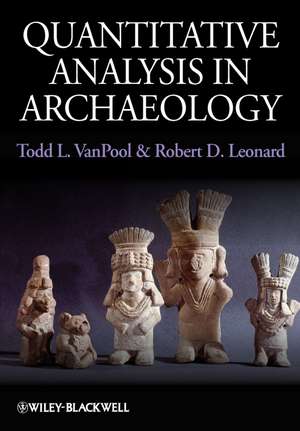
Quantitative Analysis in Archa
Autor Vanpoolen Limba Engleză Paperback – 3 dec 2010
Preț: 399.68 lei
Puncte Express: 600
Carte indisponibilă temporar
Livrare prin curier în România Termenul estimat este afișat lângă disponibilitate.
Transport gratuit de la 400.00 lei Plată online sau ramburs, în funcție de opțiunile comenzii.
Retur gratuit în 14 zile Comandă securizată și suport în română.
Specificații
ISBN-13: 9781405189507
ISBN-10: 1405189509
Pagini: 384
Dimensiuni: 169 x 246 x 25 mm
Greutate: 0.66 kg
Editura: Wiley
Locul publicării:Chichester, United Kingdom
ISBN-10: 1405189509
Pagini: 384
Dimensiuni: 169 x 246 x 25 mm
Greutate: 0.66 kg
Editura: Wiley
Locul publicării:Chichester, United Kingdom
V-ar putea interesa
-
 The Oxford Handbook of the European Bronze AgeAnthony Harding-32%Preț: 1357.34 lei1996.29 lei
 -
 Prehistoric Copper Mining in Europe: 5500-500 BCWilliam O'Brien-30%Preț: 784.96 lei1122.34 lei
 -
 -31%Preț: 961.78 lei1400.45 lei
 -
 Preț: 479.22 lei
 -
 Objects: Reluctant Witnesses to the PastChris CaplePreț: 388.82 lei
 -
 Preț: 440.06 lei
 -
 The Rise of HeritageAstrid Swenson-14%Preț: 790.10 lei918.72 lei
 -
 Social ZooarchaeologyNerissa Russell-11%Preț: 443.88 lei498.75 lei
 -
 The Rise of Bronze Age SocietyKristian Kristiansen-11%Preț: 498.51 lei560.13 lei
 -
 Analytical Chemistry in ArchaeologyA M Pollard-11%Preț: 473.19 lei531.68 lei
 -
 Reitz, E: ZooarchaeologyElizabeth J. Reitz-19%Preț: 498.36 lei615.25 lei
 -
 Quantitative PaleozoologyR. Lee LymanPreț: 361.36 lei
 -
 Organizing Bronze Age SocietiesTimothy EarlePreț: 315.65 lei
 -
 Geographical Information Systems in ArchaeologyJames Conolly-11%Preț: 500.47 lei562.31 lei
 -
 Archaeological Theory TodayIan HodderPreț: 292.10 lei
 -
 Digging Up the PastJohn Collis-16%Preț: 116.36 lei138.14 lei
 -
 The Urnfield Culture in Continental CroatiaSnjezana Karavanic-8%Preț: 551.91 lei599.91 lei
 -
 Training and Practice for Modern Day ArchaeologistsJohn H. JamesonPreț: 409.45 lei
 -
 European PrehistorySarunas Milisauskas-18%Preț: 851.43 lei1038.33 lei
 -
 Preț: 362.67 lei
 -
 Good Practice in Archaeological DiagnosticsCristina Corsi-18%Preț: 1044.53 lei1273.82 lei
Public țintă
Advanced undergraduate and graduate level courses on statistical analysis in Archaeology; professionals in the fieldNotă biografică
Todd L. VanPool is Assistant Professor at the Department of Anthropology, University of Missouri, Columbia. He is the co-author with Christine S. VanPool of Signs of the Casas Grandes Shamans (2007), Religion in the Prehispanic Southwest (2006) and Essential Tensions in Archaeological Method and Theory (2003).
Robert D. Leonard is retired from the Department of Anthropology, University of New Mexico, Albuquerque, where he taught for 17 years. He is currently the co-owner and a project director of Human Inquiry, a consulting firm that uses an interdisciplinary anthropological approach to help improve building designs.
Robert D. Leonard is retired from the Department of Anthropology, University of New Mexico, Albuquerque, where he taught for 17 years. He is currently the co-owner and a project director of Human Inquiry, a consulting firm that uses an interdisciplinary anthropological approach to help improve building designs.
Descriere
This text is an ideal introduction to the use of quantitative methods in archaeology. Statistical techniques are presented in a clear and straightforward manner throughout, and the careful balance between introduction of key concepts and their application to archaeological data is perfectly suited for both students and professionals in the field.