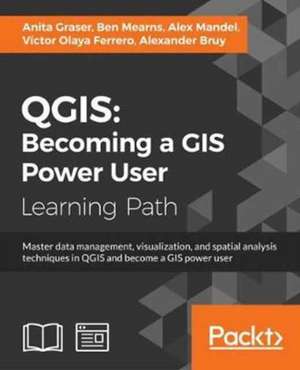
QGIS
Autor Ben Mearns, Alex Mandel, Alexander Bruyen Limba Engleză Paperback – 28 feb 2017
Remarcăm abordarea aplicată a acestui volum încă din primele capitole, unde cititorul este invitat să construiască un model de predicție a vulnerabilității culturilor agricole la mană, utilizând variabile climatice precum precipitațiile și umiditatea relativă. Nu este doar un manual de utilizare, ci un parcurs de învățare structurat în trei module care transformă un utilizator obișnuit într-un expert în sisteme informatice geografice (GIS). Credem că forța acestei lucrări rezidă în capacitatea de a acoperi întreg fluxul de lucru: de la instalarea și configurarea mediului, până la automatizarea proceselor complexe prin scripturi Python și extinderea capabilităților native prin plugin-uri personalizate.
Structura volumului permite o tranziție fluidă de la cartografia vectorială și raster către analize spațiale avansate. Dacă Learning QGIS - Third Edition v-a oferit cadrul teoretic și bazele manipulării datelor, această carte, sub semnătura lui Ben Mearns și a colaboratorilor săi, oferă instrumentele practice necesare pentru a gestiona formate de date dificile și pentru a rula analize hidrologice sau de rețea. Analizăm aici un ghid progresiv care nu ignoră aspectele estetice ale cartografiei, dar pune accent pe rigoarea tehnică a interoperabilității datelor și a reproiectării sistemelor de coordonate. Recomandăm acest titlu pentru densitatea informației tehnice, cele peste 800 de pagini funcționând ca o enciclopedie a soluțiilor open-source pentru probleme spațiale complexe, depășind simpla vizualizare în favoarea modelării analitice.
Preț: 513.64 lei
Preț vechi: 634.13 lei
-19%
Carte tipărită la comandă
Livrare economică 23 iunie-07 iulie
Specificații
ISBN-10: 1788299728
Pagini: 818
Dimensiuni: 191 x 235 x 44 mm
Greutate: 1.38 kg
Editura: Packt Publishing
V-ar putea interesa
-
 On the Foundations of ComputingGiuseppe Primiero-21%Preț: 366.63 lei466.40 lei
 -
 Computational Intelligence in Healthcare ApplicationsRajeev Agrawal-32%Preț: 803.82 lei1180.30 lei
 -
 Blockchain Chicken FarmXiaowei WangPreț: 89.84 lei
 -
 Possible Minds: Twenty-Five Ways of Looking at AIJohn Brockman-37%Preț: 78.14 lei124.15 lei
 -
 The Zynq BookLouise H. CrockettPreț: 297.25 lei
 -
 Algorithms Illuminated (Part 2)Tim Roughgarden-20%Preț: 89.06 lei111.32 lei
 -
 How To Be An Agile Business AnalystKent J McDonald-20%Preț: 129.68 lei162.10 lei
 -
 Database SystemsRamez Elmasri-20%Preț: 574.50 lei718.13 lei
 -
 -20%Preț: 206.92 lei258.64 lei
 -
 Oracle APEXSathya Jegan N Rajan ChandruPreț: 177.91 lei
 -
 Tmux 2Brian Hogan-20%Preț: 120.70 lei150.88 lei
 -
 The Revolutionary PhenotypeJean-François GariépyPreț: 113.91 lei
 -
 AdventureJamie LendinoPreț: 117.78 lei
 -
 QGIS By ExampleAlexander Bruy-20%Preț: 262.69 lei328.37 lei
 -
 QGIS 2 CookbookAlex Mandel-20%Preț: 298.27 lei372.84 lei
 -
 QGIS BlueprintsBen Mearns-20%Preț: 289.95 lei362.45 lei
 -
 Expert GeoServerBen Mearns-20%Preț: 170.32 lei212.90 lei
 -
 The Infinite RetinaIrena Cronin-20%Preț: 421.05 lei526.31 lei
 -
 Preț: 429.57 lei
 -
 Cybersecurity Law, Standards and RegulationsTari Schreider-20%Preț: 472.47 lei590.59 lei
 -
 Peeling Design PatternsNarasimha KarumanchiPreț: 292.65 lei
 -
 Advances in Computers and Software EngineeringSergey Yurish-20%Preț: 542.97 lei678.71 lei
De ce să citești această carte
Recomandăm această carte specialiștilor GIS și dezvoltatorilor care doresc să stăpânească ecosistemul QGIS la nivel avansat. Cititorul câștigă competențe critice în automatizarea fluxurilor de lucru cu Python și în realizarea de analize spațiale complexe, precum cele hidrologice sau de rețea. Este un instrument esențial pentru trecerea de la utilizarea de bază la crearea de aplicații cartografice stratificate și profesionale.
Despre autor
Ben Mearns este un specialist în sisteme informatice geografice cu o vastă experiență în aplicarea tehnologiilor spațiale în mediul academic și în cercetare, fiind recunoscut pentru contribuțiile sale în domeniul digital humanities. Alături de el, Alex Mandel și Alexander Bruy aduc expertiză tehnică în dezvoltarea de software și analiză de date. Alexander Bruy este un contribuitor activ la proiectul QGIS, expert în dezvoltarea de plugin-uri și instrumente de procesare, asigurând astfel că informațiile prezentate respectă standardele actuale ale comunității open-source.
Notă biografică
Ben Mearns was previously the Lead Geospatial Information Consultant at the University of Delaware, where he was the senior GIS professional charged with leading, developing, and advising on GIS solutions. He developed the GeoServer-based campus mapping system. He has held GIS and data positions at the University of Pennsylvania Cartographic Modeling Lab, Princeton University Department of Sociology, and Macalester College Department of Geography.
Descriere scurtă
Master data management, visualization, and spatial analysis techniques in QGIS and become a GIS power user Key Features:Learn how to work with various types of data and create beautiful maps using this easy-to-follow guide Give a touch of professionalism to your maps, both for functionality and look and feel, with the help of this practical guide This progressive, hands-on guide builds on a geo-spatial data and adds more reactive maps using geometry tools. Book Description: The first module Learning QGIS, Third edition covers the installation and configuration of QGIS. You'll become a master in data creation and editing, and creating great maps. By the end of this module, you'll be able to extend QGIS with Python, getting in-depth with developing custom tools for the Processing Toolbox. The second module QGIS Blueprints gives you an overview of the application types and the technical aspects along with few examples from the digital humanities. After estimating unknown values using interpolation methods and demonstrating visualization and analytical techniques, the module ends by creating an editable and data-rich map for the discovery of community information. The third module QGIS 2 Cookbook covers data input and output with special instructions for trickier formats. Later, we dive into exploring data, data management, and preprocessing steps to cut your data to just the important areas. At the end of this module, you will dive into the methods for analyzing routes and networks, and learn how to take QGIS beyond the out-of-the-box features with plug-ins, customization, and add-on tools. This Learning Path combines some of the best that Packt has to offer in one complete, curated package. It includes content from the following Packt products: ¿ Learning QGIS, Third Edition by Anita Graser ¿ QGIS Blueprints by Ben Mearns ¿ QGIS 2 Cookbook by Alex Mandel, Víctor Olaya Ferrero, Anita Graser, Alexander Bruy What You Will Learn:Create your first map by styling both vector and raster layers from different data sources Use parameters such as precipitation, relative humidity, and temperature to predict the vulnerability of fields and crops to mildew Re-project vector and raster data and see how to convert between different style formats Use a mix of web services to provide a collaborative data system Use raster analysis and a model automation tool to model the physical conditions for hydrological analysis Get the most out of the cartographic tools to in QGIS to reveal the advanced tips and tricks of cartography Who this book is for: If you are a user, developer, or consultant and want to know how to use QGIS to achieve the results you are used to from other types of GIS, then this learning path is for you. You are expected to be comfortable with core GIS concepts. This Learning Path will make you an expert with QGIS by showing you how to develop more complex, layered map applications. It will launch you to the next level of GIS users.