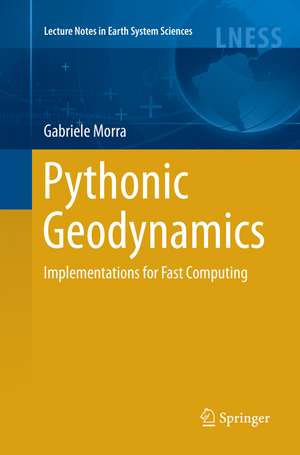
Pythonic Geodynamics: Lecture Notes in Earth System Sciences
Autor Gabriele Morraen Limba Engleză Paperback – 3 aug 2018
arn by experimenting and experiencing, not by theory.
Din seria Lecture Notes in Earth System Sciences
- 18%
 Preț: 1912.89 lei
 - 15%
 Preț: 650.18 lei
 - 15%
 Preț: 692.17 lei
 - 18%
 Preț: 1292.44 lei
 - 24%
 Preț: 1190.12 lei
 - 15%
 Preț: 673.77 lei
 - 15%
 Preț: 722.00 lei
 - 18%
 Preț: 812.65 lei
 - 18%
 Preț: 1253.46 lei
 - 18%
 Preț: 1252.02 lei
 - 18%
 Preț: 1187.62 lei
 - 24%
 Preț: 975.39 lei
 -
 Preț: 450.35 lei
 - 18%
 Preț: 914.61 lei
 - 18%
 Preț: 947.90 lei
 - 15%
 Preț: 633.08 lei
Preț: 563.78 lei
Preț vechi: 704.73 lei
-20%
Puncte Express: 846
Carte tipărită la comandă
Livrare economică 30 noiembrie-07 decembrie
Livrare prin curier în România Termenul estimat este afișat lângă disponibilitate.
Transport gratuit pentru acest produs Plată online sau ramburs, în funcție de opțiunile comenzii.
Retur gratuit în 14 zile Comandă securizată și suport în română.
Specificații
ISBN-13: 9783319857251
ISBN-10: 3319857258
Pagini: 244
Ilustrații: XVI, 227 p. 46 illus., 40 illus. in color.
Dimensiuni: 155 x 235 x 14 mm
Greutate: 0.38 kg
Ediția:Softcover reprint of the original 1st edition 2018
Editura: Springer
Colecția Lecture Notes in Earth System Sciences
Seria Lecture Notes in Earth System Sciences
Locul publicării:Cham, Switzerland
ISBN-10: 3319857258
Pagini: 244
Ilustrații: XVI, 227 p. 46 illus., 40 illus. in color.
Dimensiuni: 155 x 235 x 14 mm
Greutate: 0.38 kg
Ediția:Softcover reprint of the original 1st edition 2018
Editura: Springer
Colecția Lecture Notes in Earth System Sciences
Seria Lecture Notes in Earth System Sciences
Locul publicării:Cham, Switzerland
V-ar putea interesa
-
 Eriksen, A: Field GeophysicsJohn MilsomPreț: 265.10 lei
 -
 Seismic InterferometrySchuster Gerard ThomasPreț: 444.40 lei
 -
 Introduction to SeismologyPeter M. Shearer-11%Preț: 559.43 lei628.57 lei
 -
 -29%Preț: 385.89 lei542.45 lei
 -
 An Introduction to Our Dynamic PlanetNick Rogers-19%Preț: 471.28 lei581.83 lei
 -
 The LithosphereIrina Artemieva-14%Preț: 1357.40 lei1578.36 lei
 -
 -22%Preț: 461.65 lei589.77 lei
 -
 Physics of the EarthFrank Stacey-19%Preț: 710.28 lei876.89 lei
 -
 -23%Preț: 697.54 lei905.89 lei
 -
 Earthquake and Volcano DeformationPaul Segall-19%Preț: 695.94 lei859.18 lei
 -
 The Global Carbon CycleDavid ArcherPreț: 336.45 lei
 -
 -25%Preț: 81.07 lei108.74 lei
 -
 Geoid DeterminationFernando Sansò-18%Preț: 1912.89 lei2332.79 lei
Cuprins
Bird’s eye view.- Visualization.- Fast Python: NumPy and Cython.- Mechanics I: Kinematics.- Mechanics II: Newtonian Dynamics.- Insights on the physics of Stokes Flow.- Lagrangian Transport.- Operator Formulation.- Laplacian Operator and Diffusion.- Beyond Linearity.- Trees, Particles and Boundaries.- Applications to Geodynamics.- The future.
Textul de pe ultima copertă
This book addresses students and young researchers who want to learn to use numerical modeling to solve problems in geodynamics. Intended as an easy-to-use and self-learning guide, readers only need a basic background in calculus to approach most of the material. The book difficulty increases very gradually, through four distinct parts. The first is an introduction to the Python techniques necessary to visualize and run vectorial calculations. The second is an overview with several examples on classical Mechanics with examples taken from standard introductory physics books. The third part is a detailed description of how to write Lagrangian, Eulerian and Particles in Cell codes for solving linear and non-linear continuum mechanics problems. Finally the last one address advanced techniques like tree-codes, Boundary Elements, and illustrates several applications to Geodynamics. The entire book is organized around numerous examples in Python, aiming at encouraging the reader to le
arn by experimenting and experiencing, not by theory.
arn by experimenting and experiencing, not by theory.
Caracteristici
Hands-on approach, with Python examples and practical exercises Covers visualization in 2D and 3D, NumPy Arrays, MPI, Jupyter Notebooks Diverse numerical techniques: Lagrangian, Particles in Cell, Tree Codes, Boundary Elements Includes supplementary material: sn.pub/extras