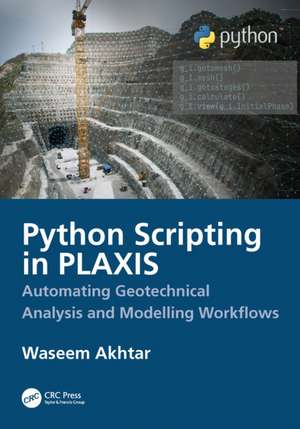
Python Scripting in PLAXIS: Automating Geotechnical Analysis and Modelling Workflows
Autor Waseem Akhtaren Limba Engleză Paperback – 18 noi 2026
The book then transitions to Python programming, starting with an introductory chapter designed for readers with no prior coding experience. Building on these basics, it delves into the PLAXIS Remote Scripting Server, providing detailed guidance on setting up and using the Python Development Environment within PLAXIS. Subsequent chapters focus exclusively on applying Python scripting to various stages of PLAXIS modeling, including model creation, material property assignment, load application, meshing, analysis execution, and results extraction. Each concept is reinforced with solved examples and complete Python scripts, making it a single source for learning FEM, PLAXIS, and Python.
This book is tailored for students, researchers, and practitioners in geotechnical engineering who frequently work with PLAXIS and seek to automate repetitive tasks. Whether you are a beginner or an experienced user, this guide will help you save time, reduce errors, and improve productivity by leveraging the power of Python scripting in PLAXIS.
Preț: 379.20 lei
Preț vechi: 482.66 lei
-21% Precomandă
Puncte Express: 569
Carte nepublicată încă
Livrare prin curier în România Precomanda se expediază când titlul devine disponibil.
Transport gratuit de la 400.00 lei Plată online sau ramburs, în funcție de opțiunile comenzii.
Retur gratuit în 14 zile Comandă securizată și suport în română.
Doresc să fiu notificat când acest titlu va fi disponibil:
Se trimite...
Specificații
ISBN-13: 9781041245131
ISBN-10: 1041245130
Pagini: 232
Ilustrații: 76
Dimensiuni: 178 x 254 mm
Ediția:1
Editura: CRC Press
Colecția CRC Press
ISBN-10: 1041245130
Pagini: 232
Ilustrații: 76
Dimensiuni: 178 x 254 mm
Ediția:1
Editura: CRC Press
Colecția CRC Press
Public țintă
Academic, Postgraduate, Professional Practice & Development, and Professional ReferenceCuprins
Chapter 1: Fundamentals of the Finite Element Method1.1Introduction1.2Concept of Stress and Strain and Sign conventions1.3Fundamentals of Constitutive Models 1.4Principal Stresses & Strains and their transformation1.5Problem Domain Discretization1.6Mesh Elements and Shape Functions1.7Solution of the Differential Equation (Workflow of an FEM analysis)1.8Commercial software for Geotechnical FEM computations1.9Key Takeaways of Chapter 1 & What’s nextChapter 2: Introduction to PLAXIS 2D2.1PLAXIS – An introduction2.2Key strengths of PLAXIS2.3Implementation of FEM in PLAXIS2.4A look at the PLAXIS GUI2.5PLAXIS Input and Output Programs2.6PLAXIS Input modes – Soil, Structure, Mesh, Flow conditions, Stage Construction2.7Key Takeaways of Chapter 2 & What’s nextChapter 3: Python – A primer3.1Basics of Python3.2Python Objects (numbers, strings, lists, dictionaries, tuples, files)3.3Flow Control in Python (if, ifelse)3.4Loops in Python (while, for)3.5Functions in Python3.6Python Modules (pandas, matplotlib, openpyxl etc)3.7Key Takeaways of Chapter 3 & What’s nextChapter 4: Getting started with Python Remote Scripting API4.1PLAXIS command line scripting4.2Commands and Objects in PLAXIS4.3Command line vs. Python4.4Integration of Python into PLAXIS workflow4.5Python Remote Scripting Server4.6PLAXIS Interactive Python Console – Jupyter QtConsole4.7PLAXIS Python Editor – SciTE4.8Jupyter notebooks for scripting in PLAXIS4.9Boilerplate code4.10Your first Python script in PLAXIS4.11Installing additional Python modules in PLAXIS4.12Key Takeaways of Chapter 4 & What’s nextChapter 5: Scripting for model creation in PLAXIS Input5.1Common Python commands for model creation5.2Creating boreholes, soil layers and model geometry5.3Defining and assigning materials5.4Adding structures, loads, anchors and other support elements5.5Generating mesh5.6Setting up boundary conditions5.7Sample scripts5.8Key Takeaways of Chapter 5 & What’s nextChapter 6: Automating Analysis runs6.1Common Python commands for running PLAXIS analysis6.2Marking phases for analysis6.3Assigning analysis type to each phase6.4Using variable properties across phases6.5Calculating marked phases for analysis6.6Sample scripts6.7Key Takeaways of Chapter 6 & What’s nextChapter 7: Extracting and Visualizing Results in PLAXIS Output7.1Common Python commands for visualizing results7.2Accessing PLAXIS Output through Python7.3Extracting desired results for selective nodes across phases7.4Plotting results for better visualization 7.5Scripting workflow in PLAXIS Output7.6Sample scripts7.7Key Takeaways of Chapter 7 & What’s nextChapter 8: Example Scripts8.1Example 1: Spread Footing8.2Example 2: Dam Embankment8.3Example 3: Tunnel excavation and supportChapter 9: Advanced Scripting features9.1Importing data from Excel spreadsheets9.2Exporting data to Excel9.3Setting up alerts after analysis runs9.4Batch processing of PLAXIS models9.5Parametric Engineering for PLAXIS9.6Optimization loops with PythonChapter 10: Scripting Best Practices and Conclusion10.1Writing a neat code10.2Common errors10.3Debugging tips10.4Using comments10.5Where to go from here
Notă biografică
Waseem Akhtar is a Senior Geotechnical Engineer currently working with National Engineering Services Pakistan (NESPAK) Pvt. Ltd., a renowned engineering consultancy in Pakistan. He graduated with a bachelor's degree in civil engineering from the National University of Sciences & Technology (NUST) and holds a master's degree in Earthquake Engineering from Imperial College London, UK. With over 10 years of experience in geotechnical engineering, he specializes in dams and hydropower projects, covering feasibility studies, detailed design, and construction phases. He is proficient in using industry-standard Finite Element Modeling (FEM) software, including PLAXIS, Rocscience RS2, RS3, and ABAQUS. He is a passionate advocate for automation in geotechnical engineering, aiming to enhance productivity and streamline workflows, reflecting a forward-thinking approach to innovation in the field.
Descriere
This book serves as a comprehensive guide for mastering PLAXIS and Python scripting, offering a unique combination of theoretical insights and practical applications. Key elements of the PLAXIS interface and the general workflow of a typical model are thoroughly explained, making it accessible even to beginners.