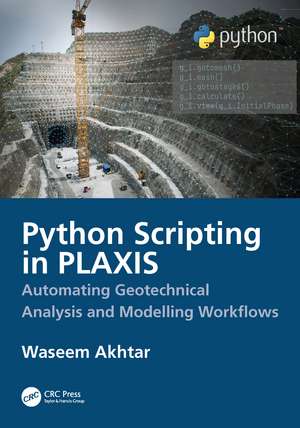
Python Scripting for PLAXIS: Automating Geotechnical Analysis and Modeling Workflows
Autor Waseem Akhtaren Limba Engleză Paperback – 18 noi 2026
PLAXIS is a widely used finite element software for analyzing safety, stability, deformation, consolidation and groundwater flow problems in geotechnical engineering. It is routinely applied to complex projects such as foundations, dams, embankments, ground improvement, and both surface and underground excavations. While most users rely on the graphical user interface (GUI), PLAXIS also provides powerful scripting capabilities through its command-line interface and Python API. This book demonstrates how these capabilities can be leveraged to automate repetitive modeling and analysis tasks, streamline workflows and enhance consistency in model definition and execution.
Written for researchers, academics and practicing engineers alike, the book is ideal for both new and experienced PLAXIS users seeking to integrate scripting into their daily workflows and unlock the full potential of the software.
Preț: 462.02 lei
Preț vechi: 543.54 lei
-15% Nou
Puncte Express: 693
Carte tipărită la comandă
Livrare economică 02-16 ianuarie 27
Livrare prin curier în România Termenul estimat este afișat lângă disponibilitate.
Transport gratuit pentru acest produs Plată online sau ramburs, în funcție de opțiunile comenzii.
Retur gratuit în 14 zile Comandă securizată și suport în română.
Specificații
ISBN-13: 9781041245131
ISBN-10: 1041245130
Pagini: 244
Ilustrații: 76
Dimensiuni: 178 x 254 mm
Greutate: 0.43 kg
Ediția:1
Editura: CRC Press
Colecția CRC Press
ISBN-10: 1041245130
Pagini: 244
Ilustrații: 76
Dimensiuni: 178 x 254 mm
Greutate: 0.43 kg
Ediția:1
Editura: CRC Press
Colecția CRC Press
Public țintă
Academic, Postgraduate, Professional Practice & Development, and Professional ReferenceCuprins
Chapter 1: Fundamentals of the Finite Element Method 1.1 Introduction 1.2 Physical Systems – From Observation to Mathematical Representation 1.3 Concept of Stress and Strain and Sign Conventions 1.4 Principal Stresses and Strains and Their Transformation 1.5 Fundamentals of Constitutive Models 1.6 Problem Domain Discretization and FE Mesh 1.7 Finite Element Types and Shape Functions 1.8 Isoparametric Elements and the Jacobian Matrix 1.9 Finite Element Analysis Workflow 1.10 Commercial Software for Geotechnical FE Computations 1.11 Key Takeaways from This Chapter and What’s Next Chapter 2: An Introduction to PLAXIS 2D 2.1 PLAXIS – An introduction 2.2 Key Strengths of PLAXIS 2.3 Overview of the PLAXIS Input Program GUI 2.4 PLAXIS Input Modes 2.5 Overview of the PLAXIS Output Program GUI 2.6 Typical Workflow of a PLAXIS FEM Model 2.7 Key Takeaways from This Chapter and What's Next Chapter 3: Python – A Primer 3.1 Python as a Programming Language 3.2 Installing and Running Python 3.3 Python Objects 3.4 Operators and Operations in Python 3.5 Control Flow in Python 3.6 Functions in Python 3.7 Python Libraries 3.8 Key Takeaways of This Chapter and What’s Next Chapter 4: Getting Started with Python Scripting in PLAXIS 4.1 PLAXIS Command-Line Scripting 4.2 Commands in PLAXIS 4.3 PLAXIS Modeling through Commands Runner 4.4 Command-Line versus Python Scripting 4.5 Integrating Python into PLAXIS Workflow 4.6 PLAXIS Remote Scripting Server (RSS) 4.7 Boilerplate Code 4.8 Python Interpreter for PLAXIS – Jupyter QtConsole 4.9 Python Editor for PLAXIS – SciTE 4.10 Jupyter Notebooks for Scripting in PLAXIS 4.11 Running Python Scripts in PLAXIS 4.12 Using IDEs for Scripting in PLAXIS 4.13 Your First Python Script in PLAXIS 4.14 Installing Additional Python Libraries in PLAXIS 4.15 Key Takeaways from This Chapter and What’s Next Chapter 5: Scripting for Model Creation in PLAXIS Input 5.1 Common Python Commands for Project Definition 5.2 Creating Boreholes, Soil Layers and Model Geometry 5.3 Defining and Assigning Materials 5.4 Adding Structures, Loads and Support Elements 5.5 Finite Element Mesh 5.6 Key Takeaways from This Chapter and What’s Next Chapter 6: Setting Up PLAXIS Analyses 6.1 Pore Pressures in PLAXIS Analysis 6.2 Setting Up Material Properties and Flow Boundary Conditions 6.3 Setting Up Construction Sequencing 6.4 Using Variable Properties Across Phases 6.5 Marking Phases for Analysis 6.6 Calculating Marked Phases for Analysis 6.7 Key Takeaways from This Chapter and What’s Next Chapter 7: Extracting and Visualizing Results in PLAXIS Output 7.1 Introduction to PLAXIS Output Program 7.2 Accessing PLAXIS Output through Python 7.3 Common Parameters for Visualizing Results 7.4 PLAXIS Output Results Data 7.5 Extracting Desired Results for Selective Nodes Across Phases 7.6 Plotting Results for Better Visualization 7.7 Key Takeaways from This Chapter and What’s Next Chapter 8: Sample Python Scripts for PLAXIS 8.1 Example Script 1: Static Pile Load Test 8.2 Example Script 2: Dam Embankment under Seismic Loading 8.3 Example Script 3: Tunnel Excavation and Support 8.4 Example Script 4: Slope Stability Analysis 8.5 Key Takeaways from This Chapter and What’s Next Chapter 9: Advanced Python Features for PLAXIS Scripting 9.1 Data Exchange between PLAXIS and External Software (I/O Operations) 9.2 Batch Processing of PLAXIS Models 9.3 Setting Up Alerts after Analysis Runs 9.4 Parametric Engineering for PLAXIS 9.5 Optimization Loops with Python 9.6 Machine Learning and Scientific Computing in PLAXIS 9.7 Key Takeaways from This Chapter and What’s Next Chapter 10: Scripting Best Practices and Final Thoughts 10.1 Misgivings about Scripting 10.2 Writing a Clean and Readable Code 10.3 Common Errors in Python Scripting 10.4 PLAXIS Debugging Tips for Efficient Scripting 10.5 Final Thoughts on Python Scripting and Where to Go from Here
Notă biografică
Waseem Akhtar is a practicing geotechnical engineer with over 12 years of experience in the design and consultancy services for dams and hydropower projects. He holds Civil Engineering degrees from the National Univeristy of Sciences and Technology, Pakistan, and Imperial College London, UK. Over the course of his career, he has contributed to the design of major geotechnical structures, including dams, tunnels, shafts, caverns, surface excavations, foundations and ground support systems. He is currently engaged on the under-construction Mohmand Dam Hydropower Project in Pakistan, expected to be the world's fifth-largest concrete-faced rockfill dam, where he is responsible for the geotechnical design of surface and underground works. Waseem is a strong advocate of automation and scripting to enhance efficiency, accuracy and consistency in geotechnical modeling and analysis workflows, reflecting a forward-thinking approach to innovation in the field.
Descriere
This book serves as a comprehensive guide for mastering PLAXIS and Python scripting, offering a unique combination of theoretical insights and practical applications. Key elements of the PLAXIS interface and the general workflow of a typical model are thoroughly explained, making it accessible even to beginners.