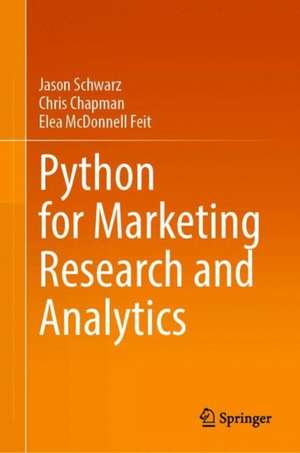
Python for Marketing Research and Analytics
Autor Jason S. Schwarz, Chris Chapman, Elea McDonnell Feiten Limba Engleză Hardback – 3 noi 2020
Accesul la resursele practice este elementul central al volumului Python for Marketing Research and Analytics; toate analizele și exemplele sunt livrate sub formă de notebook-uri Colab, permițând cititorului să copieze, să adapteze și să refolosească codul direct în proiectele proprii de cercetare. Suntem de părere că această abordare orientată către cercetarea reproductibilă transformă învățarea într-un proces aplicat, eliminând barierele tehnice inițiale. Structura cărții urmărește o progresie logică, de la sintaxa de bază a limbajului în prima parte, la fundamentele analizei de date și, în final, la tehnici avansate de modelare predictivă. Găsim în cuprins capitole dedicate relațiilor dintre variabile, testelor statistice și modelelor liniare, culminând cu utilizarea bibliotecii sklearn pentru segmentarea clienților și clasificare. Ca și Art Yudin în Basic Python for Data Management, Finance, and Marketing, autorii distilează experiența reală în principii acționabile, însă acest titlu se diferențiază prin focalizarea strictă pe ecosistemul cercetării de marketing cantitative. De asemenea, spre deosebire de abordarea generalistă din Python Machine Learning de Sebastian Raschka, lucrarea de față prioritizează aplicațiile de business precum clustering-ul pentru subpopulații și identificarea factorilor determinanți pentru rezultatele de piață. Stilul este unul tehnic și concis, punând accent pe execuție și pe interpretarea rezultatelor în context comercial, fără a suprasolicita cititorul cu demonstrații matematice complexe.
Preț: 550.10 lei
Carte tipărită la comandă
Livrare economică 17-23 noiembrie
Specificații
ISBN-10: 3030497194
Pagini: 272
Ilustrații: XI, 272 p. 90 illus., 79 illus. in color.
Dimensiuni: 210 x 279 mm
Greutate: 0.86 kg
Ediția:1st ed. 2020
Editura: Springer International Publishing
Colecția Springer
Locul publicării:Cham, Switzerland
V-ar putea interesa
-
 -20%Preț: 287.70 lei359.63 lei
 -
 Reproducible Research with R and RStudioChristopher Gandrud-20%Preț: 1463.71 lei1829.65 lei
 -
 Learn R: As a LanguagePedro J. Aphalo-20%Preț: 1165.32 lei1456.65 lei
 -
 Introduction to Time Series Modeling with Applications in RGenshiro Kitagawa-18%Preț: 1010.62 lei1232.47 lei
 -
 Statistical Programming in SASA. John Bailer-18%Preț: 1427.98 lei1741.43 lei
 -
 -15%Preț: 530.47 lei624.09 lei
 -
 The Art of Modeling in Science and Engineering with MathematicaDiran Basmadjian-20%Preț: 534.62 lei668.28 lei
 -
 Fundamentals of Seismic Wave PropagationChristopher Chapman-14%Preț: 705.49 lei820.35 lei
 -
 ADR in Employment LawStephen Hardy-18%Preț: 713.80 lei870.48 lei
 -
 Quantitative User Experience ResearchChris Chapman-20%Preț: 324.26 lei405.33 lei
 -
 Encyclopedia of Robust ControlZac Fredericks-20%Preț: 556.70 lei695.87 lei
 -
 Chapman, C: The Monthly Adventures #264 Scorched EarthChris ChapmanPreț: 103.67 lei
 -
 ADR in Employment LawStephen Hardy-15%Preț: 467.38 lei549.85 lei
 -
 -18%Preț: 1019.05 lei1242.73 lei
 -
 Preț: 392.75 lei
 -
 Text Analysis with RRosamond Thalken-20%Preț: 573.03 lei716.28 lei
 -
 Collaboration and Networking in EducationDaniel Muijs-15%Preț: 613.99 lei722.33 lei
 -
 -20%Preț: 400.49 lei500.61 lei
De ce să citești această carte
Recomandăm această carte analiștilor de date și cercetătorilor de piață care doresc să facă tranziția de la unelte tradiționale precum SPSS sau R către Python. Cititorul câștigă un set complet de instrumente digitale pentru analiza comportamentului consumatorului, beneficiind de un flux de lucru modern bazat pe notebook-uri interactive și modele de machine learning gata de implementat.
Despre autor
Echipa de autori este formată din experți recunoscuți în domeniu: Jason S. Schwarz, Chris Chapman și Elea McDonnell Feit. Chris Chapman este cunoscut pentru lucrările sale anterioare despre marketing analytics, având o vastă experiență în aplicarea metodelor statistice în corporații de tehnologie de top, în timp ce Elea McDonnell Feit este profesor asociat de marketing, cercetările sale concentrându-se pe intersecția dintre econometrie și machine learning. Împreună, aceștia aduc o perspectivă echilibrată între rigoarea academică și necesitățile practice ale industriei de marketing.
Descriere scurtă
This book is designed for three groups of readers: experienced marketing researchers who wish to learn to program in Python, coming from tools and languages such as R, SAS, or SPSS; analysts or students who already program in Python and wish to learn about marketing applications; and undergraduate or graduate marketing students with little or no programming background. It presumes only an introductory level of familiarity with formal statistics and contains a minimum of mathematics.
Cuprins
Notă biografică
Chris Chapman PhD is a Quantitative Researcher at Google, and an author of Chapman & Feit, R for Marketing Research and Analytics (Springer, 2015). In the broader industry, he has served as President of the American Marketing Association’s Practitioner Council, chaired the AMA Advanced Research Techniques Forum in 2012 and 2017, and is a member of several conference and industry committees. Chris regularly presents research innovations and teaches workshops on R, conjoint analysis, strategic modeling, and other analytics topics.
EleaMcDonnell Feit is an Assistant Professor of Marketing at Drexel University and a Senior Fellow of Marketing at The Wharton School. She enjoys making quantitative methods accessible to a broad audience and teaches workshops and courses on advertising measurement, marketing experiments, marketing analytics in R, discrete choice modeling and hierarchical Bayes methods. She is an author of Chapman & Feit, R for Marketing Research and Analytics (Springer, 2015).