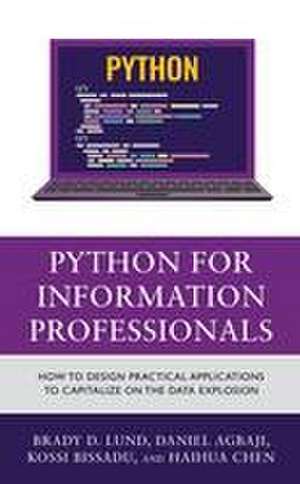
Python for Information Professionals: How to Design Practical Applications to Capitalize on the Data Explosion
Autor Brady Lund, Daniel Agbaji, Kossi Dodzi Bissadu, Haihua Chenen Limba Engleză Hardback – noi 2023
Readers of Python for Information Professionals will learn to:
Develop Python applications for the retrieval, cleaning, and analysis of large datasets. Design applications to support traditional library functions and create new opportunities to maximize library value. Consider data security and privacy relevant to data analysis when using the Python language.
Preț: 524.03 lei
Preț vechi: 777.57 lei
-33%
Puncte Express: 786
Carte tipărită la comandă
Livrare economică 07-21 decembrie
Livrare prin curier în România Termenul estimat este afișat lângă disponibilitate.
Transport gratuit pentru acest produs Plată online sau ramburs, în funcție de opțiunile comenzii.
Retur gratuit în 14 zile Comandă securizată și suport în română.
Specificații
ISBN-13: 9781538178249
ISBN-10: 1538178249
Pagini: 172
Ilustrații: 9 b/w photos; 2 tables
Dimensiuni: 158 x 239 x 17 mm
Greutate: 0.4 kg
Editura: Bloomsbury Publishing
Colecția Rowman & Littlefield
Locul publicării:New York, United States
ISBN-10: 1538178249
Pagini: 172
Ilustrații: 9 b/w photos; 2 tables
Dimensiuni: 158 x 239 x 17 mm
Greutate: 0.4 kg
Editura: Bloomsbury Publishing
Colecția Rowman & Littlefield
Locul publicării:New York, United States
Cuprins
Preface
Part I: Python: The Basics
Chapter 1 - The Python WorkspaceChapter 2 - Object Oriented ProgrammingChapter 3 - Data Types, Structures, Sets and AlgorithmsChapter 4 - Functions: Code that Puts Our Data to WorkChapter 5 - Importing, Creating, and Maintaining Data FilesChapter 6 - Testing and TroubleshootingPart II: Further Applications of Python in Information Organizations
Chapter 7 - Library Management and Usage DataChapter 8 - Library Research Data ManagementChapter 9 - Text AnalysisChapter 10 - Library and Information Science ResearchChapter 11 - Artificial Intelligence ApplicationsPart III: Practical and Ethical Considerations for Using Python
Chapter 12 - Data Explosion, Big Data, and Data LiteracyChapter 13 - Data EthicsChapter 14 - Knowledge and Data EconomyChapter 15 - Further Resources for Advancing Your Python Mastery Glossary
Index
About the Author
Part I: Python: The Basics
Chapter 1 - The Python WorkspaceChapter 2 - Object Oriented ProgrammingChapter 3 - Data Types, Structures, Sets and AlgorithmsChapter 4 - Functions: Code that Puts Our Data to WorkChapter 5 - Importing, Creating, and Maintaining Data FilesChapter 6 - Testing and TroubleshootingPart II: Further Applications of Python in Information Organizations
Chapter 7 - Library Management and Usage DataChapter 8 - Library Research Data ManagementChapter 9 - Text AnalysisChapter 10 - Library and Information Science ResearchChapter 11 - Artificial Intelligence ApplicationsPart III: Practical and Ethical Considerations for Using Python
Chapter 12 - Data Explosion, Big Data, and Data LiteracyChapter 13 - Data EthicsChapter 14 - Knowledge and Data EconomyChapter 15 - Further Resources for Advancing Your Python Mastery Glossary
Index
About the Author
Recenzii
Python for Information Professionals unpacks a topic that both fascinates and terrifies information professionals: computational programming. While the pacing and tone are introductory, the book assumes some familiarity with programming concepts and will likely find a more eager audience among the already-data-savvy versus those trying to re-skill within the profession. [The] authors give Python outsiders a digestible way to familiarize themselves with a programming language and start the learning journey. The book leaves behind the mawkish puns that pervade the genre of programming manuals, and those who finish this work will be rewarded with a desire to keep digging into how Python-and coding in general-can elevate library work and services. Recommended. Graduate students, faculty, and professionals.