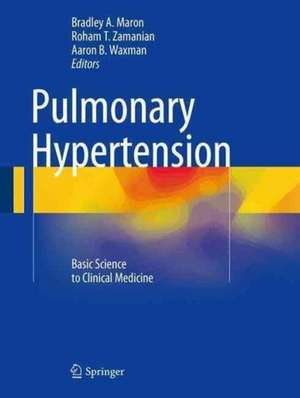
Pulmonary Hypertension
Editat de Bradley A. Maron, Roham T. Zamanian, Aaron B. Waxmanen Limba Engleză Hardback – 10 noi 2015
Adresat specialiștilor în cardiologie, pneumologie și medicină internă, precum și rezidenților dornici de aprofundare, Pulmonary Hypertension reprezintă o sinteză clinică și științifică de înalt nivel. Găsim în această primă ediție publicată de Springer un cadru de referință pentru înțelegerea unei patologii complexe, caracterizată prin remodelarea arteriolelor distale și creșterea rezistenței vasculare. Descoperim o structură riguroasă care pornește de la nomenclatura istorică și genetica bolii vasculare pulmonare, avansând către mecanisme inovatoare precum biologia de rețea și semnalizarea MicroRNA. Suntem de părere că forța acestui volum rezidă în capacitatea de a acoperi lacuna dintre cercetarea translațională și practica clinică, oferind protocoale detaliate pentru evaluarea hemodinamică cardiopulmonară și tehnici de imagistică avansată. În ceea ce privește contextul bibliografic, acolo unde Pathophysiology of Pulmonary Hypertension de Yuansheng Gao se concentrează pe mecanismele de semnalizare și contractilitate vasculară, volumul de față extinde perspectiva, tratând hipertensiunea pulmonară și ca o boală metabolică și neurohumorală, implicând sistemul renină-angiotensină-aldosteron. De asemenea, spre deosebire de abordările pur clinice, această lucrare subliniază importanța modelelor animale în înțelegerea patogenezei. Progresia capitolelor este logică, facilitând tranziția de la epidemiologie la biomarcatori și metode de evaluare a stării bolii în cercetare, oferind astfel instrumentele necesare pentru gestionarea unui număr tot mai mare de pacienți eligibili pentru noile farmacoterapii selective.
Preț: 1294.00 lei
Preț vechi: 1362.11 lei
-5%
Carte tipărită la comandă
Livrare economică 03-09 decembrie
Specificații
ISBN-10: 3319235931
Pagini: 388
Ilustrații: XVI, 371 p.
Dimensiuni: 215 x 285 x 26 mm
Greutate: 1.23 kg
Ediția:1st edition 2016
Editura: Springer
Locul publicării:Cham, Switzerland
V-ar putea interesa
-
 The Expert Guide to Beating Heart DiseaseHarlan M Krumholz-5%Preț: 107.93 lei113.61 lei
 -
 Trends in Angiogenesis ResearchRoberta V Zubar-23%Preț: 1251.91 lei1629.94 lei
 -
 Pharmacological Therapies for Peripheral Vascular DiseaseDebabrata Mukherjee-5%Preț: 728.86 lei767.22 lei
 -
 Hypertension: Community Control of High Blood Pressure, Third EditionHart Julian Tudor-5%Preț: 352.48 lei371.03 lei
 -
 -5%Preț: 944.72 lei994.44 lei
 -
 White Coat HypertensionGiuseppe Mancia-5%Preț: 379.90 lei399.89 lei
 -
 Erectile Dysfunction in Hypertension and Cardiovascular DiseaseMargus Viigimaa-5%Preț: 369.33 lei388.77 lei
 -
 Vasovagal SyncopePaolo Alboni-5%Preț: 744.60 lei783.79 lei
 -
 Clinico-Pathological Atlas of Cardiovascular DiseasesJoaquín S. Lucena-5%Preț: 1269.24 lei1336.04 lei
 -
 Vascular EngineeringKazuo Tanishita-5%Preț: 1146.40 lei1206.74 lei
 -
 Blood Flow in the Heart and Large VesselsMotoaki Sugawara-5%Preț: 693.55 lei730.06 lei
 -
 Regulation of Coronary Blood FlowMichitoshi Inoue-5%Preț: 749.57 lei789.02 lei
 -
 The Right Ventricle in Adults with Tetralogy of FallotMassimo Chessa-5%Preț: 352.71 lei371.27 lei
Public țintă
Professional/practitionerDe ce să citești această carte
Recomandăm această carte medicilor care tratează insuficiența cardiacă și patologiile respiratorii cronice. Cititorul câștigă o înțelegere profundă a cuplajului ventricul drept-circulație pulmonară, esențială pentru diagnosticul precoce. Este un instrument indispensabil pentru a naviga prin complexitatea noilor tratamente selective și a tehnicilor de monitorizare hemodinamică, traduse din cercetarea translațională direct în practica de cabinet.
Despre autor
Bradley A. Maron, Roham T. Zamanian și Aaron B. Waxman sunt autorități recunoscute în domeniul medicinei vasculare și pulmonare, activând în instituții academice de prestigiu. Expertiza lor combinată acoperă spectrul complet al hipertensiunii pulmonare, de la cercetarea de laborator și studiile genetice, până la managementul clinic al pacienților cu afecțiuni cardiopulmonare complexe. Contribuția lor ca editori asigură o rigoare științifică deosebită, integrând cele mai recente descoperiri despre remodelarea vasculară și funcția ventriculară în protocoale clinice aplicabile.
Descriere scurtă
Cuprins
Recenzii
Notă biografică
Roham T. Zamanian, M.D. is an Assistant Professor of Medicine and Director of the Adult Pulmonary Hypertension Program at Stanford University School of Medicine. Dr. Zamanian completed medical school and Internal Medicine training at the University of California, Irvine Medical Center and fellowship in Pulmonary and Critical Care Medicine at Stanford University. Dr. Zamanian was also an eBay Pulmonary Vascular Disease super-fellow at the Vera Moulton Wall Center (VMWC) for Pulmonary Vascular Diseases at Stanford University. Besides an active clinical career, Dr. Zamanian is a translational scientist focusing on the discovery of novel biochemical and clinical risk factors for pulmonary vascular disease. Dr. Zamanian’s research is funded by the NIH and VMWC. Aaron Waxman, M.D., Ph.D., is the Executive Director of the Center for Pulmonary Heart Diseases at the Brigham and Women’s Hospital (BWH) Heart and Vascular and Lung Centers. Dr. Waxman directs the Pulmonary Vascular Disease Program at BWH. His interests focus on integrating clinical and basic investigations to understand further pulmonary vascular disease and right heart failure. Dr. Waxman directs a robust NIH-funded clinical and basic research program, posts leadership roles in several international organizations, and collaborates actively with clinical experts and investigators around the world.
Textul de pe ultima copertă
Pulmonary Hypertension: Basic Science to Clinical Medicine is the essential reference for any physician or scientist with an interest in pulmonary hypertension. The Editors and their hugely knowledgeable listof contributors have provided a contemporary, comprehensive overview of the field in all of its complexity that will be vital for all levels of clinician, researcher and trainee in respiratory medicine, cardiology, critical care and all disciplines involved in the management of patients with pulmonary hypertension.