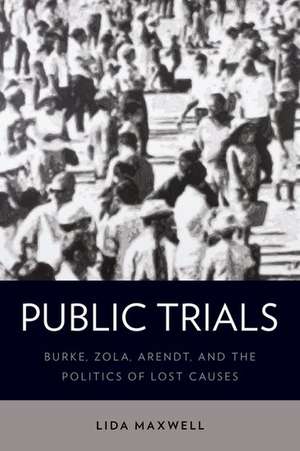
Public Trials: Burke, Zola, Arendt, and the Politics of Lost Causes
Autor Lida Maxwellen Limba Engleză Hardback – 15 ian 2015
Preț: 479.35 lei
Preț vechi: 669.12 lei
-28%
Puncte Express: 719
Carte tipărită la comandă
Livrare economică 26 noiembrie-02 decembrie
Livrare prin curier în România Termenul estimat este afișat lângă disponibilitate.
Transport gratuit pentru acest produs Plată online sau ramburs, în funcție de opțiunile comenzii.
Retur gratuit în 14 zile Comandă securizată și suport în română.
Specificații
ISBN-13: 9780199383740
ISBN-10: 019938374X
Pagini: 256
Dimensiuni: 236 x 160 x 31 mm
Greutate: 0.52 kg
Editura: Oxford University Press
Colecția OUP USA
Locul publicării:New York, United States
ISBN-10: 019938374X
Pagini: 256
Dimensiuni: 236 x 160 x 31 mm
Greutate: 0.52 kg
Editura: Oxford University Press
Colecția OUP USA
Locul publicării:New York, United States
V-ar putea interesa
-
 The End of DaysGershom GorenbergPreț: 135.82 lei
 -
 -31%Preț: 583.14 lei840.53 lei
 -
 -21%Preț: 506.53 lei643.61 lei
 -
 Eunomia: New Order for a New WorldPhilip Allott-28%Preț: 448.46 lei623.85 lei
 -
 -28%Preț: 400.53 lei557.75 lei
 -
 Human Rights in Criminal ProceedingsStefan Trechsel-17%Preț: 736.90 lei883.19 lei
 -
 The Future of the Welfare State: Crisis Myths and Crisis RealitiesFrancis G. Castles-13%Preț: 332.02 lei380.59 lei
 -
 The Nature of Political TheoryAndrew Vincent-28%Preț: 447.14 lei623.08 lei
 -
 Preț: 131.01 lei
 -
 Rampage: The Social Roots of School ShootingsCybelle Fox-22%Preț: 105.26 lei134.48 lei
 -
 China's Legal Reforms and Their Political LimitsIngrid Hooghe-18%Preț: 1250.97 lei1525.57 lei
 -
 Why We Hate PoliticsColin HayPreț: 147.34 lei
 -
 -15%Preț: 437.03 lei514.15 lei
 -
 Children of the MatrixDavid IckePreț: 116.57 lei
 -
 How Did We Get Into This Mess?George MonbiotPreț: 92.64 lei
 -
 What NextDaniel Hannan-25%Preț: 55.08 lei73.16 lei
 -
 The Trump PhenomenonPeter KivistoPreț: 197.62 lei
Recenzii
Public Trials is an excellent book. Clearly written, well organized, and jargon free, it will be of interest to a wide range of scholars of democracy and law.
If it is a commonplace that democratic causes are often defeated, even by the people themselves, it does not (indeed, it cannot!) follow that democratic thinkers and actors should abandon their commitments to realizing more just ways of living. Lida Maxwell's Public Trials advances an altogether original and inspiring alternative. Through rich readings of Burke, Zola, and Arendt, Maxwell exemplifies the 'art of losing causes.' Public Trials demonstrates how to create new ways of speaking, writing, and acting in the face of past and present injustice. Vigorously, it summons readers to do the same.
Lida Maxwell has produced a provocative and thrilling book on the 'politics of lost causes.' Seeing in democratic failure opportunity as much as loss, promise as much as pessimism, Maxwell shows how failure solicits action, demands accountability and builds counter-intuitive and unpredictable affiliations committed to lost causes and the possible futures they reveal. This is a risky and unconventional work on the art of losing.
Maxwell's book is a highly innovative work that proposes to see public trials as exemplary sites for democratic politics. She brilliantly reads the 'lost cause' narratives of three public intellectuals, Burke, Zola, and Arendt as offering a productive reformulation of democratic failures and as occasions for responsiveness rather than resignation. It provides a fresh reading of these trials, by going beyond the legal texts to less familiar terrain of the literary imagination. The major contribution of the book lies in its ability to redirect the literature on transitional justice from attempting to tame politics in order to allow for justice, to encouraging a politics of resistance as essential to the pursuit of justice.
If it is a commonplace that democratic causes are often defeated, even by the people themselves, it does not (indeed, it cannot!) follow that democratic thinkers and actors should abandon their commitments to realizing more just ways of living. Lida Maxwell's Public Trials advances an altogether original and inspiring alternative. Through rich readings of Burke, Zola, and Arendt, Maxwell exemplifies the 'art of losing causes.' Public Trials demonstrates how to create new ways of speaking, writing, and acting in the face of past and present injustice. Vigorously, it summons readers to do the same.
Lida Maxwell has produced a provocative and thrilling book on the 'politics of lost causes.' Seeing in democratic failure opportunity as much as loss, promise as much as pessimism, Maxwell shows how failure solicits action, demands accountability and builds counter-intuitive and unpredictable affiliations committed to lost causes and the possible futures they reveal. This is a risky and unconventional work on the art of losing.
Maxwell's book is a highly innovative work that proposes to see public trials as exemplary sites for democratic politics. She brilliantly reads the 'lost cause' narratives of three public intellectuals, Burke, Zola, and Arendt as offering a productive reformulation of democratic failures and as occasions for responsiveness rather than resignation. It provides a fresh reading of these trials, by going beyond the legal texts to less familiar terrain of the literary imagination. The major contribution of the book lies in its ability to redirect the literature on transitional justice from attempting to tame politics in order to allow for justice, to encouraging a politics of resistance as essential to the pursuit of justice.
Notă biografică
Lida Maxwell is Assistant Professor of Political Science at Trinity College in Hartford, Connecticut.