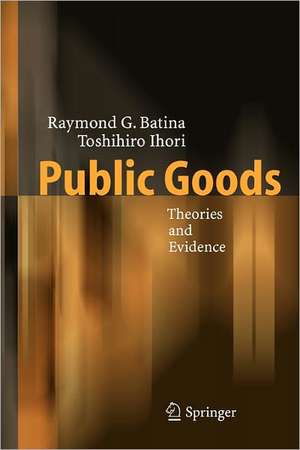
Public Goods
Autor Raymond G. Batina, Toshihiro Ihorien Limba Engleză Paperback – 14 oct 2010
Remarcăm în lucrarea Public Goods un model analitic riguros ce propune o trecere sistematică de la rezultatele clasice ale economiei publice la cele mai recente dezvoltări din literatura de specialitate. Modelul propus de Raymond G. Batina și Toshihiro Ihori funcționează ca un pod între teorie și dovezile empirice, oferind cititorului instrumentele necesare pentru a înțelege cum mecanisme precum sortarea Tiebout sau competiția fiscală influențează alocarea resurselor colective. Merită menționat că autorii nu se limitează la prezentarea unor formule, ci oferă o explicație intuitivă pentru fiecare rezultat tehnic, facilitând înțelegerea unor concepte complexe precum evaluarea contingentă sau finanțarea „second-best”. Pe linia practică a volumului The Theory of Externalities, Public Goods, and Club Goods, dar cu un focus pronunțat pe dinamica cercetărilor din ultimul deceniu și pe integrarea dovezilor experimentale, această lucrare se distinge prin actualitatea datelor. Putem afirma că volumul completează preocupările anterioare ale lui Raymond G. Batina, vizibile în Consumption Tax Policy and the Taxation of Capital Income, unde acesta explora impactul taxării asupra economiei. Aici, perspectiva se lărgește de la simpla impozitare la gestionarea și furnizarea bunurilor publice în economii deschise și sisteme fiscale competitive. Structura cărții este organizată progresiv: primele secțiuni analizează furnizarea publică și privată a bunurilor, urmate de o explorare a externalităților și a capitalului public. Ultimele capitole sunt dedicate economiei publice locale și testării empirice, oferind o acoperire exhaustivă ce transformă cuprinsul într-o hartă completă a disciplinei. Este o resursă esențială pentru cei care doresc să stăpânească fundamentele economiei publice moderne.
Preț: 955.93 lei
Preț vechi: 1165.77 lei
-18%
Carte tipărită la comandă
Livrare economică 08-22 decembrie
Specificații
ISBN-10: 3642063357
Pagini: 440
Ilustrații: XVI, 422 p. 13 illus.
Dimensiuni: 155 x 235 x 24 mm
Greutate: 0.61 kg
Ediția:Softcover reprint of hardcover 1st ed. 2005
Editura: Springer
Locul publicării:Berlin, Heidelberg, Germany
V-ar putea interesa
-
 Economics Of The Public SectorSara Connolly-15%Preț: 658.54 lei774.76 lei
 -
 -19%Preț: 509.83 lei629.43 lei
 -
 RinsedGeoff WhitePreț: 85.95 lei
 -
 The Winner's CurseRichard H. ThalerPreț: 241.30 lei
 -
 Economics of the Public Sector 4eJoseph E. Stiglitz-11%Preț: 496.79 lei558.20 lei
 -
 Private Finance, Public Power - A History of Bank Supervision in AmericaPeter Conti-BrownPreț: 307.10 lei
 -
 Demand & Supply of Public GoodsJames BuchananPreț: 78.03 lei
 -
 -23%Preț: 1226.02 lei1592.23 lei
 -
 The Truth About InvestingJonathan GuthriePreț: 122.10 lei
 -
 -32%Preț: 568.65 lei831.31 lei
 -
 CommunityJ. Toby ReinerPreț: 138.63 lei
 -
 Public Data CulturesJonathan W. Y. GrayPreț: 139.47 lei
 -
 As Public as PossibleDavid I BackerPreț: 172.16 lei
 -
 Economy, Society, and Public PolicyThe CORE Econ Team-22%Preț: 495.22 lei638.62 lei
 -
 Year of the RatHarry ShukmanPreț: 108.23 lei
 -
 LikeMartin ReevesPreț: 194.17 lei
Public țintă
ResearchDe ce să citești această carte
Această carte este o resursă de referință pentru cercetători și studenți la nivel de master sau doctorat, oferind o sinteză rară între rigoarea matematică și intuiția economică. Cititorul va câștiga o înțelegere profundă a modului în care infrastructura, educația și alte bunuri publice sunt finanțate și gestionate eficient. Reprezintă un salt calitativ de la manualele introductive către frontiera cercetării actuale în finanțe publice.
Descriere scurtă
Descriere
Cuprins
Caracteristici
In-depth insight into the development of the literature in this field
Includes supplementary material: sn.pub/extras