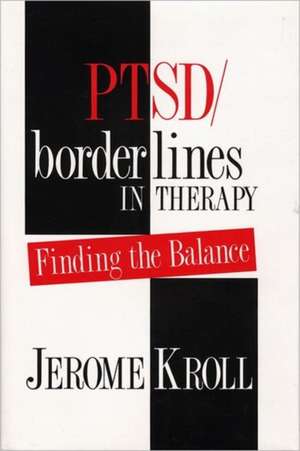
PTSD/Borderlines in Therapy
Autor Jerome Krollen Limba Engleză Hardback – iun 1993
În ultimele decenii, practica psihoterapiei s-a deplasat de la modelele liniare de diagnostic către o înțelegere nuanțată a traumelor complexe, recunoscând că granița dintre patologia de personalitate și sechelele post-traumatice este adesea permeabilă. În lucrarea Ptsd/Borderlines in Therapy – Finding the Balance, autorul Jerome Kroll investighează această intersecție critică, oferind o analiză clinică asupra modului în care abuzul suferit în copilărie fundamentează stiluri de personalitate autodistructive la vârsta adultă. Găsim în această carte o abordare riguroasă a ceea ce autorul numește o „tulburare a fluxului conștiinței”, unde pacientul devine prizonierul unui amestec de amintiri distorsionate, senzații somatice intruzive și o nevoie compulsivă de a pune în scenă traumele trecute. Spre deosebire de Child Abuse Trauma de John Briere, care oferă o sinteză a literaturii de cercetare despre formele de maltratare, volumul de față se concentrează pe dinamica terapeutică propriu-zisă, fiind o alternativă mai pragmatică pentru clinicieni. Dacă The Complex PTSD Workbook de Arielle Schwartz este orientat către instrumente de auto-ajutorare și tehnici somatice, Jerome Kroll păstrează un ton sceptic și analitic, chestionând teoriile care pot limita viziunea terapeutului. Reținem cele peste 20 de cazuri clinice detaliate, care nu servesc doar ca ilustrații, ci ca avertismente privind erorile ce pot submina procesul de recuperare. Structura cărții facilitează o tranziție fluidă de la schemele teoretice la nuanțele fine ale dialogului terapeutic, făcând-o o resursă esențială în gestionarea cazurilor de borderline cu etiologie traumatică.
Preț: 308.97 lei
Carte disponibilă
Livrare economică 13-27 noiembrie
Specificații
ISBN-10: 0393701573
Pagini: 298
Dimensiuni: 161 x 240 x 22 mm
Greutate: 0.68 kg
Ediția:New.
Editura: W. W. Norton & Company
V-ar putea interesa
-
 Schema Therapy: Distinctive FeaturesEshkol Rafaeli-5%Preț: 178.32 lei187.71 lei
 -
 Borderline Personality Disorder in Adolescents, 3rd EditionBlaise Aguirre-19%Preț: 127.92 lei157.38 lei
 -
 Cognitive-Behavioral Treatment of Borderline Personality DisorderMarsha M. Linehan-15%Preț: 578.29 lei680.34 lei
 -
 -5%Preț: 273.22 lei287.59 lei
 -
 -30%Preț: 74.50 lei107.17 lei
 -
 -26%Preț: 99.13 lei134.55 lei
 -
 The Borderline Personality Disorder Survival Guide: Everything You Need to Know About Living with BPDAlexander L. Chapman, PhD, RPsych-25%Preț: 86.15 lei114.76 lei
 -
 -5%Preț: 300.73 lei316.56 lei
 -
 Schema Therapy: A Practitioner's GuideJeffrey E. Young-5%Preț: 427.34 lei449.83 lei
 -
 -30%Preț: 90.40 lei128.23 lei
 -
 -5%Preț: 428.28 lei450.83 lei
 -
 -31%Preț: 133.07 lei194.16 lei
 -
 -20%Preț: 102.68 lei128.22 lei
 -
 Too Tired to FightErin Mitchell-18%Preț: 99.68 lei121.87 lei
 -
 It Didn't Start With You WorkbookMark WolynnPreț: 121.05 lei
 -
 -26%Preț: 200.24 lei269.05 lei
 -
 -19%Preț: 135.65 lei167.30 lei
 -
 Re-RegulatedAnna Runkle-19%Preț: 87.40 lei107.67 lei
 -
 Embrace Pleasure: How Psychedelics Can Heal Our SexualityDee Dee Goldpaugh-23%Preț: 118.63 lei154.99 leiRecomandat
 -
 The Workbook for Healing Developmental TraumaBrad J. KammerPreț: 119.11 lei
De ce să citești această carte
Această lucrare este esențială pentru psihoterapeuți și psihiatri care lucrează cu pacienți diagnosticați cu tulburare de personalitate borderline. Cititorul câștigă un model de lucru flexibil, ancorat în realitatea clinică, ce permite navigarea prin complexitatea disocierii și a comportamentelor autodistructive. Este o resursă valoroasă pentru a înțelege cum trecutul traumatic dictează prezentul pacientului, oferind strategii concrete pentru a evita capcanele transferențiale specifice acestor cazuri dificile.