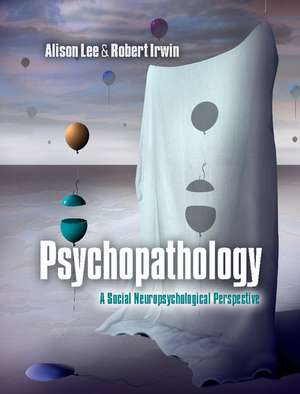
Psychopathology
Autor Alison Lee, Robert Irwinen Limba Engleză Hardback – 12 oct 2018
Preț: 693.34 lei
Preț vechi: 729.83 lei
-5%
Puncte Express: 1040
Carte tipărită la comandă
Livrare economică 07-21 decembrie
Livrare prin curier în România Termenul estimat este afișat lângă disponibilitate.
Transport gratuit pentru acest produs Plată online sau ramburs, în funcție de opțiunile comenzii.
Retur gratuit în 14 zile Comandă securizată și suport în română.
Specificații
ISBN-13: 9781107009813
ISBN-10: 1107009812
Pagini: 374
Ilustrații: 9 b/w illus. 4 tables
Dimensiuni: 208 x 260 x 25 mm
Greutate: 1.02 kg
Editura: Cambridge University Press
Locul publicării:New York, United States
ISBN-10: 1107009812
Pagini: 374
Ilustrații: 9 b/w illus. 4 tables
Dimensiuni: 208 x 260 x 25 mm
Greutate: 1.02 kg
Editura: Cambridge University Press
Locul publicării:New York, United States
V-ar putea interesa
-
 -26%Preț: 309.17 lei416.85 lei
 -
 -25%Preț: 824.89 lei1098.06 lei
 -
 Cognition and AddictionMarcus Munafó-23%Preț: 584.03 lei759.13 lei
 -
 Clinical Psychology: A Very Short IntroductionSusan Llewelyn-24%Preț: 57.89 lei75.86 lei
 -
 -12%Preț: 354.62 lei400.75 lei
 -
 -23%Preț: 778.50 lei1008.69 lei
 -
 -20%Preț: 579.03 lei728.22 lei
 -
 The Collected Works of D. W. Winnicott: 12-Volume SetLesley Caldwell-5%Preț: 18156.20 lei19111.79 lei
 -
 The Psychology of Meditation: Research and PracticeMichael A. West-16%Preț: 555.07 lei664.29 lei
 -
 Schizophrenia and Its Treatment: Where Is the Progress?Matthew M. Kurtz-26%Preț: 677.31 lei915.48 lei
 -
 Changing Practices of Doctoral EducationDavid Boud-18%Preț: 1119.70 lei1365.49 lei
 -
 Publishing Pedagogies for the Doctorate and BeyondClaire AitchisonPreț: 404.23 lei
 -
 Preț: 425.04 lei
 -
 Explanatory StyleGregory McClell Buchanan-5%Preț: 1237.18 lei1302.30 lei
 -
 Contemporary Rorschach InterpretationJ. Reid Meloy-18%Preț: 1735.14 lei2116.03 lei
 -
 Neuroimaging and Psychosocial Addiction TreatmentSarah W Feldstein Ewing-5%Preț: 751.54 lei791.09 lei
 -
 Gender, Literacy, Curriculum: Rewriting School GeographySydney Alison Lee University of TechnologyPreț: 452.95 lei
 -
 SL, UTAlison LeePreț: 80.82 lei
Cuprins
1. Introduction; 2. Madness: a history of ideas; 3. Emotions and normal life; 4. Control, stress and coping; 5. Distress; 6. Psychosocial perspectives on distress; 7. Psychosis: symptoms and causes; 8. Psychosocial perspectives of psychosis; 9. Recovery; 10. Psychological therapies; 11. The treatment of mental distress with psychiatric medication; 12. Conclusions.
Descriere
An undergraduate textbook taking a critical view of the dominant psychiatric model of psychopathology, and offering both psychosocial and neuro/biopsychological approaches.