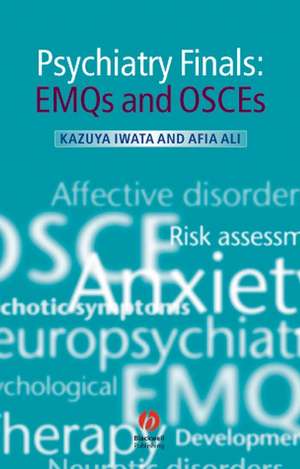
Psychiatry Finals
Autor Iwataen Limba Engleză Paperback – 12 mar 2008
Part 1 comprises 58 EMQs, divided into 8 chapters, covering questions on mental state examinations, general adult psychiatry, developmental and organic disorders, treatments, and management issues. Most EMQs focus on a particular presentation or issue and are based on clinical vignettes that describe a clinical scenario. Each EMQ is organized as five stems with 10 possible choices and answers to each EMQ are given at the end of each chapter with additional notes clarifying specific options not covered in the questions.
Part 2 covers OSCEs, which are based on common clinical scenarios and stations frequently encountered in exams. The 23 questions cover history-taking, communication, and practical stations.
Ideal for medical students and junior doctors, this book is intended to complement rather than replace other psychiatry books, and will help students develop a better understanding of the clinical aspects of psychiatry.
Preț: 334.38 lei
Preț vechi: 351.97 lei
-5%
Puncte Express: 502
Carte tipărită la comandă
Livrare economică 16-30 octombrie
Livrare prin curier în România Termenul estimat este afișat lângă disponibilitate.
Transport gratuit de la 400.00 lei Plată online sau ramburs, în funcție de opțiunile comenzii.
Retur gratuit în 14 zile Comandă securizată și suport în română.
Specificații
ISBN-13: 9781405175272
ISBN-10: 1405175273
Pagini: 254
Dimensiuni: 140 x 216 x 14 mm
Greutate: 0.33 kg
Editura: Wiley
Locul publicării:Chichester, United Kingdom
ISBN-10: 1405175273
Pagini: 254
Dimensiuni: 140 x 216 x 14 mm
Greutate: 0.33 kg
Editura: Wiley
Locul publicării:Chichester, United Kingdom
V-ar putea interesa
-
 Treatment-Resistant Mood DisordersAndré F Carvalho-20%Preț: 282.36 lei351.33 lei
 -
 -21%Preț: 539.40 lei685.82 lei
 -
 -26%Preț: 666.80 lei903.61 lei
 -
 Oxford Textbook of Correctional PsychiatryRobert Trestman-26%Preț: 1129.60 lei1519.38 lei
 -
 Medical PsychotherapyJessica Yakeley-26%Preț: 515.98 lei694.70 lei
 -
 Psychological Assessment and Therapy with Older AdultsBob G. Knight-17%Preț: 541.26 lei651.34 lei
 -
 Disasters and Mental HealthLopez-Ibor-5%Preț: 1243.93 lei1309.40 lei
 -
 -27%Preț: 701.32 lei960.71 lei
 -
 Handbook of Couples TherapyHarway-9%Preț: 716.80 lei787.70 lei
 -
 Attention-Deficit Hyperactivity Disorder in Adults and Children`Lenard A. Adler-5%Preț: 914.78 lei962.94 lei
 -
 Treating DepressionIra D. GlickPreț: 429.25 lei
 -
 Psychiatry ReconsideredH. Middleton-5%Preț: 370.78 lei390.30 lei
 -
 -8%Preț: 456.23 lei495.90 lei
 -
 -23%Preț: 487.98 lei633.74 lei
 -
 Posttraumatic and Acute Stress DisordersMatthew J. Friedman-5%Preț: 648.56 lei682.69 lei
 -
 An Outline of Psychiatry in Clinical LecturesOnzm Miller-5%Preț: 1083.49 lei1140.51 lei
 -
 Bipolar DisorderKostas N. Fountoulakis-5%Preț: 717.78 lei755.55 lei
Public țintă
Medical students and junior doctors preparing for MRCPsychNotă biografică
Kazuya Iwata, UCL Psychiatry Training Rotation
Afia Ali, UCL Psychiatry Training Rotation
Afia Ali, UCL Psychiatry Training Rotation
Cuprins
Preface. List of Abbreviations.
Introduction.
Part 1 Extended matching questions (EMQs).
Chapter 1 Introduction to psychiatry.
Answers.
Chapter 2 General adult psychiatry.
Answers.
Chapter 3 Organic and substance psychiatry.
Answers.
Chapter 4 Developmental disorders and other clinical syndromes.
Answers.
Chapter 5 Treatments in psychiatry.
Answers.
Chapter 6 Management issues in psychiatry.
Answers.
Chapter 7 Determinants of psychiatric illnesses.
Answers.
Chapter 8 Integrated diagnosis.
Answers.
Part 2 Objective structured clinical examinations (OSCEs).
Approaches to objective structured clinical examination stations.
1 History and assessment: Depression.
2 History and assessment: Bipolar affective disorder.
3 History and assessment: Anxiety disorders.
4 History and assessment: Obsessive-compulsive disorder.
5 History and assessment: Eating disorders.
6 History and assessment: Post-traumatic stress disorder.
7 History and assessment: Psychotic illness.
8 History and assessment: Puerperal psychosis.
9 History and assessment: Alcohol history.
10 History and assessment: Opiate misuse and.
risk minimisation.
11 History and assessment: Risk assessment for suicidality.
12 History and assessment: Risk assessment for violence.
13 Communication: Schizophrenia.
14 Communication: Alzheimer's disease.
15 Communication: Attention-deficit/hyperkinetic disorder.
16 Communication: Autism (pervasive developmental disorder).
17 Communication: Antidepressant therapy with selective.
serotonin reuptake inhibitors.
18 Communication: Lithium therapy.
19 Communication: Clozapine.
20 Communication: Cognitive behavioural therapy.
21 Communication: Electroconvulsive therapy.
22 Communication: Detention under the.
Mental Health Act (1983).
23 Practical: Interpretation of blood tests.
Further reading
Introduction.
Part 1 Extended matching questions (EMQs).
Chapter 1 Introduction to psychiatry.
Answers.
Chapter 2 General adult psychiatry.
Answers.
Chapter 3 Organic and substance psychiatry.
Answers.
Chapter 4 Developmental disorders and other clinical syndromes.
Answers.
Chapter 5 Treatments in psychiatry.
Answers.
Chapter 6 Management issues in psychiatry.
Answers.
Chapter 7 Determinants of psychiatric illnesses.
Answers.
Chapter 8 Integrated diagnosis.
Answers.
Part 2 Objective structured clinical examinations (OSCEs).
Approaches to objective structured clinical examination stations.
1 History and assessment: Depression.
2 History and assessment: Bipolar affective disorder.
3 History and assessment: Anxiety disorders.
4 History and assessment: Obsessive-compulsive disorder.
5 History and assessment: Eating disorders.
6 History and assessment: Post-traumatic stress disorder.
7 History and assessment: Psychotic illness.
8 History and assessment: Puerperal psychosis.
9 History and assessment: Alcohol history.
10 History and assessment: Opiate misuse and.
risk minimisation.
11 History and assessment: Risk assessment for suicidality.
12 History and assessment: Risk assessment for violence.
13 Communication: Schizophrenia.
14 Communication: Alzheimer's disease.
15 Communication: Attention-deficit/hyperkinetic disorder.
16 Communication: Autism (pervasive developmental disorder).
17 Communication: Antidepressant therapy with selective.
serotonin reuptake inhibitors.
18 Communication: Lithium therapy.
19 Communication: Clozapine.
20 Communication: Cognitive behavioural therapy.
21 Communication: Electroconvulsive therapy.
22 Communication: Detention under the.
Mental Health Act (1983).
23 Practical: Interpretation of blood tests.
Further reading
Descriere
Revise and prepare for Psychiatry Finals with this unique collection of EMQs and OSCEs that test your knowledge and help you learn This revision guide contains Extended Matching Questions (EMQs) and Observed Structured Clinical Examinations (OSCEs) that comprehensively cover the major topics in Psychiatry likely to be tested at medical school.