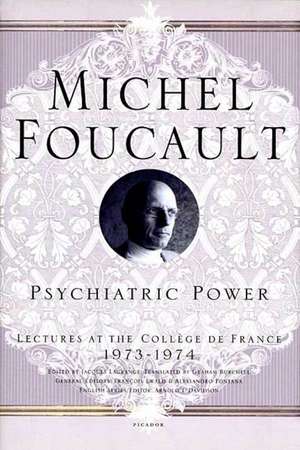
Psychiatric Power
Autor Michel Foucaulten Limba Engleză Paperback – 24 iun 2008
Preț: 164.28 lei
Puncte Express: 246
Carte disponibilă
Livrare economică 07-21 noiembrie
Livrare prin curier în România Termenul estimat este afișat lângă disponibilitate.
Transport gratuit de la 400.00 lei Plată online sau ramburs, în funcție de opțiunile comenzii.
Retur gratuit în 14 zile Comandă securizată și suport în română.
Specificații
ISBN-13: 9780312203313
ISBN-10: 0312203314
Pagini: 412
Dimensiuni: 140 x 216 x 25 mm
Greutate: 0.48 kg
Ediția:First.
Editura: St. Martins Press-3pl
ISBN-10: 0312203314
Pagini: 412
Dimensiuni: 140 x 216 x 25 mm
Greutate: 0.48 kg
Ediția:First.
Editura: St. Martins Press-3pl
V-ar putea interesa
-
 Madness ExplainedRichard P BentallPreț: 123.75 lei
 -
 Madness, Language, LiteratureMichel FoucaultPreț: 278.92 lei
 -
 Discipline and PunishMichel Foucault-19%Preț: 76.33 lei93.66 lei
 -
 PowerMichel Foucault-28%Preț: 78.30 lei108.72 lei
 -
 Society Must Be DefendedMichel Foucault-19%Preț: 75.16 lei93.18 lei
 -
 Centuries of ChildhoodPhilippe AriesPreț: 144.72 lei
 -
 The Archaeology of KnowledgeMichel FoucaultPreț: 101.39 lei
 -
 Power/KnowledgeMichel FoucaultPreț: 104.40 lei
 -
 Michel FoucaultBarry SmartPreț: 426.23 lei
 -
 -22%Preț: 96.23 lei123.35 lei
 -
 This Way Madness LiesMike Jay-20%Preț: 160.62 lei201.02 lei
 -
 Madness and CivilizationMichel FoucaultPreț: 110.80 lei
 -
 Discipline and PunishMichel FoucaultPreț: 105.22 lei
 -
 The Birth of the ClinicMichel FoucaultPreț: 105.45 lei
 -
 Centuries Of ChildhoodPhilippe AriesPreț: 122.91 lei
 -
 Speech Begins After DeathMichel FoucaultPreț: 91.99 lei
 -
 Two Regimes of Madness, revised editionGilles Deleuze-14%Preț: 108.41 lei125.49 lei
 -
 Dominique: The Case of an AdolescentFrancoise Dolto-19%Preț: 81.30 lei100.11 lei
 -
 -25%Preț: 81.86 lei109.32 lei
 -
 Introducing FoucaultChris HorrocksPreț: 63.60 lei
 -
 The Divided Mind: Uncovering psychiatry's dark past and reimagining its futureProfessor Edward Bullmore-29%Preț: 103.03 lei144.79 lei
Notă biografică
Michel Foucault; Edited by Jacques Lagrange; Translated by Graham Burchell; General Editors: François Ewald and Alessandro Fontana; English Series Editor: Arnold I. Davidson
Cuprins
Foreword: François Ewald and Alessandro Montana
Introduction: Arnold I. Davidson
Translator's Note
One: 7 November 1973
The space of the asylum and disciplinary order. - Therapeutic process and "moral treatment."- Scenes of curing. - Changes made by the course from the approach of Histoire de la folie; 1. From an analysis of "representations" to an "analytics of power"; 2. From "violence" to the "microphysics of power"; 3. From "institutional regularities" to the "arrangements" of power.
Two: 14 November 1973
Scene of a cure: George III. From the "macrophysics of sovereignty" to the "microphysics of disciplinary power." The new figure of the madman. - Little encyclopedia of scenes of cures. - The practice of hypnosis and hysteria. - The psychoanalytic scene; the antipsychiatric scene. - Mary Barnes at Kingsley Hall. - Manipulation of madness and stratagem of truth: Mason Cox.
Three: 21 November 1973
Genealogy of "disciplinary power." The "power of sovereignty." The subject-function in disciplinary power and in the power of sovereignty. - Forms of disciplinary power: army, police, apprenticeship, workshop, school. -Disciplinary power as "normalizing agency." - Technology of disciplinary power and constitution of the "individual." - Emergence of the human sciences.
Four: 28 November 1973
Elements for a history of disciplinary apparatuses: religious communities in the Middle Ages; pedagogical colonization of youth; the Jesuit missions to Paraguay; the army; workshops; workers' cities. - The formalization of these apparatuses in Jeremy Bentham's model of the Panopticon. - The family institution and emergence of the Psy-function.
Five: 5 December 1973
The asylum and the family. From interdiction to confinement. The break between the asylum and the family. - The asylum; a curing machine. - Typology of "corporal apparatuses (appareils corporels)". - The madman and the child. - Clinics (maisons de santé). - Disciplinary apparatuses and family power.
Six: 12 December 1973
Constitution of the child as target of psychiatric intervention. - A family-asylum utopia: the Clermont-en-Oise asylum. - From psychiatry as "ambiguous master" of reality and truth in proto-psychiatric practices to psychiatry as "agent of intensification" of reality. - Psychiatric power and discourse of truth. - The problem of simulation and the insurrection of the hysterics. - The question of the birth of psychoanalysis.
Seven: 19 December 1973
Psychiatric power. - A treatment by François Leuret and its strategic elements: 1-creating an imbalance of power; 2-the ruse of language; 3-the management of needs; 4-the statement of truth. - The pleasure of illness. - The asylum apparatus (dispositif).
Eight: 9 January 1974
Psychiatric power and the practice of "direction". - The game of "reality" in the asylum. - The asylum, a medically demarcated space and the question of its medical or administrative direction. - The tokens of psychiatric knowledge: ( a ) the technique of questioning; ( b ) the interplay of medication and punishment; ( c ) the clinical presentation. -Asylum "microphysics of power." - Emergence of the Psy-function and of neuropathology. - The triple destiny of psychiatric power.
Nine: 16 January 1974
The modes of generalization of psychiatric power and the psychiatrization of childhood. - 1. The theoretical specification of idiocy. The criterion of development. - Emergence of a psychopathology of idiocy and mental retardation. - Édouard Seguin: instinct and abnormality. - 2. The institutional annexation of idiocy by psychiatric power. - T he "moral treatment" of idiots: Seguin. - The process of confinement and the stigmatization of the dangerousness of idiots. - Recourse to the notion of degeneration.
Ten: 23 January 1974
Psychiatric power and the question of truth: questioning and confession; magnetism and hypnosis; drugs. - Elements for a history of truth: 1. The truth-event and its forms: judicial, alchemical and medical practices. - Transition to a technology of demonstrative truth. Its elements: ( a ) procedures of inquiry; ( b ) institution of a subject of knowledge; ( c ) ruling out the crisis in medicine and psychiatry and its supports: the disciplinary space of the asylum, recourse to pathological anatomy; relationships between madness and crime. - Psychiatric power and hysterical resistance.
Eleven: 30 January 1974
The problem of diagnosis in medicine and psychiatry. - The place of the body in psychiatric nosology: the model of general paralysis. - The fate of the notion of crisis in medicine and psychiatry. - The test of reality in psychiatry and its forms: 1. Psychiatric questioning (l'interrogatoire) and the confession. The ritual of clinical presentation. Note on "pathological heredity" and degeneration. - 2. Drugs. Moreau de Tours and hasish. Madness and dreams. - 3. Magnetism and hypnosis. The discovery of the "neurological body."
Twelve: 6 February 1974
The emergence of the neurological body: Broca and Duchenne de Boulogne. - Illnesses of differential diagnosis and illnesses of absolute diagnosis. - The model of "general paralysis" and the neuroses. - The battle of hysteria: 1. The organization of a "symptomatological scenario." - 2. The maneuver of the "functional mannequin" and hypnosis. The question of simulation. - 3. Neurosis and trauma. The irruption of the sexual body.
Course Summary
Course Context
Index of Names
Index of Notions
Index of Places
Introduction: Arnold I. Davidson
Translator's Note
One: 7 November 1973
The space of the asylum and disciplinary order. - Therapeutic process and "moral treatment."- Scenes of curing. - Changes made by the course from the approach of Histoire de la folie; 1. From an analysis of "representations" to an "analytics of power"; 2. From "violence" to the "microphysics of power"; 3. From "institutional regularities" to the "arrangements" of power.
Two: 14 November 1973
Scene of a cure: George III. From the "macrophysics of sovereignty" to the "microphysics of disciplinary power." The new figure of the madman. - Little encyclopedia of scenes of cures. - The practice of hypnosis and hysteria. - The psychoanalytic scene; the antipsychiatric scene. - Mary Barnes at Kingsley Hall. - Manipulation of madness and stratagem of truth: Mason Cox.
Three: 21 November 1973
Genealogy of "disciplinary power." The "power of sovereignty." The subject-function in disciplinary power and in the power of sovereignty. - Forms of disciplinary power: army, police, apprenticeship, workshop, school. -Disciplinary power as "normalizing agency." - Technology of disciplinary power and constitution of the "individual." - Emergence of the human sciences.
Four: 28 November 1973
Elements for a history of disciplinary apparatuses: religious communities in the Middle Ages; pedagogical colonization of youth; the Jesuit missions to Paraguay; the army; workshops; workers' cities. - The formalization of these apparatuses in Jeremy Bentham's model of the Panopticon. - The family institution and emergence of the Psy-function.
Five: 5 December 1973
The asylum and the family. From interdiction to confinement. The break between the asylum and the family. - The asylum; a curing machine. - Typology of "corporal apparatuses (appareils corporels)". - The madman and the child. - Clinics (maisons de santé). - Disciplinary apparatuses and family power.
Six: 12 December 1973
Constitution of the child as target of psychiatric intervention. - A family-asylum utopia: the Clermont-en-Oise asylum. - From psychiatry as "ambiguous master" of reality and truth in proto-psychiatric practices to psychiatry as "agent of intensification" of reality. - Psychiatric power and discourse of truth. - The problem of simulation and the insurrection of the hysterics. - The question of the birth of psychoanalysis.
Seven: 19 December 1973
Psychiatric power. - A treatment by François Leuret and its strategic elements: 1-creating an imbalance of power; 2-the ruse of language; 3-the management of needs; 4-the statement of truth. - The pleasure of illness. - The asylum apparatus (dispositif).
Eight: 9 January 1974
Psychiatric power and the practice of "direction". - The game of "reality" in the asylum. - The asylum, a medically demarcated space and the question of its medical or administrative direction. - The tokens of psychiatric knowledge: ( a ) the technique of questioning; ( b ) the interplay of medication and punishment; ( c ) the clinical presentation. -Asylum "microphysics of power." - Emergence of the Psy-function and of neuropathology. - The triple destiny of psychiatric power.
Nine: 16 January 1974
The modes of generalization of psychiatric power and the psychiatrization of childhood. - 1. The theoretical specification of idiocy. The criterion of development. - Emergence of a psychopathology of idiocy and mental retardation. - Édouard Seguin: instinct and abnormality. - 2. The institutional annexation of idiocy by psychiatric power. - T he "moral treatment" of idiots: Seguin. - The process of confinement and the stigmatization of the dangerousness of idiots. - Recourse to the notion of degeneration.
Ten: 23 January 1974
Psychiatric power and the question of truth: questioning and confession; magnetism and hypnosis; drugs. - Elements for a history of truth: 1. The truth-event and its forms: judicial, alchemical and medical practices. - Transition to a technology of demonstrative truth. Its elements: ( a ) procedures of inquiry; ( b ) institution of a subject of knowledge; ( c ) ruling out the crisis in medicine and psychiatry and its supports: the disciplinary space of the asylum, recourse to pathological anatomy; relationships between madness and crime. - Psychiatric power and hysterical resistance.
Eleven: 30 January 1974
The problem of diagnosis in medicine and psychiatry. - The place of the body in psychiatric nosology: the model of general paralysis. - The fate of the notion of crisis in medicine and psychiatry. - The test of reality in psychiatry and its forms: 1. Psychiatric questioning (l'interrogatoire) and the confession. The ritual of clinical presentation. Note on "pathological heredity" and degeneration. - 2. Drugs. Moreau de Tours and hasish. Madness and dreams. - 3. Magnetism and hypnosis. The discovery of the "neurological body."
Twelve: 6 February 1974
The emergence of the neurological body: Broca and Duchenne de Boulogne. - Illnesses of differential diagnosis and illnesses of absolute diagnosis. - The model of "general paralysis" and the neuroses. - The battle of hysteria: 1. The organization of a "symptomatological scenario." - 2. The maneuver of the "functional mannequin" and hypnosis. The question of simulation. - 3. Neurosis and trauma. The irruption of the sexual body.
Course Summary
Course Context
Index of Names
Index of Notions
Index of Places