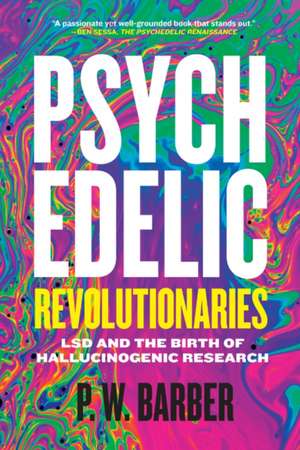
Psychedelic Revolutionaries
Autor P W Barberen Limba Engleză Paperback – 8 iun 2018
Preț: 203.35 lei
Puncte Express: 305
Carte tipărită la comandă
Livrare economică 24 noiembrie-08 decembrie
Livrare prin curier în România Termenul estimat este afișat lângă disponibilitate.
Transport gratuit de la 400.00 lei Plată online sau ramburs, în funcție de opțiunile comenzii.
Retur gratuit în 14 zile Comandă securizată și suport în română.
Specificații
ISBN-13: 9780889774209
ISBN-10: 088977420X
Pagini: 384
Dimensiuni: 156 x 230 x 27 mm
Greutate: 0.65 kg
Editura: University of Regina Press
ISBN-10: 088977420X
Pagini: 384
Dimensiuni: 156 x 230 x 27 mm
Greutate: 0.65 kg
Editura: University of Regina Press
Recenzii
"Author P.W. Barber chronicles the psychedelic saga like a page-turning thriller while also dropping massive doses of enlightening information." Merry Jane
" Psychedelic Revolutionaries is a remarkably detailed accounting of a period in Canadian research history long obfuscated by larger cultural forces." Winnipeg Free Press
" Psychedelic Revolutionaries is a remarkably detailed accounting of a period in Canadian research history long obfuscated by larger cultural forces." Winnipeg Free Press
Descriere
Descriere de la o altă ediție sau format:
The post-World War II era was a tumultuous period in the world of psychiatry. Medical history has cast it as a clash between biology and psychoanalysis or as a time that lacked objectivism, that is until the introduction of psychotropic drugs such as chlorpromazine which triggered a change in our treatment of mental health as profound and far-reaching in its consequences as the war itself. In the early years of this psychopharmacological revolution, hallucinogens such as mescaline and LSD played as much of a role as other psychotropics. In fact, psychedelics constituted a scientific revolution in their own right, one that does not however fit the narrative of twentieth century scientific history.
Looking beyond the countercultural manifestations and references that have for decades obfuscated the psychedelic story, historian P.W. Barber delves into a serious examination of both the science and the people behind the research. Showing why and how this experimentation unfolded, what its findings were and how these findings were received both within and outside the scientific community, Psychedelic Revolutionaries completely resets a long-misunderstood history by following the work of three pioneering psychiatrists - Humphry Osmond, who coined the term 'psychedelic' and administered Aldous Huxley his first dose of mescaline, Abram Hoffer and Duncan Blewett, also known as the 'Leary of the North'.
While considering how it is that scientific discoveries become accepted as established truths, Barber invites us to ask: what is it that makes a scientific discovery revolutionary?
The post-World War II era was a tumultuous period in the world of psychiatry. Medical history has cast it as a clash between biology and psychoanalysis or as a time that lacked objectivism, that is until the introduction of psychotropic drugs such as chlorpromazine which triggered a change in our treatment of mental health as profound and far-reaching in its consequences as the war itself. In the early years of this psychopharmacological revolution, hallucinogens such as mescaline and LSD played as much of a role as other psychotropics. In fact, psychedelics constituted a scientific revolution in their own right, one that does not however fit the narrative of twentieth century scientific history.
Looking beyond the countercultural manifestations and references that have for decades obfuscated the psychedelic story, historian P.W. Barber delves into a serious examination of both the science and the people behind the research. Showing why and how this experimentation unfolded, what its findings were and how these findings were received both within and outside the scientific community, Psychedelic Revolutionaries completely resets a long-misunderstood history by following the work of three pioneering psychiatrists - Humphry Osmond, who coined the term 'psychedelic' and administered Aldous Huxley his first dose of mescaline, Abram Hoffer and Duncan Blewett, also known as the 'Leary of the North'.
While considering how it is that scientific discoveries become accepted as established truths, Barber invites us to ask: what is it that makes a scientific discovery revolutionary?
Cuprins
Introduction
Part I: Psychedelic Science: The Saskatchewan Experiments (1951-61)
1. Model Psychoses and the Adrenochrome Hypothesis
2. Psychiatric Paradigm Clash
3. Beginning Hallucinogenic Therapy
4. The Other World: Psychedelic Therapy
5. New Frontiers in Psychedelic Research
Part II: The Scientific Fallout: Psychedelic Science on Trial (1961-75)
6. The Great Schizophrenia Controversy
7. LSD: A New Hope for Alcoholism?
8. Psychedelic Drug Research, the CIA, and the '60s Counterculture
Epilogue
Part I: Psychedelic Science: The Saskatchewan Experiments (1951-61)
1. Model Psychoses and the Adrenochrome Hypothesis
2. Psychiatric Paradigm Clash
3. Beginning Hallucinogenic Therapy
4. The Other World: Psychedelic Therapy
5. New Frontiers in Psychedelic Research
Part II: The Scientific Fallout: Psychedelic Science on Trial (1961-75)
6. The Great Schizophrenia Controversy
7. LSD: A New Hope for Alcoholism?
8. Psychedelic Drug Research, the CIA, and the '60s Counterculture
Epilogue