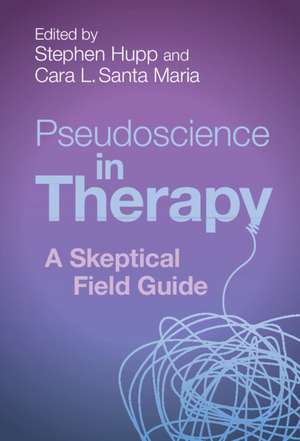
Pseudoscience in Therapy
Editat de Stephen Hupp, Cara L Santa Mariaen Limba Engleză Paperback – 23 mar 2023
Preț: 230.94 lei
Preț vechi: 243.09 lei
-5%
Puncte Express: 346
Carte tipărită la comandă
Livrare economică 23 mai-06 iunie
Specificații
ISBN-13: 9781009005104
ISBN-10: 1009005103
Pagini: 372
Dimensiuni: 152 x 229 x 20 mm
Greutate: 0.49 kg
Editura: Cambridge University Press
Locul publicării:New York, United States
ISBN-10: 1009005103
Pagini: 372
Dimensiuni: 152 x 229 x 20 mm
Greutate: 0.49 kg
Editura: Cambridge University Press
Locul publicării:New York, United States
Cuprins
1. Thinking critically about therapy Cara L. Santa Maria; 2. Depression R. Trent Codd III; 3. Bipolar spectrum Monica Ramirez Basco and Brittany L. Mason; 4. Anxiety Dean McKay; 5. Obsessions and compulsions Dean McKay; 6. Trauma Gerald M. Rosen, Henry Otgaar, and Harald Merckelbach; 7. Dissociation Steven Jay Lynn, Fiona Sleight, Craig P. Polizzi, Damla Aksen, Lawrence Patihis, Henry Otgaar and Olivier Dodier; 8. Pain Harriet Hall; 9. Eating issues Jamie Loor, Jennifer Battles, Brooke L. Bennett, Brooke L. Whisenhunt, and Danae L. Hudson; 10. Insomnia Colleen E. Carney, Parky H. Lau and Samlau Kutana; 11. Sexual issues Caroline F. Pukall; 12. Substance use and addiction Jonathan N. Stea, Igor Yakovenko, Hyoun S. Kim, and David C. Hodgins; 13. Significant cognitive decline Claudia Drossel and Jacqueline Pachis; 14. Antisocial behavior Devon L. L. Polaschek; 15. Personality Joel Paris; 16. Psychosis and schizophrenia Brandon A. Gaudiano, Katherine Visser and Elizabeth Thompson; 17. Autism spectrum and intellectual disability Jason C. Travers; 18. Inattention and hyperactivity J. Russell Ramsay; 19. Tics Kirsten Bootes, Brianna Wellen, Emily Braley and Michael B Himle; 20. Couples discord Erin F. Alexander and Matthew D. Johnson; Postscript: Scientific skepticism resources Stephen Hupp; Index.
Recenzii
''Psychotherapy' offers a spectrum of practices and techniques, some effective and evidence-based, some of dubious value, and some that violate the principle of 'do no harm'. This book is an impressive, comprehensive, and well-written guide to choosing efficacious therapy while avoiding the useless and the bogus. I highly recommend it.' James E. Alcock, York University, Canada
'This book is a valuable contribution to the literature on bogus psychotherapeutic techniques for a wide range of psychological disorders. It provides a comprehensive overview of what works and, more importantly, what doesn't. It will be useful to therapists to guide their choices of which techniques to employ.' Terence Hines, Pace University, USA
'Pseudoscience in Therapy is about bad ideas in the mental health field, and also about good ones. It's about the untested, unsupported, and potentially harmful treatments for various conditions, such as trauma, dissociative disorders, pain, and insomnia. And it's about the good, evidence-based practices for these conditions. A superb collection of clinicians and researchers share their wisdom about the pseudoscience they have seen, and the good practices they encourage. With this one-of-a-kind book, that so artfully encourages skeptical thinking, both patients and their treaters will be far better off.' Elizabeth F. Loftus, University of California, Irvine, USA
'Hupp and Santa Maria have produced a book that should be on every therapist's shelf. A complete, easy-to-use guide to all the many dubious psychological therapies and their evidence-based counterpoints. Experts in the major psychological disorders succinctly review the scientific and pseudoscientific landscape in a form that makes additional research easy to pursue. Highly recommended.' Stuart Vyse, contributing editor Skeptical Inquirer magazine and author of Believing in Magic: The Psychology of Superstition
'This client- and outcomes-focused book is a valuable read for both new and experienced therapists. Experts from multiple fields weigh in on potentially harmful practices commonly used for various diagnoses, as well as provide effective evidence-based treatments for the same diagnoses. The chapters in this interesting collection can help you think more critically about popular treatments and our responsibility as therapists to deliver the best care possible, supported by science.' Judith Beck, President of the Beck Institute, USA
'This book is a valuable contribution to the literature on bogus psychotherapeutic techniques for a wide range of psychological disorders. It provides a comprehensive overview of what works and, more importantly, what doesn't. It will be useful to therapists to guide their choices of which techniques to employ.' Terence Hines, Pace University, USA
'Pseudoscience in Therapy is about bad ideas in the mental health field, and also about good ones. It's about the untested, unsupported, and potentially harmful treatments for various conditions, such as trauma, dissociative disorders, pain, and insomnia. And it's about the good, evidence-based practices for these conditions. A superb collection of clinicians and researchers share their wisdom about the pseudoscience they have seen, and the good practices they encourage. With this one-of-a-kind book, that so artfully encourages skeptical thinking, both patients and their treaters will be far better off.' Elizabeth F. Loftus, University of California, Irvine, USA
'Hupp and Santa Maria have produced a book that should be on every therapist's shelf. A complete, easy-to-use guide to all the many dubious psychological therapies and their evidence-based counterpoints. Experts in the major psychological disorders succinctly review the scientific and pseudoscientific landscape in a form that makes additional research easy to pursue. Highly recommended.' Stuart Vyse, contributing editor Skeptical Inquirer magazine and author of Believing in Magic: The Psychology of Superstition
'This client- and outcomes-focused book is a valuable read for both new and experienced therapists. Experts from multiple fields weigh in on potentially harmful practices commonly used for various diagnoses, as well as provide effective evidence-based treatments for the same diagnoses. The chapters in this interesting collection can help you think more critically about popular treatments and our responsibility as therapists to deliver the best care possible, supported by science.' Judith Beck, President of the Beck Institute, USA
Descriere
This field guide covers mental health myths, diagnostic controversies, questionable assessment practices, and dubious treatments.