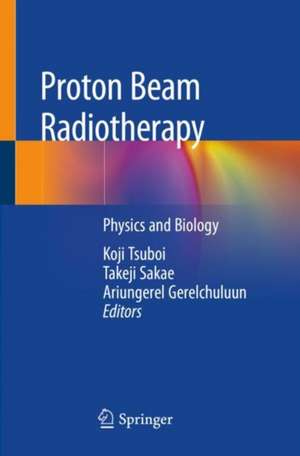
Proton Beam Radiotherapy
Editat de Koji Tsuboi, Takeji Sakae, Ariungerel Gerelchuluunen Limba Engleză Paperback – 26 aug 2021
În domeniul oncologiei moderne, Proton Beam Radiotherapy reprezintă o resursă clinică esențială pentru radioterapeuți, fizicieni medicali și rezidenți care doresc să stăpânească fundamentele tehnice ale acestei tehnologii avansate. Considerăm că volumul reușește să sintetizeze complexitatea fizicii particulelor și a răspunsului biologic într-un format accesibil, facilitând tranziția de la radioterapia convențională la cea cu protoni. Descoperim aici o analiză riguroasă a modului în care proprietățile intrinseci ale protonilor permit o precizie superioară în vizarea tumorilor solide, protejând simultan integritatea organelor la risc. Structura cărții urmărește o progresie logică, de la contextul istoric și dezvoltarea sistemelor de livrare (precum ciclotronii și sistemele de transport al fasciculului), până la aspectele critice de dozimetrie și microdozimetrie. Merită menționat faptul că editorii Koji Tsuboi și Takeji Sakae au alocat secțiuni generoase radiobiologiei, explorând daunele la nivelul ADN-ului și aberațiile cromozomiale, elemente vitale pentru înțelegerea eficacității biologice relative (RBE). Ca alternativă la Basic Radiotherapy Physics and Biology de David S. Chang pentru rezidenți, această lucrare oferă avantajul unei specializări stricte pe fasciculul de protoni, eliminând generalitățile despre fotoni pentru a aprofunda tehnici precum managementul mișcării și planificarea tratamentului asistată de calculator. De asemenea, față de Proton and Carbon Ion Therapy, volumul de față se concentrează exclusiv pe protoni, oferind o claritate sporită asupra protocoalelor specifice de asigurare a calității (QA) necesare în centrele dedicate.
Preț: 718.40 lei
Preț vechi: 756.21 lei
-5%
Carte disponibilă
Livrare economică 17 noiembrie-01 decembrie
Specificații
ISBN-10: 9811374562
Pagini: 244
Ilustrații: VI, 235 p. 120 illus., 89 illus. in color.
Dimensiuni: 155 x 235 x 13 mm
Greutate: 0.43 kg
Ediția:1st ed. 2020
Editura: Springer
Locul publicării:Singapore, Singapore
V-ar putea interesa
-
 -5%Preț: 425.80 lei448.21 lei
 -
 Interventional Diagnostic and Therapeutic ProceduresB. T. Katzen-5%Preț: 354.38 lei373.03 lei
 -
 -5%Preț: 1473.08 lei1550.61 lei
 -
 Proton Beam TherapySantosh Yajnik-5%Preț: 1065.50 lei1121.58 lei
 -
 -18%Preț: 325.21 lei397.72 lei
 -
 Strahlentherapie: Radiologische OnkologieE. Scherer-5%Preț: 500.32 lei526.65 lei
 -
 High Energy Electrons in Radiation TherapyA. Zuppinger-5%Preț: 349.57 lei367.97 lei
 -
 Wirkungssteigerung der Strahlentherapie maligner TumorenKarl Zum Winkel-5%Preț: 443.01 lei466.33 lei
 -
 Radiologie und StrahlenschutzEberhard Willich-5%Preț: 330.57 lei347.96 lei
 -
 -5%Preț: 459.90 lei484.10 lei
 -
 Thermoradiotherapy and ThermochemotherapyM. Heinrich Seegenschmiedt-5%Preț: 1546.39 lei1627.77 lei
 -
 -5%Preț: 731.49 lei769.98 lei
 -
 Praktische Aspekte der supportiven Therapie in Hämatologie und OnkologieCarsten Bokemeyer-5%Preț: 461.58 lei485.88 lei
 -
 -5%Preț: 1090.05 lei1147.43 lei
 -
 -5%Preț: 442.87 lei466.18 lei
 -
 Thermoradiotherapy and ThermochemotherapyM. Heinrich Seegenschmiedt-5%Preț: 762.27 lei802.39 lei
 -
 Carcinoma of the ProstateZbigniew Petrovich-5%Preț: 779.42 lei820.45 lei
 -
 Frontiers in European RadiologyA. L. Baert-5%Preț: 709.91 lei747.27 lei
 -
 Mediastinal TumorsDouglas E. Wood-5%Preț: 714.33 lei751.93 lei
 -
 Radiopathology of Organs and TissuesEberhard Scherer-5%Preț: 774.95 lei815.73 lei
 -
 Intraoperative RadiotherapyFelipe A. Calvo-5%Preț: 371.25 lei390.79 lei
 -
 Radiation Therapy in Pediatric OncologyJ. Robert Cassady-5%Preț: 756.92 lei796.76 lei
 -
 Current Topics in Clinical Radiobiology of TumorsHans-Peter Beck-Bornholdt-5%Preț: 717.60 lei755.38 lei
 -
 -5%Preț: 408.92 lei430.45 lei
 -
 -5%Preț: 374.49 lei394.21 lei
 -
 Dengue VirusesR. W. Schlesinger-5%Preț: 350.07 lei368.50 lei
 -
 Klinische StrahlenbiologieT. Herrmann-5%Preț: 373.61 lei393.27 lei
 -
 NMR in Living SystemsT. Axenrod-5%Preț: 378.98 lei398.92 lei
De ce să citești această carte
Această carte este indispensabilă specialiștilor care implementează sau operează tehnologii de radioterapie cu protoni. Cititorul câștigă o înțelegere profundă a raportului doză-răspuns și a sistemelor de accelerare, fiind un ghid practic ce facilitează optimizarea planurilor de tratament oncologic prin prisma celor mai recente date de fizică medicală și radiobiologie.
Despre autor
Koji Tsuboi și Takeji Sakae sunt figuri marcante în comunitatea medicală și științifică din Japonia, țară aflată în avangarda tehnologiei de radioterapie cu particule. Koji Tsuboi este recunoscut pentru contribuțiile sale în oncologia radiologică și cercetarea clinică, în timp ce Takeji Sakae aduce expertiza sa vastă în fizica medicală și ingineria sistemelor de radioterapie. Împreună cu Ariungerel Gerelchuluun, aceștia au coordonat un colectiv de experți pentru a oferi o perspectivă integrată asupra modului în care proprietățile fizice ale protonilor se traduc în beneficii clinice reale pentru pacienții cu cancer.
Descriere scurtă
The major aspects discussed include the technique’s development background, the generation and delivery system for proton beams, physical characteristics, biological consequences, dosimetry, and future prospects in both medical physics and radiation biology in terms of effective cancer treatment. Gathering contributions from experts who provide clear and detailed information on the basics of proton beams, the book will greatly benefit not only radiological technicians, medical physicists, and physicians, but also scientists in cancer radiotherapy.
Cuprins
Notă biografică
Dr. Takeji Sakae has continued research in the field of medical physics, which related to equipments for proton beam preparation and quality control. In this field, due to advancements such as scanning irradiation and target tracking, equipment and software have become more complicated year by year. In order for the system to obtain reliability and stability, it is considered important to have a balanced quality control that covers the entire system.
Ariungerel Gerelchuluun is a Senior Director for Clinical Research at EagleForce Associates Inc, from 2018. She had been worked as researcher and an assistant professor at University of Tsukuba, Japan. She received her MD from Health Sciences University of Mongolia, School of Medicine at 2005 and her PhD in medical sciences from University of Tsukuba, Japan at 2015. She has strong interest in radiation especially proton beam induced DNA damages and its repair mechanisms, and radiation induced anticancer immune cell modulation. She has multiple articles in this field.