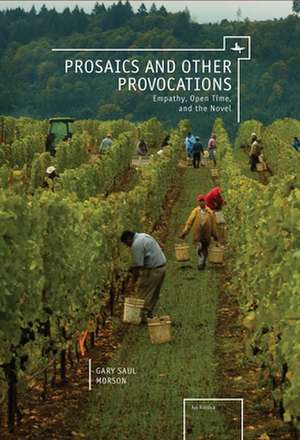
Prosaics and Other Provocations: Empathy, Open Time, and the Novel: Ars Rossica
Autor Gary Saul Morsonen Limba Engleză Hardback – 15 aug 2013
Din seria Ars Rossica
- 33%
 Preț: 691.19 lei
 - 23%
 Preț: 746.89 lei
 - 23%
 Preț: 916.03 lei
 -
 Preț: 248.07 lei
 - 26%
 Preț: 677.43 lei
 - 16%
 Preț: 147.84 lei
 -
 Preț: 263.72 lei
 -
 Preț: 358.74 lei
 -
 Preț: 219.15 lei
 - 26%
 Preț: 595.71 lei
 -
 Preț: 280.69 lei
 - 19%
 Preț: 227.68 lei
 -
 Preț: 248.31 lei
 -
 Preț: 272.78 lei
 -
 Preț: 312.20 lei
 -
 Preț: 275.69 lei
 - 25%
 Preț: 753.73 lei
 - 33%
 Preț: 640.86 lei
 - 29%
 Preț: 201.58 lei
 - 32%
 Preț: 509.97 lei
Preț: 602.35 lei
Preț vechi: 801.91 lei
-25%
Puncte Express: 904
Carte disponibilă
Livrare economică 14-28 noiembrie
Livrare express 03-07 noiembrie pentru 94.23 lei
Livrare prin curier în România Termenul estimat este afișat lângă disponibilitate.
Transport gratuit pentru acest produs Plată online sau ramburs, în funcție de opțiunile comenzii.
Retur gratuit în 14 zile Comandă securizată și suport în română.
Specificații
ISBN-13: 9781618111616
ISBN-10: 1618111612
Pagini: 300
Dimensiuni: 159 x 238 x 21 mm
Greutate: 0.6 kg
Ediția:New.
Editura: Academic Studies Press
Colecția Academic Studies Press
Seria Ars Rossica
Locul publicării:Boston, MA, United States
ISBN-10: 1618111612
Pagini: 300
Dimensiuni: 159 x 238 x 21 mm
Greutate: 0.6 kg
Ediția:New.
Editura: Academic Studies Press
Colecția Academic Studies Press
Seria Ars Rossica
Locul publicării:Boston, MA, United States
V-ar putea interesa
-
 George Steiner: A ReaderGeorge Steiner-14%Preț: 197.71 lei229.66 lei
 -
 Alterities: Criticism, History, RepresentationThomas Docherty-23%Preț: 220.79 lei286.68 lei
 -
 The Holocaust and the PostmodernRobert Eaglestone-18%Preț: 388.39 lei472.86 lei
 -
 The New Oxford Book of Literary AnecdotesJohn Gross-19%Preț: 93.16 lei114.82 lei
 -
 Literary Theory: A Very Short IntroductionJonathan Culler-19%Preț: 57.68 lei71.12 lei
 -
 Postmodern Narrative TheoryMark CurriePreț: 233.22 lei
 -
 Studying Literature: The Essential CompanionDr Paul Goring-22%Preț: 249.48 lei318.48 lei
 -
 Preț: 213.65 lei
 -
 From Agamben to ZizekJon Simons-16%Preț: 185.76 lei220.75 lei
 -
 Death and the LabyrinthJames Faubion-45%Preț: 126.21 lei229.95 lei
 -
 The Wizard Knight CompanionMichael Andre-DriussiPreț: 54.26 lei
 -
 A Companion to Ayn RandAllan Gotthelf-9%Preț: 1264.17 lei1389.20 lei
 -
 Karl Marx and World LiteratureS S PrawerPreț: 247.11 lei
 -
 Introducing SemioticsPaul CobleyPreț: 64.46 lei
Recenzii
“Morson epitomizes the elusive scholar/teacher, equally comfortable theorizing about literature (particularly the novel) and teaching us how to teach in a way that captivates and fascinates students of all levels. His trademark wit is everywhere in evidence in this delightful and wide-ranging collection that shows he belongs to the ranks of the greatest scholars and readers of literature, on a level with Frank Kermode and Wayne Booth.”
“Morson’s provocations elevate sheer common sense to the level of non-absolutist metaphysics. His learning and wit would be a pleasure to encounter at any time, but they are particularly welcome—indeed, needed—amidst the glum earnestness and hand-wringing now rife in the academic humanities. ‘Prosaics,’ as it has evolved since Morson’s early work on Tolstoy and Bakhtin, emerges as a pragmatic worldview. Here is a vision of the novel (and its potential consequences) capacious as the genre itself. Wise, funny, and beautifully written, this is a fine contribution to ethics and pedagogy, as well as the study of literature.”
“Gary Saul Morson’s work discusses literature splendidly, but also goes beyond it to present a new, compelling vision of the human world. Our lives, Morson tells us, do not follow abstract, definite laws, be they historical or economic. We interact with other human beings without always fully knowing what situation we or they are in, we improvise, we invent, we thrive among details rather than grand pictures, we need concrete truths rather than poetic ones, and this is why realist novels, in particular the Russian ones, are so revealing. Morson’s book provides an extraordinary introduction to the prosaics of life.”
"Morson, in a tremendous collection of pieces, extends his ongoing interest in what he calls 'prosaics'—basically, a way of attending to fictional prose that makes room for the messiness, the loose ends, and the improvised form that one finds in the great realist writers (for Morson, especially Dostoyevsky)."
“Read this book. While it is inspired by (and offers brief but illuminating studies of) the masterworks of Tolstoy and Dostoevsky, the volume’s relevance greatly transcends Russian literature, indeed it offers a corrective to much (one is tempted to say all) thought, whether that includes technological or economic history, animal or language speciation, or deconstructing the Old Testament. . . . Readers who cherish various theories of literature or even science itself will find Morson a contentious, amusing, and always-eloquent conversationalist, who argues for a “counter-tradition,” a life affirming perspective that opposes all-encompassing laws and patterns with details, processes, and especially our consciousness of the present moment with all its innumerable potentials.”
“Professors in undergraduate and especially graduate courses offered, and perhaps still offer, dire warnings against treating literary characters as though they somehow resembled real people or focusing on the writer’s intent in producing a work. Evaluation—declaring a work to be “good” or “bad”—was to be abjured. Morson cheerfully, even aggressively, violates these prohibitions. He is not afraid to single out those writers and works that he calls great, to consider the views of authors on literature, and to use novels as a means for probing ethical issues that individuals may face in real life.”
“Morson’s provocations elevate sheer common sense to the level of non-absolutist metaphysics. His learning and wit would be a pleasure to encounter at any time, but they are particularly welcome—indeed, needed—amidst the glum earnestness and hand-wringing now rife in the academic humanities. ‘Prosaics,’ as it has evolved since Morson’s early work on Tolstoy and Bakhtin, emerges as a pragmatic worldview. Here is a vision of the novel (and its potential consequences) capacious as the genre itself. Wise, funny, and beautifully written, this is a fine contribution to ethics and pedagogy, as well as the study of literature.”
“Gary Saul Morson’s work discusses literature splendidly, but also goes beyond it to present a new, compelling vision of the human world. Our lives, Morson tells us, do not follow abstract, definite laws, be they historical or economic. We interact with other human beings without always fully knowing what situation we or they are in, we improvise, we invent, we thrive among details rather than grand pictures, we need concrete truths rather than poetic ones, and this is why realist novels, in particular the Russian ones, are so revealing. Morson’s book provides an extraordinary introduction to the prosaics of life.”
"Morson, in a tremendous collection of pieces, extends his ongoing interest in what he calls 'prosaics'—basically, a way of attending to fictional prose that makes room for the messiness, the loose ends, and the improvised form that one finds in the great realist writers (for Morson, especially Dostoyevsky)."
“Read this book. While it is inspired by (and offers brief but illuminating studies of) the masterworks of Tolstoy and Dostoevsky, the volume’s relevance greatly transcends Russian literature, indeed it offers a corrective to much (one is tempted to say all) thought, whether that includes technological or economic history, animal or language speciation, or deconstructing the Old Testament. . . . Readers who cherish various theories of literature or even science itself will find Morson a contentious, amusing, and always-eloquent conversationalist, who argues for a “counter-tradition,” a life affirming perspective that opposes all-encompassing laws and patterns with details, processes, and especially our consciousness of the present moment with all its innumerable potentials.”
“Professors in undergraduate and especially graduate courses offered, and perhaps still offer, dire warnings against treating literary characters as though they somehow resembled real people or focusing on the writer’s intent in producing a work. Evaluation—declaring a work to be “good” or “bad”—was to be abjured. Morson cheerfully, even aggressively, violates these prohibitions. He is not afraid to single out those writers and works that he calls great, to consider the views of authors on literature, and to use novels as a means for probing ethical issues that individuals may face in real life.”
Notă biografică
Gary Saul Morson (PhD Yale University) is a member of the American Academy of Arts and Sciences and Frances Hooper Professor of the Arts and Humanities at Northwestern University. His study Narrative and Freedom: The Shadows of Time (1996) won a best book award from the American Comparative Literature Association. He is also the author of Mikhail Bakhtin: Creation of a Prosaics (co-authored with Caryl Emerson, 1990), Anna Karenina in Our Time: Seeing More Wisely (2007), and The Words of Others: From Quotations to Culture (2011).