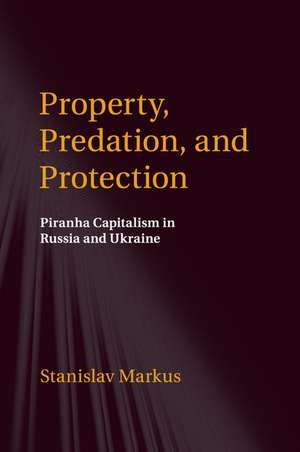
Property, Predation, and Protection
Autor Stanislav Markusen Limba Engleză Paperback – 25 iul 2016
Preț: 300.32 lei
Puncte Express: 450
Carte tipărită la comandă
Livrare economică 24 noiembrie-08 decembrie
Livrare prin curier în România Termenul estimat este afișat lângă disponibilitate.
Transport gratuit de la 400.00 lei Plată online sau ramburs, în funcție de opțiunile comenzii.
Retur gratuit în 14 zile Comandă securizată și suport în română.
Specificații
ISBN-13: 9781107459076
ISBN-10: 1107459079
Pagini: 256
Ilustrații: 7 b/w illus. 7 tables
Dimensiuni: 152 x 229 x 15 mm
Greutate: 0.42 kg
Editura: Cambridge University Press
Locul publicării:New York, United States
ISBN-10: 1107459079
Pagini: 256
Ilustrații: 7 b/w illus. 7 tables
Dimensiuni: 152 x 229 x 15 mm
Greutate: 0.42 kg
Editura: Cambridge University Press
Locul publicării:New York, United States
V-ar putea interesa
-
 -31%Preț: 742.50 lei1072.02 lei
 -
 America's Supreme Court: Making Democracy WorkStephen Breyer-11%Preț: 348.83 lei391.44 lei
 -
 After Public LawCormac Mac Amhlaigh-31%Preț: 822.38 lei1193.78 lei
 -
 The Cosmopolitan StateH. Patrick Glenn-31%Preț: 761.46 lei1102.52 lei
 -
 The Oxford Edition of DiceyA. V. Dicey-23%Preț: 1556.65 lei2021.63 lei
 -
 The North Carolina State ConstitutionJohn V. Orth-31%Preț: 1451.08 lei2118.06 lei
 -
 Preț: 406.18 lei
 -
 Competing SovereigntiesRichard Joyce-18%Preț: 1257.96 lei1534.10 lei
 -
 Preț: 249.59 lei
 -
 Ruling EuropeMartin HeipertzPreț: 305.45 lei
 -
 PlatoPlatoPreț: 153.02 lei
 -
 The Cambridge Companion to Plato's RepublicG. R. F. FerrariPreț: 293.96 lei
 -
 The Rise and Decline of the StateMartin Van CreveldPreț: 311.81 lei
 -
 Understanding Russian PoliticsStephen WhitePreț: 558.31 lei
 -
 The Power of American GovernorsThad KousserPreț: 248.50 lei
 -
 The President's Legislative Policy Agenda, 1789-2002Jeffrey E. Cohen-23%Preț: 216.14 lei279.73 lei
 -
 Preț: 26.72 lei
Cuprins
1. Introduction; 2. Agent predation and secure ownership; 3. Not too petty: disorganized threats beyond corruption; 4. Minibeasts versus sovereign: ownership threats beyond 'the system'; 5. Commitment dissolved; 6. Firm stakeholders versus state predators; 7. Firm stakeholders and rule of law.
Recenzii
'This book takes on a big topic - the origins of property rights, which are widely held to be fundamental to economic growth. Theoretically, Markus departs from the existing literature in emphasizing the threat to property rights posed by agents of the sovereign rather than the sovereign himself. Empirically, he paints a vivid picture of piranha capitalism in postcommunist Russia and Ukraine, with much that will be new even to seasoned observers of the postcommunist region.' Scott Gehlbach, University of Wisconsin, Madison
'Brilliantly mobilizing evidence from Russia and Ukraine, Stanislav Markus forces us to fundamentally revise how we think of property rights security in weak states. Documenting that one of the greatest threats to property rights in such states tends to be piranha-like lower-level officials acting on their own, this book shows that firms can protect themselves through strategically arranged stakeholder alliances with other powerful actors, including foreign firms, and that this can constitute a previously unrecognized path toward the rule of law. Property, Predation, and Protection is an outstanding example of new theory developed through deep research into how politics actually works outside the developed West.' Henry Hale, George Washington University, Washington DC
'Property, Predation, and Protection assesses the political circumstances under which property rights in emerging markets become more or less secure. As a perennial research question in comparative political economy, one might expect that fresh insights would be hard to come by. Yet Stanislav Markus has defied the odds by producing a truly groundbreaking book. When asked 'what has the study of postcommunist countries contributed to theory building in comparative politics?', scholars should now include Markus's theory of property rights and agent predation as an outstanding example.' Juliet Johnson, McGill University, Montréal
'Stanislav Markus's book rigorously dissects the problem of securing property rights in postcommunist states. Markus develops a theoretical framework for classifying the types of vulnerability to state predation faced by firms, and relates these to the difficulty that rulers of weak states face in restraining their own bureaucratic agents. He grounds his analysis in carefully researched case studies of Russia and Ukraine. The result is a masterful contribution to the theory of property rights and its application in the post-Soviet region.' Thomas Remington, Emory University, Atlanta
'… the author's arguments … address important issues and do so in a way that demands attention. I thoroughly recommend the book to anyone interested in business-state relations in transition societies.' Stephen Fortescue, Slavic Review
'The book's greatest strength lies in its empirical richness. Markus draws on his interview with managers, political observers, and policymakers, as well as on his own survey of 396 Russian and 120 Ukrainian firms.' Katheryn Hendley, The Russian Review
'Brilliantly mobilizing evidence from Russia and Ukraine, Stanislav Markus forces us to fundamentally revise how we think of property rights security in weak states. Documenting that one of the greatest threats to property rights in such states tends to be piranha-like lower-level officials acting on their own, this book shows that firms can protect themselves through strategically arranged stakeholder alliances with other powerful actors, including foreign firms, and that this can constitute a previously unrecognized path toward the rule of law. Property, Predation, and Protection is an outstanding example of new theory developed through deep research into how politics actually works outside the developed West.' Henry Hale, George Washington University, Washington DC
'Property, Predation, and Protection assesses the political circumstances under which property rights in emerging markets become more or less secure. As a perennial research question in comparative political economy, one might expect that fresh insights would be hard to come by. Yet Stanislav Markus has defied the odds by producing a truly groundbreaking book. When asked 'what has the study of postcommunist countries contributed to theory building in comparative politics?', scholars should now include Markus's theory of property rights and agent predation as an outstanding example.' Juliet Johnson, McGill University, Montréal
'Stanislav Markus's book rigorously dissects the problem of securing property rights in postcommunist states. Markus develops a theoretical framework for classifying the types of vulnerability to state predation faced by firms, and relates these to the difficulty that rulers of weak states face in restraining their own bureaucratic agents. He grounds his analysis in carefully researched case studies of Russia and Ukraine. The result is a masterful contribution to the theory of property rights and its application in the post-Soviet region.' Thomas Remington, Emory University, Atlanta
'… the author's arguments … address important issues and do so in a way that demands attention. I thoroughly recommend the book to anyone interested in business-state relations in transition societies.' Stephen Fortescue, Slavic Review
'The book's greatest strength lies in its empirical richness. Markus draws on his interview with managers, political observers, and policymakers, as well as on his own survey of 396 Russian and 120 Ukrainian firms.' Katheryn Hendley, The Russian Review
Descriere
This book analyzes the threats to the property rights of business owners and investigates what makes these rights secure.