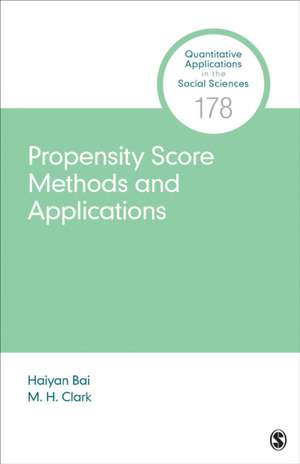
Propensity Score Methods and Applications: Quantitative Applications in the Social Sciences
Autor Haiyan Bai, M. H. Clarken Limba Engleză Paperback – 29 dec 2018
Using succinct and approachable language to introduce the basic concepts of PSM, authors Haiyan Bai and M. H. Clark present basic concepts, assumptions, procedures, available software packages, and step-by-step examples for implementing PSM using real-world data, with exercises at the end of each chapter allowing readers to replicate examples on their own.
Din seria Quantitative Applications in the Social Sciences
-
 Preț: 324.81 lei
 -
 Preț: 372.89 lei
 -
 Preț: 378.02 lei
 -
 Preț: 378.07 lei
 -
 Preț: 374.30 lei
 -
 Preț: 379.12 lei
 -
 Preț: 378.11 lei
 -
 Preț: 379.22 lei
 -
 Preț: 379.72 lei
 -
 Preț: 354.40 lei
 -
 Preț: 377.76 lei
 -
 Preț: 331.27 lei
 -
 Preț: 362.73 lei
 -
 Preț: 366.67 lei
 -
 Preț: 373.03 lei
 -
 Preț: 341.40 lei
 -
 Preț: 378.39 lei
 -
 Preț: 378.69 lei
 -
 Preț: 341.19 lei
 -
 Preț: 378.09 lei
 -
 Preț: 341.82 lei
 -
 Preț: 379.62 lei
 -
 Preț: 341.51 lei
 -
 Preț: 379.62 lei
 -
 Preț: 377.47 lei
 -
 Preț: 378.39 lei
 -
 Preț: 378.64 lei
 -
 Preț: 377.77 lei
 -
 Preț: 377.77 lei
 -
 Preț: 379.00 lei
 -
 Preț: 341.16 lei
 -
 Preț: 379.00 lei
 -
 Preț: 341.36 lei
 -
 Preț: 379.07 lei
 -
 Preț: 378.32 lei
 -
 Preț: 341.36 lei
 -
 Preț: 341.46 lei
 -
 Preț: 341.36 lei
 - nou
 Preț: 114.20 lei
 - nou
 Preț: 114.20 lei
 - nou
 Preț: 114.20 lei
 - nou
 Preț: 114.20 lei
 - nou
 Preț: 114.20 lei
 -
 Preț: 114.20 lei
 -
 Preț: 175.73 lei
 - nou
 Preț: 114.20 lei
 - nou
 Preț: 114.20 lei
Preț: 384.17 lei
Puncte Express: 576
Carte disponibilă
Livrare economică 14-28 noiembrie
Livrare express 31 octombrie-06 noiembrie pentru 24.02 lei
Livrare prin curier în România Termenul estimat este afișat lângă disponibilitate.
Transport gratuit de la 400.00 lei Plată online sau ramburs, în funcție de opțiunile comenzii.
Retur gratuit în 14 zile Comandă securizată și suport în română.
Specificații
ISBN-13: 9781506378053
ISBN-10: 1506378056
Pagini: 136
Dimensiuni: 138 x 215 x 7 mm
Greutate: 0.17 kg
Ediția:1
Editura: Sage Publications, Inc
Colecția Quantitative Applications in the Social Sciences
Seria Quantitative Applications in the Social Sciences
Locul publicării:Thousand Oaks, United States
ISBN-10: 1506378056
Pagini: 136
Dimensiuni: 138 x 215 x 7 mm
Greutate: 0.17 kg
Ediția:1
Editura: Sage Publications, Inc
Colecția Quantitative Applications in the Social Sciences
Seria Quantitative Applications in the Social Sciences
Locul publicării:Thousand Oaks, United States
Recenzii
“Haiyan Bai and M.H. Clark have delivered a readable and easily applicable guide for eager researchers with data-in-hand, chomping at the bit to determine whether and how their empirical challenges might be addressed through the careful application of propensity score methods.”
“This volume provides a thorough introduction to propensity score methods while taking care to not overwhelm the reader with dense mathematics. Simple examples, straightforward language, and a catalog of software options make this a fine primer for researchers seeking to incorporate propensity score methods into their own research plans, and an excellent desk reference.”
“This book contains excellent descriptions of propensity score matching with practical examples and clear guides using different software programs.”
“This volume provides a thorough introduction to propensity score methods while taking care to not overwhelm the reader with dense mathematics. Simple examples, straightforward language, and a catalog of software options make this a fine primer for researchers seeking to incorporate propensity score methods into their own research plans, and an excellent desk reference.”
“This book contains excellent descriptions of propensity score matching with practical examples and clear guides using different software programs.”
Cuprins
Series Editor’s Introduction
About the Authors
Acknowledgments
1. Basic Concepts of Propensity Score Methods
1.1 Causal Inference
1.2 Propensity Scores
1.3 Assumptions
1.4 Summary of the Chapter
2. Covariate Selection and Propensity Score Estimation
2.1 Covariate Selection
2.2 Propensity Score Estimation
2.3 Summary of the Chapter
2.4 An Example
3. Propensity Score Adjustment Methods
3.1 Propensity Score Matching
3.2 Other Propensity Score Adjustment Methods
3.3 Summary of the Chapter
3.4 An Example
4. Covariate Evaluation and Causal Effect Estimation
4.1 Evaluating the Balance of Covariate Distributions
4.2 Causal Effect Estimation
4.3 Sensitivity Analysis
4.4 Summary of the Chapter
4.5 An Example
5. Conclusion
5.1 Limitations of the Propensity Score Methods and How to Address Them
5.2 Summary of Propensity Score Procedures
5.3 Final Comments
References
Index
About the Authors
Acknowledgments
1. Basic Concepts of Propensity Score Methods
1.1 Causal Inference
1.2 Propensity Scores
1.3 Assumptions
1.4 Summary of the Chapter
2. Covariate Selection and Propensity Score Estimation
2.1 Covariate Selection
2.2 Propensity Score Estimation
2.3 Summary of the Chapter
2.4 An Example
3. Propensity Score Adjustment Methods
3.1 Propensity Score Matching
3.2 Other Propensity Score Adjustment Methods
3.3 Summary of the Chapter
3.4 An Example
4. Covariate Evaluation and Causal Effect Estimation
4.1 Evaluating the Balance of Covariate Distributions
4.2 Causal Effect Estimation
4.3 Sensitivity Analysis
4.4 Summary of the Chapter
4.5 An Example
5. Conclusion
5.1 Limitations of the Propensity Score Methods and How to Address Them
5.2 Summary of Propensity Score Procedures
5.3 Final Comments
References
Index
Notă biografică
Dr. Haiyan Bai is a Professor at the University of Central Florida. She earned her Ph.D. in quantitative research methodology at the University of Cincinnati. Her research interests include issues that revolve around statistical/quantitative methods, specifically, propensity score methods, resampling techniques, research design, measurement, and the application of statistical methods in social and behavioral sciences.
Descriere
A concise, introductory text on propensity score methods that is easy to comprehend by those who have a limited background in statistics, and is practical enough for researchers to quickly generalize and apply the methods.