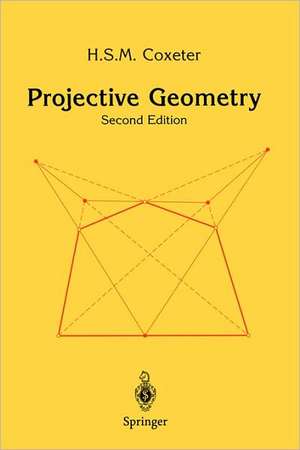
Projective Geometry
Autor H. S. M. Coxeteren Limba Engleză Paperback – 9 oct 2003
Găsim în Projective Geometry o abordare riguroasă care transformă radical percepția asupra spațiului geometric. Spre deosebire de geometria euclidiană, unde compasul și rigla gradată sunt instrumente de bază, acest volum demonstrează cum construcțiile pot fi realizate utilizând exclusiv rigla, deoarece în geometria proiectivă nu se măsoară distanțe, ci se stabilesc relații între seturi de puncte prin proiectivitate. Structura logică a ediției a doua, publicată de Springer, este exemplară: primele capitole pun bazele axiomatice, urmate de prezentarea teoremelor clasice ale lui Desargues și Pappus, evoluând natural spre studiul conicelor prin metoda lui von Staudt și explorarea geometriei finite. Apreciem modul în care H. S. M. Coxeter reușește să sintetizeze concepte complexe pentru nivelul licență, oferind un text auto-conținut. Această lucrare completează perspectiva oferită de Introduction to Projective Geometry de C. R. Wylie; în timp ce Wylie pune un accent egal pe metodele analitice și axiomatice, Coxeter se concentrează pe puritatea axiomatică și pe eleganța construcției geometrice, oferind o fundamentare mai profundă a conceptelor de incidență și dualitate. Față de alte lucrări ale autorului, precum Regular Polytopes, unde accentul cade pe figuri geometrice complexe în dimensiuni multiple, volumul de față servește drept fundament teoretic esențial, explicând cum principiile proiective stau la baza structurilor mai complexe studiate în cariera sa. Progresia textului, de la proiectivități pe o linie la cele în plan, pregătește cititorul pentru capitolele finale care unifică viziunea proiectivă cu cea euclidiană și analitică.
Preț: 361.97 lei
Carte disponibilă
Livrare economică 16-30 noiembrie
Specificații
ISBN-10: 0387406239
Pagini: 176
Ilustrații: XII, 162 p.
Dimensiuni: 155 x 235 x 10 mm
Greutate: 0.28 kg
Ediția:Second Edition 1987
Editura: Springer
Locul publicării:New York, NY, United States
V-ar putea interesa
-
 Finite Geometries, Buildings, and Related TopicsWilliam M. Kantor-21%Preț: 305.49 lei386.25 lei
 -
 Chaos and FractalsHeinz-Otto Peitgen-23%Preț: 724.70 lei941.16 lei
 -
 Fractals and Scaling in FinanceBenoit B. Mandelbrot-18%Preț: 1049.92 lei1280.39 lei
 -
 Geometry: Euclid and BeyondRobin HartshornePreț: 508.72 lei
 -
 Topological GroupsMarkley-9%Preț: 797.55 lei876.42 lei
 -
 Making GeometryJon AllenPreț: 97.17 lei
 -
 -15%Preț: 665.77 lei783.25 lei
 -
 A Short Course in Computational Geometry and TopologyHerbert Edelsbrunner-15%Preț: 521.16 lei613.12 lei
 -
 Geometry and PhysicsJürgen Jost-15%Preț: 489.53 lei575.92 lei
 -
 Computational GeometryMark de BergPreț: 441.16 lei
 -
 Gems of GeometryJohn Barnes-8%Preț: 420.17 lei456.71 lei
Public țintă
Lower undergraduateDe ce să citești această carte
Recomandăm această ediție studenților la matematică și pasionaților de geometrie pură. Cititorul câștigă o înțelegere clară a modului în care geometria poate fi construită fără măsurători metrice, bazându-se doar pe proprietăți de incidență. Este o poartă de acces către gândirea axiomatică modernă, scrisă de unul dintre cei mai mari geometri ai secolului XX, oferind claritate acolo unde alte manuale devin excesiv de tehnice.
Descriere scurtă
Cuprins
Textul de pe ultima copertă
This classic book introduces the important concepts of the subject and provides the logical foundations, including the famous theorems of Desargues and Pappus and a self-contained account of von Staudt's approach to the theory of conics. The modern approach used in this account is then utilized to deal with the simplest finite geometry that is rich enough to illustrate all the theorems nontrivially. The book concludes by demonstrating the connections among projective, Euclidean, and analytic geometry.
From the reviews of Projective Geometry:
...The book is written with all the grace and lucidity that characterize the author's other writings. ...
-T. G. Room, Mathematical Reviews
This is an elementary introduction to projective geometry based on the intuitive notions of perspectivity and projectivity and, formally, on axioms essentially the same as the classical ones of Vebber and Young...This book is an excellent introduction.
- T. G. Ostrom, Zentralblatt