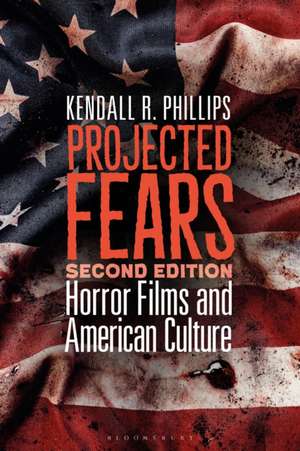
Projected Fears
Autor Kendall R. Phillipsen Limba Engleză Hardback – 13 noi 2025
Remarcăm cum analiza peliculei Get Out (2017) deschide acest volum, servind drept argument central pentru puterea filmului de groază de a interoga ideologiile și sistemele de opresiune contemporane. Projected Fears, aflat la a doua ediție revizuită, nu este doar o cronică a sperieturilor cinematografice, ci un studiu riguros despre modul în care temerile colective ale societății americane sunt proiectate pe marele ecran. Merită menționat că autorul Kendall R. Phillips selectează treisprezece titluri esențiale — de la clasicul Dracula (1931) la revoluționarul Saw (2004) — pentru a demonstra cum fiecare dintre acestea a redefinit genul. Reținem conceptul de „încălcare rezonantă” (resonant violations), o teorie prin care Phillips explică de ce anumite imagini ne urmăresc mult timp după ce am părăsit sala de cinema. Structura cărții urmărește o progresie cronologică fascinantă, dedicând capitole unor piloni precum Psycho, Halloween sau The Silence of the Lambs. Această ediție extinde orizontul cercetării, integrând subgenul „torture porn” și noile narațiuni culturale din secolul XXI. Colecționarii care au apreciat 100 American Horror Films de Barry Keith Grant vor găsi aici aceeași rigoare în contextualizarea culturală, însă Projected Fears oferă o profunzime teoretică suplimentară asupra modului în care horror-ul funcționează ca un barometru social. Lucrarea se aliniază tematic cu alte volume ale autorului, precum A Place of Darkness, continuând să exploreze originile și evoluția monștrilor în imaginarul american.
Preț: 553.27 lei
Preț vechi: 748.55 lei
-26%
Carte tipărită la comandă
Livrare economică 07-21 decembrie
Specificații
Pagini: 330
Ilustrații: 26 bw illus
Dimensiuni: 154 x 230 x 24 mm
Greutate: 0.63 kg
Ediția:2. Auflage
Editura: BLOOMSBURY ACADEMIC
Locul publicării:New York, United States
V-ar putea interesa
-
 -30%Preț: 372.22 lei531.01 lei
 -
 -30%Preț: 473.51 lei674.98 lei
 -
 Cinematic Savior: Hollywood's Making of the American ChristStephenson Humphries-Brooks-27%Preț: 392.35 lei534.28 lei
 -
 Movies and the Modern PsycheSharon Packer MD-19%Preț: 365.22 lei448.74 lei
 -
 Controversial Cinema: The Films That Outraged AmericaKendall R. Phillips-34%Preț: 296.30 lei449.76 lei
 -
 Feeding the MonsterAnna BogutskayaPreț: 92.94 lei
 -
 -19%Preț: 116.01 lei142.59 lei
 -
 -18%Preț: 227.86 lei276.27 lei
 -
 -21%Preț: 116.38 lei148.10 lei
 -
 The Definitive Guide to Horror MoviesKim Newman-25%Preț: 151.90 lei203.01 lei
 -
 The Horror FilmRick WorlandPreț: 303.04 lei
 -
 The Horror Theory ReaderJeffrey Andrew WeinstockPreț: 226.96 lei
 -
 The Making of Horror MoviesJennifer SelwayPreț: 145.75 lei
 -
 Preț: 102.20 lei
 -
 -29%Preț: 151.71 lei214.13 lei
 -
 -17%Preț: 120.39 lei145.23 leiRecomandat
 -
 Horror's New Wave: 15 Years of BlumhouseBlumhousePreț: 202.04 leiRecomandat
 -
 The Book of HorrorMatt GlasbyPreț: 127.99 lei
 -
 Games of TerrorVera Dika-15%Preț: 622.50 lei732.36 lei
 -
 100 American Horror FilmsBarry Keith Grant-33%Preț: 109.81 lei163.79 lei
 -
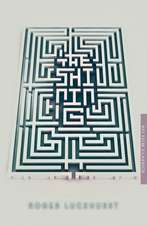 The ShiningRoger Luckhurst-32%Preț: 67.29 lei99.22 lei
 -
 -21%Preț: 163.00 lei205.35 lei
 -
 -19%Preț: 115.83 lei142.47 lei
 -
 -17%Preț: 138.31 lei166.83 lei
 -
 Horror CinemaJonathan PennerPreț: 190.55 lei
De ce să citești această carte
Această carte se adresează studenților și pasionaților de cinema care doresc să înțeleagă mecanismele din spatele fricii. Cititorul câștigă o perspectivă critică asupra modului în care filmele horror reflectă realitățile politice și sociale, transformând vizionarea unui film dintr-o simplă experiență senzorială într-un exercițiu de analiză culturală profundă. Este resursa ideală pentru a înțelege de ce genul horror a devenit atât de influent în cultura de masă actuală.
Despre autor
Kendall R. Phillips este profesor în cadrul Departamentului de Comunicare și Studii Retorice de la Universitatea Syracuse. Cu o carieră dedicată analizei fenomenelor culturale prin prisma cinematografiei, Phillips a explorat în lucrările sale, precum Controversial Cinema sau A Cinema of Hopelessness, teme legate de ostilitate, refuz politic și impactul social al filmelor controversate. Expertiza sa în retorică și filosofie îi permite să abordeze genul horror nu doar ca divertisment, ci ca un limbaj complex prin care societatea își procesează traumele și conflictele ideologice.
Descriere
This book examines thirteen films that redefined the notion of cinematic horror and influenced the films that followed: Dracula (1931), The Thing (1951), Psycho (1960), Night of the Living Dead (1968), The Exorcist (1973), The Texas Chainsaw Massacre (1974), Halloween (1978), The Silence of the Lambs (1991), Scream (1996), The Sixth Sense (1999), The Blair Witch Project (1999), Saw (2004), and Get Out (2017). Carefully situating each film in relation to the history of the genre and the cultural contexts in which it emerged, the book explains why certain horror films create a connection with a wide audience.
Since the publication of the first edition in 2005, the horror genre has become even more culturally prominent and commercially successful. The genre has also shown rapid development, and several prominent trends have emerged in the 21st century. This edition includes two additional chapters that focus on Saw (2004) and Get Out (2017), as James Wan's Saw helped to launch a highly successful franchise as well as the subgenre of "torture porn," while Jordan Peele's Get Out inaugurated a broader cultural conversation about the power of horror narratives to interrogate systems of ideology and oppression.
Cuprins
Acknowledgements
Introduction to 2nd Edition
Introduction to 1st Edition
1. Dracula (1931)
2. The Thing From Another World (1951)
3. Psycho (1960)
4. Night of the Living Dead (1968)
5. The Exorcist (1973) and The Texas Chain Saw Massacre (1974)
6. Halloween (1978)
7. The Silence of the Lambs (1991)
8. Scream (1996)
9. The Sixth Sense (1999) and The Blair Witch Project (1999)
10. Saw (2004)
11. Get Out (2017)
Conclusion
Appendix: Conclusion to the 1st Edition
Selected Bibliography
Index
Recenzii
Kendall Philips's Projected Fears is a keenly argued exegesis of American horror films and the cultural contexts from which they emerge. This new edition, which includes two new chapters - on Saw and Get Out respectively - and a new introduction assessing the place of horror films within contemporary academic discourse, will - like the first - make an excellent teaching resource and generate much debate within and beyond Horror Studies.
Projected Fears is an indispensable resource for anyone interested in understanding the relationship between culture and horror. Phillips's theory of popular horror films as "resonant violations" is foundational for understanding how these movies jolt viewers into new ways of thinking about their social and political contexts. This second edition provides additional insight into horror cinema's growing popularity and status as a subject of academic inquiry. The two new chapters on the movies Saw and Get Out help to make this book an easy choice for use in undergraduate rhetoric, film, and media studies classes.