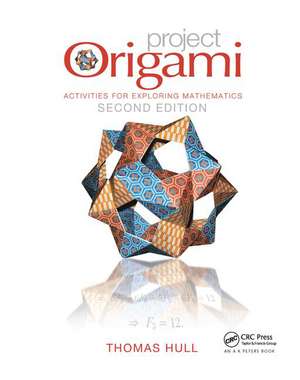
Project Origami: Activities for Exploring Mathematics, Second Edition: AK Peters/CRC Recreational Mathematics Series
Autor Thomas Hullen Limba Engleză Hardback – 27 iul 2017
Din seria AK Peters/CRC Recreational Mathematics Series
-
 Preț: 386.78 lei
 - 11%
 Preț: 610.93 lei
 -
 Preț: 277.71 lei
 - 14%
 Preț: 838.19 lei
 - 8%
 Preț: 467.87 lei
 - 14%
 Preț: 919.58 lei
 -
 Preț: 300.02 lei
 -
 Preț: 229.83 lei
 -
 Preț: 280.45 lei
 - 8%
 Preț: 552.87 lei
 -
 Preț: 319.09 lei
 -
 Preț: 270.76 lei
 -
 Preț: 323.93 lei
 -
 Preț: 193.27 lei
 - 8%
 Preț: 471.04 lei
 -
 Preț: 240.41 lei
 -
 Preț: 245.41 lei
 - 18%
 Preț: 724.09 lei
 - 18%
 Preț: 1259.34 lei
 - 13%
 Preț: 1315.22 lei
 -
 Preț: 477.59 lei
 - 8%
 Preț: 433.43 lei
 -
 Preț: 351.02 lei
 - 15%
 Preț: 481.87 lei
 - 9%
 Preț: 663.16 lei
 - 15%
 Preț: 500.04 lei
 -
 Preț: 379.50 lei
 -
 Preț: 290.61 lei
 - 15%
 Preț: 611.12 lei
 -
 Preț: 367.60 lei
 - 18%
 Preț: 1415.48 lei
 - 18%
 Preț: 894.29 lei
 - 18%
 Preț: 1516.18 lei
 -
 Preț: 317.72 lei
 - 15%
 Preț: 665.77 lei
 -
 Preț: 224.95 lei
 - 18%
 Preț: 1068.59 lei
 -
 Preț: 253.14 lei
Preț: 1480.56 lei
Preț vechi: 1805.57 lei
-18%
Puncte Express: 2221
Carte tipărită la comandă
Livrare economică 05-19 decembrie
Livrare prin curier în România Termenul estimat este afișat lângă disponibilitate.
Transport gratuit pentru acest produs Plată online sau ramburs, în funcție de opțiunile comenzii.
Retur gratuit în 14 zile Comandă securizată și suport în română.
Specificații
ISBN-13: 9781138427211
ISBN-10: 1138427217
Pagini: 364
Dimensiuni: 203 x 254 mm
Greutate: 0.83 kg
Ediția:2 New edition
Editura: CRC Press
Colecția A K Peters/CRC Press
Seria AK Peters/CRC Recreational Mathematics Series
ISBN-10: 1138427217
Pagini: 364
Dimensiuni: 203 x 254 mm
Greutate: 0.83 kg
Ediția:2 New edition
Editura: CRC Press
Colecția A K Peters/CRC Press
Seria AK Peters/CRC Recreational Mathematics Series
V-ar putea interesa
-
 -23%Preț: 735.38 lei955.03 lei
 -
 The Colossal Book of Short Puzzles and ProblemsMartin GardnerPreț: 253.02 lei
 -
 Preț: 117.86 lei
 -
 Do You Get the Point?Dee GoldsteinPreț: 64.02 lei
 -
 Game Theory - Analysis of Conflict (Paper) (OISC)Roger B. MyersonPreț: 350.89 lei
 -
 The Enjoyment of MathHans RademacherPreț: 257.13 lei
 -
 Preț: 59.48 lei
 -
 Preț: 201.62 lei
 -
 Wearing Gauss’s JerseyDean Hathout-18%Preț: 1417.56 lei1728.73 lei
 -
 Preț: 447.00 lei
 -
 Game Theory & Applications: Volume 4Nova Science Publishers Inc-27%Preț: 833.75 lei1134.79 lei
 -
 Mathematical Go: Chilling Gets the Last PointElwyn Berlekamp-18%Preț: 1413.75 lei1724.09 lei
 -
 Gödel's Theorem: An Incomplete Guide to Its Use and AbuseTorkel FranzénPreț: 359.91 lei
 -
 -18%Preț: 1433.19 lei1747.78 lei
 -
 Preț: 341.40 lei
 -
 MathematikKlaus D. SchmidtPreț: 227.15 lei
Recenzii
Praise for the First Edition:
For anyone who wants to enliven their class activities, this book gives wonderfully clear instructions for hands-on pager-folding activities, and specific suggestions as how to encourage students to ask questions, and to answer them, in the spirit of really ‘doing mathematics’ … I will use it next time I teach the Polya Enumeration Theorem.
—Mathematical Reviews, February 2008
Is it possible to use origami in the higher level mathematics classroom? An affirmative answer is given by Thomas Hull’s book Project Origami: Activities for Exploring Mathematics. Based on Hull’s extensive experience of combining origami and mathematics teaching over the last fifteen years, it aims to help the teacher bring origami into the mathematics classroom, at the high school, college, and university level.
—Helena Verrill, AMS Notices, May 2007
Thomas Hull … is one of the country’s foremost researchers in origami mathematics—a subject making the slow transition from the ghetto of recreational math, where Sudoku and Rubik’s Cube dwell, to the rarified air of legitimate research topic … The fun part is watching the mash-up of intellectual analysis and paper creativity … but what really drives him, he says, is understanding what’s happening underneath each figure.
—David Brooks, Nashuatelegraph.com, May 2007
In his efforts to collect everything that he could find linking origami and math (and in his own research efforts), Hull has discovered not only the obvious links between origami and geometry but also intriguing intersections of origami with other fields of mathematics, such as algebra, number theory, and combinatorics.
—Ivars Peterson, Science News, June 2006
Overall, this book is an excellent resource for mathematics educators who would like to include some hands-on experimentation in their teaching.
—Steven Frankel, MAA Reviews, July 2006
This is probably the most comprehensive study of mathematical paperfolding produced in book form to date. … Along with theorems and formulas, there are copious notes for instructors, making the book more a teachers’ manual than a recreational pursuit. Even so it will reward a study even by those wishing solely to produce decorative forms.
—John Cunliffe, ELFA and British Origami Society
This book shows you how and explains how! … The book is neatly presented and is designed to work as a sourcebook for teachers wishing to use origami in the classroom, but is easily accessible to anyone.
—Dennis Walker, British Origami Society
Thomas Hull has written a truly wonderful book … Project Origami is full of surprises and depth. Hull is passionate about his work and it shines through in this text … Concrete connections to curriculum (upper high-school levels, undergraduate levels) are made clear, highlighting the relevance and importance of this material to mathematics education. Every teacher should take a hold of this book … Hull shares the joy of doing and exploring real mathematics and provides a route that all can pursue.
—James Tanton
For anyone who wants to enliven their class activities, this book gives wonderfully clear instructions for hands-on pager-folding activities, and specific suggestions as how to encourage students to ask questions, and to answer them, in the spirit of really ‘doing mathematics’ … I will use it next time I teach the Polya Enumeration Theorem.
—Mathematical Reviews, February 2008
Is it possible to use origami in the higher level mathematics classroom? An affirmative answer is given by Thomas Hull’s book Project Origami: Activities for Exploring Mathematics. Based on Hull’s extensive experience of combining origami and mathematics teaching over the last fifteen years, it aims to help the teacher bring origami into the mathematics classroom, at the high school, college, and university level.
—Helena Verrill, AMS Notices, May 2007
Thomas Hull … is one of the country’s foremost researchers in origami mathematics—a subject making the slow transition from the ghetto of recreational math, where Sudoku and Rubik’s Cube dwell, to the rarified air of legitimate research topic … The fun part is watching the mash-up of intellectual analysis and paper creativity … but what really drives him, he says, is understanding what’s happening underneath each figure.
—David Brooks, Nashuatelegraph.com, May 2007
In his efforts to collect everything that he could find linking origami and math (and in his own research efforts), Hull has discovered not only the obvious links between origami and geometry but also intriguing intersections of origami with other fields of mathematics, such as algebra, number theory, and combinatorics.
—Ivars Peterson, Science News, June 2006
Overall, this book is an excellent resource for mathematics educators who would like to include some hands-on experimentation in their teaching.
—Steven Frankel, MAA Reviews, July 2006
This is probably the most comprehensive study of mathematical paperfolding produced in book form to date. … Along with theorems and formulas, there are copious notes for instructors, making the book more a teachers’ manual than a recreational pursuit. Even so it will reward a study even by those wishing solely to produce decorative forms.
—John Cunliffe, ELFA and British Origami Society
This book shows you how and explains how! … The book is neatly presented and is designed to work as a sourcebook for teachers wishing to use origami in the classroom, but is easily accessible to anyone.
—Dennis Walker, British Origami Society
Thomas Hull has written a truly wonderful book … Project Origami is full of surprises and depth. Hull is passionate about his work and it shines through in this text … Concrete connections to curriculum (upper high-school levels, undergraduate levels) are made clear, highlighting the relevance and importance of this material to mathematics education. Every teacher should take a hold of this book … Hull shares the joy of doing and exploring real mathematics and provides a route that all can pursue.
—James Tanton
Cuprins
Introduction. Folding Equilateral Triangles in a Square. Origami Trigonometry. Dividing a Length into Equal Nths: Fujimoto Approximation. Dividing a Length into Equal Nths Exactly. Origami Helix. Folding a Parabola. Can Origami Trisect an Angle? Solving Cubic Equations. Lill’s Method. Folding Strips into Knots. Haga’s Origamics. Modular Star Ring. Folding a Butterfly Bomb. Molly’s Hexahedron. Business Card Modulars. Five Intersecting Tetrahedra. Making Origami Buckyballs. Making Origami Tori. Modular Menger Sponge. Folding and Coloring a Crane. Exploring Flat Vertex Folds.Impossible Crease Patterns. Folding a Square Twist. Counting Flat Folds. Self-Similar Wave. Matrix Model of Flat Vertex Folds. Matrix Model of 3D Vertex Folds. Origami and Homomorphisms. Rigid Folds 1: Gaussian Curvature. Rigid Folds 2: Spherical Trigonometry. Appendix. Bibliography. Index.
Descriere
Project Origami: Activities for Exploring Mathematics, Second Edition presents a flexible, discovery-based approach to learning origami-math topics