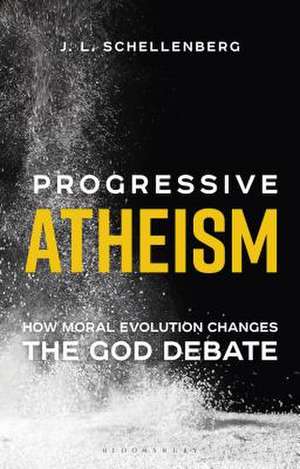
Progressive Atheism: How Moral Evolution Changes the God Debate
Autor J. L. Schellenbergen Limba Engleză Paperback – 8 aug 2019
Starting with the simple idea that our understanding of what it takes to be a good person has changed and grown over time, J. L. Schellenberg argues that our understanding of the goodness of God must now change too. Masculine images of God as haughty King or distant Father have to be replaced by God as a paragon of nonviolence and relational openness.
This more evolved conception of God is incredibly attractive and admirable. But by the same token it has become less believable. Each moral advance, applied to God, makes it even clearer that such a being would never create a world like ours.
Atheists have often approached the subject of God with disdain. Progressive Atheism proves that admiration will be far more powerful.
Preț: 136.24 lei
Preț vechi: 161.05 lei
-15%
Puncte Express: 204
Carte tipărită la comandă
Livrare economică 01-15 decembrie
Livrare prin curier în România Termenul estimat este afișat lângă disponibilitate.
Transport gratuit de la 400.00 lei Plată online sau ramburs, în funcție de opțiunile comenzii.
Retur gratuit în 14 zile Comandă securizată și suport în română.
Specificații
ISBN-13: 9781350097193
ISBN-10: 1350097195
Pagini: 200
Dimensiuni: 136 x 214 x 14 mm
Greutate: 0.26 kg
Editura: Bloomsbury Publishing
Colecția Bloomsbury Academic
Locul publicării:London, United Kingdom
ISBN-10: 1350097195
Pagini: 200
Dimensiuni: 136 x 214 x 14 mm
Greutate: 0.26 kg
Editura: Bloomsbury Publishing
Colecția Bloomsbury Academic
Locul publicării:London, United Kingdom
Cuprins
Preface
1. Getting Oriented
2. An (A)theological Dead End
3. Naturalism's Shortcut
4. Unexplored Territory: Moral Evolution
5. Updating God
6. A Relationally Responsive God
7. A Kinder God
8. A Nonviolent God
9. Challenging the New Theism
10. Atheism's Brave New World
Notes
Glossary
Acknowledgments
1. Getting Oriented
2. An (A)theological Dead End
3. Naturalism's Shortcut
4. Unexplored Territory: Moral Evolution
5. Updating God
6. A Relationally Responsive God
7. A Kinder God
8. A Nonviolent God
9. Challenging the New Theism
10. Atheism's Brave New World
Notes
Glossary
Acknowledgments
Recenzii
Schellenberg's reasoning is very clear, and his writing is beautiful. The book is written in an accessible way; I believe it would make an excellent textbook in many undergraduate philosophy of religion courses ... Schellenberg is rightly celebrated for encouraging philosophers and theologians to take seriously the idea of the deep future.
Over the last quarter century, atheism has come out of the closet and is today more acceptable-even respectable-than at any time in history. But the militancy often associated with the strong atheism that asserts God's nonexistence is not enough to build a movement. We need a progressive atheism, which the philosopher J. L. Schellenberg provides us with in this brilliantly-argued and clearly-written book. Progressive Atheism is must reading for everyone interested in these ultimate questions
How can atheism be "progressive"? First, by being based on moral progress. Such progress alters our understanding of God's perfect goodness, yielding an idea of God that is "too good to be true." Second, by freeing us to explore new spiritual terrain. Schellenberg acts as guide, ending the book with a fascinating tour of a variety of live religious possibilities. For open-minded readers, this book is a breath of fresh air. Highly recommended!
Over the last quarter century, atheism has come out of the closet and is today more acceptable-even respectable-than at any time in history. But the militancy often associated with the strong atheism that asserts God's nonexistence is not enough to build a movement. We need a progressive atheism, which the philosopher J. L. Schellenberg provides us with in this brilliantly-argued and clearly-written book. Progressive Atheism is must reading for everyone interested in these ultimate questions
How can atheism be "progressive"? First, by being based on moral progress. Such progress alters our understanding of God's perfect goodness, yielding an idea of God that is "too good to be true." Second, by freeing us to explore new spiritual terrain. Schellenberg acts as guide, ending the book with a fascinating tour of a variety of live religious possibilities. For open-minded readers, this book is a breath of fresh air. Highly recommended!