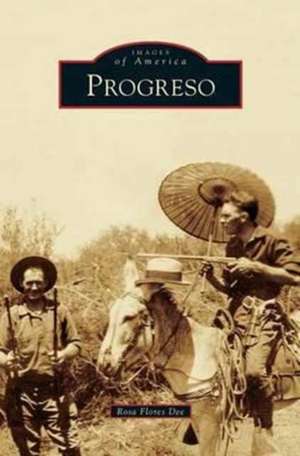
Progreso
Autor Rosa Flores Deeen Limba Engleză Hardback – 15 noi 2010
Preț: 185.98 lei
Puncte Express: 279
Carte tipărită la comandă
Livrare economică 08-22 decembrie
Livrare prin curier în România Termenul estimat este afișat lângă disponibilitate.
Transport gratuit de la 400.00 lei Plată online sau ramburs, în funcție de opțiunile comenzii.
Retur gratuit în 14 zile Comandă securizată și suport în română.
Specificații
ISBN-13: 9781531652449
ISBN-10: 1531652441
Pagini: 130
Dimensiuni: 175 x 250 x 12 mm
Greutate: 0.36 kg
Editura: Arcadia Publishing Library Editions
ISBN-10: 1531652441
Pagini: 130
Dimensiuni: 175 x 250 x 12 mm
Greutate: 0.36 kg
Editura: Arcadia Publishing Library Editions
V-ar putea interesa
-
 FrankfordBrian H HarrisPreț: 137.05 lei
 -
 Mackinac BridgeMike FornesPreț: 185.98 lei
 -
 -21%Preț: 281.40 lei355.84 lei
 -
 White RageCarol AndersonPreț: 161.85 lei
Notă biografică
Author Rosa Flores Dee earned three degrees from the University of Texas at Austin and is a reporter at WDSU, the NBC affiliate in New Orleans, Louisiana. She has gathered nearly 200 remarkable photographs from local families and museums in the Rio Grande
Descriere
Descriere de la o altă ediție sau format:
Spanish for "progress," Progreso is famous for the millions of tourists, known as "Winter Texans," who drive through the town to visit Mexico. Rumor has it that Al Capone did the same thing during Prohibition. Perhaps the first visitor captivated by the Rio Grande was Juan Jose Hinojosa, as he asked the Spanish crown for rights to the land that is now Progreso on July 4, 1776. But it was Florencio Saenz, founder of the iconic Toluca Ranch, who requested a U.S. post office in 1896. Connecting to the Spiderweb Railroad in the 1920s gave the town a short-lived commercial farming boom that attracted prominent investors. In the late 1940s, though, two disastrous freezes killed the citrus industry, and farmers switched to vegetables and cotton. After the Progreso International Bridge was built in 1953, growers gained access to the Mexican market, an advantage that continues to attract people to this small town along the Rio Grande.
Spanish for "progress," Progreso is famous for the millions of tourists, known as "Winter Texans," who drive through the town to visit Mexico. Rumor has it that Al Capone did the same thing during Prohibition. Perhaps the first visitor captivated by the Rio Grande was Juan Jose Hinojosa, as he asked the Spanish crown for rights to the land that is now Progreso on July 4, 1776. But it was Florencio Saenz, founder of the iconic Toluca Ranch, who requested a U.S. post office in 1896. Connecting to the Spiderweb Railroad in the 1920s gave the town a short-lived commercial farming boom that attracted prominent investors. In the late 1940s, though, two disastrous freezes killed the citrus industry, and farmers switched to vegetables and cotton. After the Progreso International Bridge was built in 1953, growers gained access to the Mexican market, an advantage that continues to attract people to this small town along the Rio Grande.