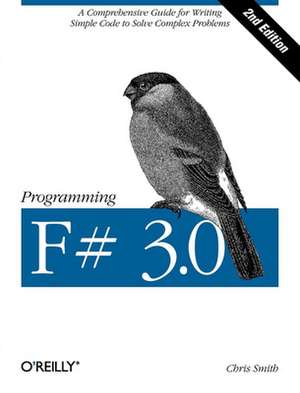
Programming F# 3.0
Autor Chris Smithen Limba Engleză Paperback – 27 noi 2012
Preț: 230.69 lei
Preț vechi: 288.37 lei
-20%
Puncte Express: 346
Carte disponibilă
Livrare economică 13-27 noiembrie
Livrare prin curier în România Termenul estimat este afișat lângă disponibilitate.
Transport gratuit de la 400.00 lei Plată online sau ramburs, în funcție de opțiunile comenzii.
Retur gratuit în 14 zile Comandă securizată și suport în română.
Specificații
ISBN-13: 9781449320294
ISBN-10: 1449320295
Pagini: 471
Ilustrații: Illustrations
Dimensiuni: 181 x 231 x 30 mm
Greutate: 0.78 kg
Ediția:2nd edition
Editura: O'Reilly
ISBN-10: 1449320295
Pagini: 471
Ilustrații: Illustrations
Dimensiuni: 181 x 231 x 30 mm
Greutate: 0.78 kg
Ediția:2nd edition
Editura: O'Reilly
V-ar putea interesa
-
 The Scheme Programming Language, fourth editionR. Kent Dybvig-20%Preț: 417.33 lei521.66 lei
 -
 The Naked Scientist: Everyday Life Under the MicroscopeDr Chris SmithPreț: 198.50 lei
 -
 Remaking ManagementSmith ChrisPreț: 494.84 lei
 -
 Bioinformatics Programming Using PythonMitchell Model-20%Preț: 317.02 lei396.27 lei
 -
 Real World Haskell: Code You Can Believe InBryan O¿sullivan-20%Preț: 270.37 lei337.97 lei
 -
 The Ruby Programming LanguageDavid Flanagan-20%Preț: 256.71 lei320.89 lei
 -
 A Late DinnerPaul Richardson-20%Preț: 100.54 lei125.69 lei
 -
 -15%Preț: 113.13 lei133.54 lei
 -
 CodermetricsJonathan Alexander-20%Preț: 231.66 lei289.58 lei
 -
 Python and AWS CookbookMitch Garnaat-20%Preț: 145.35 lei181.70 lei
 -
 Programming HiveEdward Capriolo-20%Preț: 245.20 lei306.49 lei
 -
 X64 Windows Debugging: Practical FoundationsDmitry Vostokov-20%Preț: 126.63 lei158.29 lei
 -
 Gods, Gloves, Popups, & PoniesChris SmithPreț: 161.19 lei
Cuprins
Preface; Introducing F#; Who This Book Is For; What You Need to Get Going; How the Book Is Organized; ; Conventions Used in This Book; Using Code Examples; Safari® Books Online; I'd Like to Hear from You; Acknowledgments; Multiparadigm Programming; Chapter 1: Introduction to F#; 1.1 Getting to Know F#; 1.2 Visual Studio 11; 1.3 F# Interactive; 1.4 Managing F# Source Files; Chapter 2: Fundamentals; 2.1 Primitive Types; 2.2 Comparison and Equality; 2.3 Functions; 2.4 Core Types; 2.5 Organizing F# Code; Chapter 3: Functional Programming; 3.1 Understanding Functions; 3.2 Pattern Matching; 3.3 Discriminated Unions; 3.4 Records; 3.5 Lazy Evaluation; 3.6 Sequences; 3.7 Queries; Chapter 4: Imperative Programming; 4.1 Understanding Memory in .NET; 4.2 Changing Values; 4.3 Units of Measure; 4.4 Arrays; 4.5 Mutable Collection Types; 4.6 Looping Constructs; 4.7 Exceptions; Chapter 5: Object-Oriented Programming; 5.1 Programming with Objects; 5.2 Understanding System.Object; 5.3 Understanding Classes; 5.4 Methods and Properties; 5.5 Inheritance; Chapter 6: .NET Programming; 6.1 The .NET Platform; 6.2 Interfaces; 6.3 Object Expressions; 6.4 Extension Methods; 6.5 Extending Modules; 6.6 Enumerations; 6.7 Structs; Programming F#; Chapter 7: Applied Functional Programming; 7.1 Active Patterns; 7.2 Using Modules; 7.3 Mastering Lists; 7.4 Tail Recursion; 7.5 Programming with Functions; 7.6 Functional Patterns; 7.7 Functional Data Structures; Chapter 8: Applied Object-Oriented Programming; 8.1 Operators; 8.2 Generic Type Constraints; 8.3 Delegates and Events; 8.4 Events; Chapter 9: Asynchronous and Parallel Programming; 9.1 Working with Threads; 9.2 Asynchronous Programming; 9.3 Asynchronous Workflows; 9.4 Parallel Programming; 9.5 Task Parallel Library; Chapter 10: Scripting; 10.1 F# Script Files; 10.2 Directives; 10.3 F# Script Recipes; Chapter 11: Data Processing; 11.1 Indexing; 11.2 Querying; Extending the F# Language; Chapter 12: Reflection; 12.1 Attributes; 12.2 Type Reflection; 12.3 Dynamic Instantiation; 12.4 Using Reflection; Chapter 13: Computation Expressions; 13.1 Toward Computation Expressions; 13.2 Computation Expression Builders; 13.3 Custom Computation Expression Builders; Chapter 14: Quotations; 14.1 Quotation Basics; 14.2 Generating Quotation Expressions; Chapter 15: Type Providers; 15.1 Typed Data Versus Typed Languages; 15.2 Type Providers; Appendixes; Overview of .NET Libraries; Visualization; Data Processing; Storing Data; F# Interop; .NET Interop; Unmanaged Interop; Colophon;