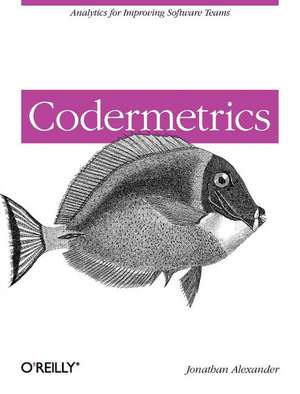
Codermetrics
Autor Jonathan Alexanderen Limba Engleză Paperback – 27 sep 2011
Experienced team builder Jonathan Alexander explains how codermetrics helps teams understand exactly what occurred during a project, and enables each coder to focus on specific improvements. Alexander presents a variety of simple and complex codermetrics, and teaches you how to create your own.
Learn how codermetrics changes long-held assumptions and improves team dynamics Get recommendations for integrating codermetrics into existing processes Ask the right questions to determine the type of data you need to collect Use metrics to measure individual coder skills and a team's effectiveness over time Identify the contributions each coder makes to the team Analyze the response to your software and its features--and verify that you're meeting team and organizational goals Build better teams, using codermetrics to make personnel adjustments and additions
Preț: 231.66 lei
Preț vechi: 289.58 lei
-20%
Puncte Express: 347
Carte tipărită la comandă
Livrare economică 27 noiembrie-11 decembrie
Livrare prin curier în România Termenul estimat este afișat lângă disponibilitate.
Transport gratuit de la 400.00 lei Plată online sau ramburs, în funcție de opțiunile comenzii.
Retur gratuit în 14 zile Comandă securizată și suport în română.
Specificații
ISBN-13: 9781449305154
ISBN-10: 1449305156
Pagini: 260
Ilustrații: illustrations
Dimensiuni: 179 x 235 x 20 mm
Greutate: 0.44 kg
Editura: O'Reilly
ISBN-10: 1449305156
Pagini: 260
Ilustrații: illustrations
Dimensiuni: 179 x 235 x 20 mm
Greutate: 0.44 kg
Editura: O'Reilly
V-ar putea interesa
-
 -18%Preț: 187.26 lei227.31 lei
 -
 Clean Code: A Handbook of Agile Software CraftsmanshipRobert Martin-20%Preț: 365.09 lei456.37 lei
 -
 -20%Preț: 226.70 lei283.37 lei
 -
 Succeeding with AgileMike Cohn-20%Preț: 309.60 lei387.00 lei
 -
 -20%Preț: 280.89 lei351.10 lei
 -
 Team: Getting Things Done with OthersDavid Allen-26%Preț: 101.79 lei137.24 lei
 -
 Lessons Learned in Software Testing - A Context- Driven ApproachBret Pettichord-20%Preț: 258.03 lei322.54 lei
 -
 Code Complete: A practical handbook of software constructionSteve McConnell-20%Preț: 285.38 lei356.73 lei
 -
 How to Measure Anything in Project ManagementDouglas W. HubbardPreț: 357.24 lei
 -
 90 Days to Level Up Your TeamworkAmy C EdmondsonPreț: 123.99 lei
 -
 Coding For Dummies, All New EditionPaul McFedries-20%Preț: 117.52 lei146.90 lei
 -
 The Collective EdgeColin M. Fisher-22%Preț: 95.04 lei122.53 leiRecomandat
 -
 Preț: 133.46 lei
 -
 CodersClive Thompson-47%Preț: 53.51 lei100.38 lei
 -
 -30%Preț: 132.32 lei190.11 lei
 -
 Street CoderSedat Kapanoglu-20%Preț: 277.22 lei346.53 lei
 -
 -20%Preț: 274.89 lei343.61 lei
 -
 Good Code, Bad CodeTom Long-20%Preț: 365.68 lei457.10 lei
 -
 Looks Good To MeAdrienne Braganza-20%Preț: 289.11 lei361.38 lei
 -
 The Culture CodeDaniel Coyle-25%Preț: 64.32 lei86.03 lei
Cuprins
Preface; Organization of This Book; Safari® Books Online; How to Contact Us; Acknowledgments; Concepts; Chapter 1: Introduction; Chapter 2: Measuring What Coders Do; 2.1 The Purpose of Metrics; 2.2 Timeout for an Example: The Magic Triangle (Partially) Debunked; 2.3 Patterns, Anomalies, and Outliers; 2.4 Understanding the Limits; 2.5 Timeout for an Example: An Unexpected Factor in Success; 2.6 Useful Data; 2.7 Timeout for an Example: Metrics and the Skeptic; Chapter 3: The Right Data; 3.1 Questions That Metrics Can Help Answer; 3.2 Timeout for an Example: An MVP Season; 3.3 The Data for Metrics; 3.4 Timeout for An Example: A Tale of Two Teams; Metrics; Chapter 4: Skill Metrics; 4.1 Input Data; 4.2 Offensive Metrics; 4.3 Defensive Metrics; 4.4 Precision Metrics; 4.5 Skill Metric Scorecards; 4.6 Observations on Coder Types; Chapter 5: Response Metrics; 5.1 Input Data; 5.2 Win Metrics; 5.3 Loss Metrics; 5.4 Momentum Metrics; 5.5 Response Metric Scorecards; 5.6 Observations on Project Types; Chapter 6: Value Metrics; 6.1 Input Data; 6.2 Contribution Metrics; 6.3 Rating Metrics; 6.4 Value Metric Scorecards; 6.5 Observations on Team Stages; Processes; Chapter 7: Metrics in Use; 7.1 Getting Started; 7.2 Timeout for an Example: The Seven Percent Rule; 7.3 Utilizing Metrics in the Development Process; 7.4 Timeout for an Example: The Turn-Around; 7.5 Using Metrics in Performance Reviews; 7.6 Taking Metrics Further; 7.7 Timeout for an Example: The Same But Different; Chapter 8: Building Software Teams; 8.1 Goals and Profiles; 8.2 Roles; 8.3 Timeout for an Example: Two All-Nighters; 8.4 Personnel; 8.5 Timeout for an Example: No Such Thing As a Perfect Team; Chapter 9: Conclusion; Codermetrics Quick Reference; Bibliography; Colophon;