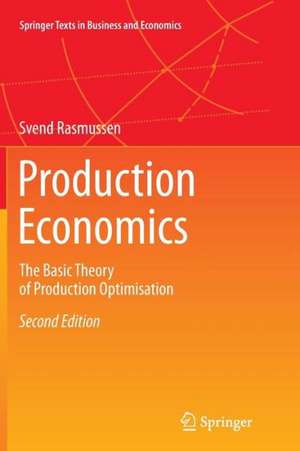
Production Economics: Springer Texts in Business and Economics
Autor Svend Rasmussenen Limba Engleză Paperback – 20 sep 2014
Din seria Springer Texts in Business and Economics
-
 Preț: 282.81 lei
 - 18%
 Preț: 706.61 lei
 -
 Preț: 200.06 lei
 - 18%
 Preț: 680.11 lei
 - 18%
 Preț: 612.19 lei
 - 17%
 Preț: 497.05 lei
 -
 Preț: 600.63 lei
 - 18%
 Preț: 616.63 lei
 - 15%
 Preț: 500.55 lei
 - 20%
 Preț: 750.29 lei
 - 15%
 Preț: 450.86 lei
 - 15%
 Preț: 626.46 lei
 - 19%
 Preț: 400.35 lei
 -
 Preț: 440.29 lei
 -
 Preț: 364.47 lei
 -
 Preț: 377.04 lei
 - 15%
 Preț: 685.78 lei
 - 18%
 Preț: 727.24 lei
 - 15%
 Preț: 642.11 lei
 - 15%
 Preț: 675.89 lei
 -
 Preț: 382.07 lei
 - 15%
 Preț: 512.89 lei
 -
 Preț: 510.27 lei
 -
 Preț: 375.34 lei
 -
 Preț: 376.01 lei
 - 15%
 Preț: 489.95 lei
 - 19%
 Preț: 413.92 lei
 - 15%
 Preț: 517.96 lei
 - 18%
 Preț: 1032.09 lei
 - 15%
 Preț: 528.76 lei
 - 46%
 Preț: 338.64 lei
 -
 Preț: 385.44 lei
 - 45%
 Preț: 321.43 lei
 -
 Preț: 474.51 lei
 - 15%
 Preț: 652.52 lei
 - 24%
 Preț: 651.83 lei
 -
 Preț: 334.68 lei
 - 23%
 Preț: 667.48 lei
 - 15%
 Preț: 576.00 lei
 - 19%
 Preț: 538.82 lei
 - 15%
 Preț: 484.84 lei
 -
 Preț: 385.94 lei
 - 15%
 Preț: 505.29 lei
 -
 Preț: 358.94 lei
Preț: 380.24 lei
Preț vechi: 448.77 lei
-15%
Puncte Express: 570
Carte indisponibilă temporar
Specificații
ISBN-13: 9783642439360
ISBN-10: 3642439365
Pagini: 304
Ilustrații: XII, 292 p.
Dimensiuni: 155 x 235 x 17 mm
Greutate: 0.46 kg
Ediția:2nd edition 2013
Editura: Springer
Colecția Springer Texts in Business and Economics
Seria Springer Texts in Business and Economics
Locul publicării:Berlin, Heidelberg, Germany
ISBN-10: 3642439365
Pagini: 304
Ilustrații: XII, 292 p.
Dimensiuni: 155 x 235 x 17 mm
Greutate: 0.46 kg
Ediția:2nd edition 2013
Editura: Springer
Colecția Springer Texts in Business and Economics
Seria Springer Texts in Business and Economics
Locul publicării:Berlin, Heidelberg, Germany
V-ar putea interesa
-
 Demand Driven PerformanceDebra Smith-15%Preț: 526.37 lei619.26 lei
 -
 Kaizen in Logistics and Supply ChainsEuclides Coimbra-33%Preț: 427.47 lei636.50 lei
 -
 Preț: 239.19 lei
 -
 Lean Retail and WholesalePaul Myerson-30%Preț: 296.58 lei423.18 lei
 -
 Logistics ClustersYossi SheffiPreț: 112.13 lei
 -
 Service ScienceRobin G Qiu-9%Preț: 780.81 lei858.03 lei
 -
 -27%Preț: 904.25 lei1238.69 lei
 -
 -15%Preț: 457.79 lei538.57 lei
 -
 Preț: 106.90 lei
 -
 Linear Models with Correlated DisturbancesPaul Knottnerus-15%Preț: 613.18 lei721.38 lei
 -
 Holistische Innovation: Konzept, Methodik und BeispieleEckehard Moritz-15%Preț: 462.87 lei544.55 lei
 -
 -18%Preț: 856.13 lei1044.07 lei
 -
 Preț: 151.59 lei
 -
 Optimisation of Production Under UncertaintySvend RasmussenPreț: 331.53 lei
 -
 -15%Preț: 451.71 lei531.42 lei
 -
 Preț: 457.65 lei
 -
 -24%Preț: 1777.69 lei2339.06 lei
Public țintă
GraduateCuprins
Preface.- 1 Introduction.- 2 The Production Function.- 3 Optimisation with One Input.- 4 Production and Optimisation with Two or More Inputs.- 5 Costs.- 6 Productivity, Efficiency and Technological Changes.- 7 Input Demand Functions.- 8 Land and Other Inputs.- 9 The Company's Supply Function.- 10 Optimisation of Production Under Restrictions.- 11 Economies of Scale and Size.- 12 The Fixation of the Production Factors.- 13 Decreasing Sales Curve.- 14 Production Over Time.- 15 Risk and Uncertainty.- 16 Economic Rent and the Value of Land.- 17 Production of Multiple Products.- 18 The Linear Programming Model.- 19 Production Planning in the linear Production Model: Linear Programming.- 20 Use of Linear Programming in Practical Production Planning.- 21 Modelling Supply Functions Using Linear Programming.- Appendix.- Index.
Recenzii
From the book reviews:
“The content of the work is divided into 21 chapters. … All the material is carefully developed, with many examples and figures supporting the concepts discussed here. The notions are well motivated and many additional explanations are given, which makes the book very readable.” (Gabriel Eduard Vîlcu, Mathematical Reviews, February, 2015)
“The content of the work is divided into 21 chapters. … All the material is carefully developed, with many examples and figures supporting the concepts discussed here. The notions are well motivated and many additional explanations are given, which makes the book very readable.” (Gabriel Eduard Vîlcu, Mathematical Reviews, February, 2015)
Notă biografică
Svend Rasmussen is a senior associate professor at Institute of Food and Resource Economics, University of Copenhagen where he teaches bachelor, master and PhD students and carries out research within the area of production economics. He has a PhD from The Royal Veterinary and Agricultural University, Copenhagen, and a doctor’s degree in empirical analysis of risk in agriculture. He has been a visiting scholar at University of California, Berkeley, University of New England, Armidale, Australia, and visiting professor at University of Kiel, Germany. He has published internationally within areas like stochastic frontier analysis of productivity changes in agriculture, development of micro-based agricultural sector models, and risk management based on the state-contingent approach to optimizing production under uncertainty.
Textul de pe ultima copertă
This book covers the basic theory of how, what and when firms should produce to maximise profits. Based on the neoclassical theory of the firm presented in most general microeconomic textbooks, it extends the general treatment and focuses on the application of the theory to specific problems that the firm faces when making production decisions to maximise profits. Increasing level of government regulation and the use of specialised and often very expensive equipment in modern production motivates the following focus areas: 1) How to optimise production under restrictions., 2) Treatment of fixed inputs and the process of input fixation, 3) Optimisation of production over time, 4) Linear and Mixed Integer Programming as tools for optimisation in practice. This updated second edition includes a more comprehensive introduction to the theory of decision making under risk and uncertainty as well as a new chapter on how to use linear programming to generate the supply function of the firm.
Caracteristici
Uses a great combination of graphical illustration and mathematical analysis Includes theory of timing of production and timing of replacement of assets Shows how to build and apply linear programming for production planning Features numerous illustrative examples Includes supplementary material: sn.pub/extras