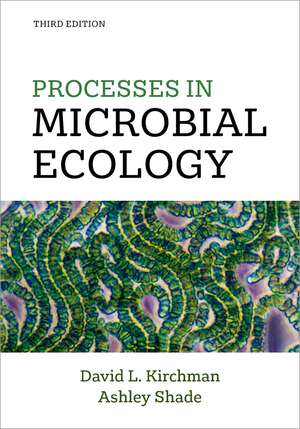
Processes in Microbial Ecology
Autor David L. Kirchman, Ashley Shadeen Limba Engleză Hardback – oct 2026
Preț: 634.75 lei
Preț vechi: 838.28 lei
-24% Nou
Puncte Express: 952
Carte tipărită la comandă
Livrare economică 27 noiembrie-08 decembrie
Livrare prin curier în România Termenul estimat este afișat lângă disponibilitate.
Transport gratuit pentru acest produs Plată online sau ramburs, în funcție de opțiunile comenzii.
Retur gratuit în 14 zile Comandă securizată și suport în română.
Specificații
ISBN-13: 9780197831601
ISBN-10: 0197831605
Pagini: 360
Ilustrații: 248 black and white and colour figures
Dimensiuni: 178 x 21 x 254 mm
Greutate: 0.14 kg
Ediția:3
Editura: Oxford University Press
Colecția OUP USA
Locul publicării:New York, United States
ISBN-10: 0197831605
Pagini: 360
Ilustrații: 248 black and white and colour figures
Dimensiuni: 178 x 21 x 254 mm
Greutate: 0.14 kg
Ediția:3
Editura: Oxford University Press
Colecția OUP USA
Locul publicării:New York, United States
Notă biografică
David Kirchman taught microbial ecology and did research in microbial oceanography at the University of Delaware for 35 years before retiring in 2021. His work took him to the Arctic Ocean and Antarctica and many oceans in between. He is an honorary fellow of the American Association for the Advancement of Science (AAAS), the American Society for Microbiology (ASM), and the Association for Limnology and Oceanography (ASLO). In addition to Processes in Microbial Ecology, he is the author of two other books, Dead Zones: The Loss of Oxygen from Rivers, Lakes, and the Oceans and Microbes: The Unseen Agents of Climate Change.Ashley Shade is Director of Research with the French National Center for Scientific Research at the University of Lyon 1, France. A microbial ecologist with over 20 years of experience, she studies microbial community ecology, biodiversity, and microbial responses to disturbances such as climate change. Dr Shade is also dedicated to teaching-as-research and has developed collaborative learning strategies while at Michigan State University, where she taught undergraduate microbial ecology from 2016 to 2021. In 2024, she received the U.S. Presidential Early Career Award for Scientists and Engineers from President Biden for her work on microbial community resilience.