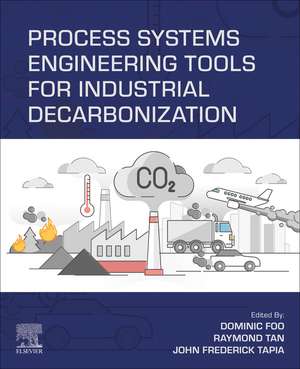
Process Systems Engineering Tools for Industrial Decarbonization
Editat de Dominic Foo, Raymond Tan, John Frederick Tapiaen Limba Engleză Paperback – 26 iun 2026
Beyond technical frameworks, the book addresses the urgent need to manage rising atmospheric CO₂ levels, which now average 420 ppm—well above safe thresholds. It highlights the importance of using decision-making tools to efficiently deploy and systematize available technologies, ensuring the industrial sector contributes effectively to climate mitigation.
- Presents the most recent developments in process systems engineering of technologies for industrial decarbonization
- Introduces methods for decision-making involving low- carbon technologies under uncertainty
- Explores case studies that demonstrate the use of mathematical tools for CCUS systems
- Provides insights into developing strategies for deploying technologies for industrial decarbonization
Preț: 895.63 lei
Preț vechi: 1300.76 lei
-31%
Puncte Express: 1343
Carte tipărită la comandă
Livrare economică 20 noiembrie-04 decembrie
Livrare prin curier în România Termenul estimat este afișat lângă disponibilitate.
Transport gratuit pentru acest produs Plată online sau ramburs, în funcție de opțiunile comenzii.
Retur gratuit în 14 zile Comandă securizată și suport în română.
Specificații
ISBN-13: 9780443217210
ISBN-10: 0443217211
Pagini: 344
Dimensiuni: 191 x 235 mm
Greutate: 0.72 kg
Editura: ELSEVIER SCIENCE
ISBN-10: 0443217211
Pagini: 344
Dimensiuni: 191 x 235 mm
Greutate: 0.72 kg
Editura: ELSEVIER SCIENCE
V-ar putea interesa
-
 The Story of CO2 Is the Story of EverythingPeter BrannenPreț: 215.36 lei
 -
 Carbon CaptureHoward J. HerzogPreț: 92.62 lei
 -
 Carbon RemovalHoward J. HerzogPreț: 100.03 lei
 -
 Design-Tech: Building Science for ArchitectsJason Alread-8%Preț: 496.29 lei539.45 leiRecomandat
 -
 Carbon - A Field Manual for Building DesignersAlan OrganschiPreț: 408.81 lei
 -
 Net-Zero and Low Carbon Solutions for the Energy SectorAmin Mirkouei-23%Preț: 805.40 lei1045.99 lei
 -
 What We Need to Do Now: For a Zero Carbon FutureChris Goodall-19%Preț: 51.56 lei63.70 lei
 -
 Possible: Ways To Net ZeroChris Goodall-18%Preț: 65.89 lei80.03 lei
 -
 Energy Technology 2023Shafiq Alam-24%Preț: 1163.45 lei1530.86 lei
 -
 The Role of Fuels in Transforming Energy End-Use in Buildings and Industrial ProcessesPraveen CheekatamarlaPreț: 211.90 lei
 -
 Energy Technology 2024Chukwunwike Iloeje-18%Preț: 1394.25 lei1700.30 lei
 -
 DecarbonisationThierry LucidarmePreț: 303.36 lei
 -
 -18%Preț: 1345.24 lei1640.54 lei
 -
 Optimization of Chemical ProcessesJosé María Ponce-Ortega-15%Preț: 663.97 lei781.14 lei
 -
 -14%Preț: 926.85 lei1077.73 lei
 -
 Preț: 175.00 lei
 -
 Digital DecarbonizationOliver D. Doleski-19%Preț: 520.22 lei642.26 lei
 -
 -19%Preț: 306.24 lei380.40 lei
 -
 Preț: 381.25 lei
Cuprins
Section 1: Carbon Capture, Utilisation & Storage (CCUS)
1. A Universal Platform for the Development and Evaluation of Various CO₂ Conversion Processes
2. Design of Carbon Capture and Storage Network – A Case Study in Malaysia
3. Evaluation of CO₂ Storage with Process System Engineering Methods – A Case Study in China
4. Selection of Geological Sinks for CO₂ Utilization and Storage under Neutrosophic Environment
5. Bilevel Optimization of CO₂ Networks with P-graph
Section 2: Negative Emission Technologies
6. Multi-footprint Optimization of Integrated Negative Emissions Technology Portfolios
7. Criticality Analysis in Negative Emissions Technologies Network
8. Development of a Rough Set-Based Model for Predicting the Change in Biochar Properties after Field Application
Section 3: Carbon Footprint Reduction
9. Carbon Footprint Reduction for an Infant Milk Production Process
10. Graphical Approach to Multi-Scope Carbon Footprint Reduction
11. Systematic Graphical Framework for Multiple Footprints Reduction for a Multi-Product Plant
Section 4: Energy Efficiency
12. Heat Exchange Network Design and Optimisation
13. Design and Optimization Approach for Sustainable Rankine Cycle Systems
Concluding
14. Research Roadmap for Computing Solutions in Carbon Management
1. A Universal Platform for the Development and Evaluation of Various CO₂ Conversion Processes
2. Design of Carbon Capture and Storage Network – A Case Study in Malaysia
3. Evaluation of CO₂ Storage with Process System Engineering Methods – A Case Study in China
4. Selection of Geological Sinks for CO₂ Utilization and Storage under Neutrosophic Environment
5. Bilevel Optimization of CO₂ Networks with P-graph
Section 2: Negative Emission Technologies
6. Multi-footprint Optimization of Integrated Negative Emissions Technology Portfolios
7. Criticality Analysis in Negative Emissions Technologies Network
8. Development of a Rough Set-Based Model for Predicting the Change in Biochar Properties after Field Application
Section 3: Carbon Footprint Reduction
9. Carbon Footprint Reduction for an Infant Milk Production Process
10. Graphical Approach to Multi-Scope Carbon Footprint Reduction
11. Systematic Graphical Framework for Multiple Footprints Reduction for a Multi-Product Plant
Section 4: Energy Efficiency
12. Heat Exchange Network Design and Optimisation
13. Design and Optimization Approach for Sustainable Rankine Cycle Systems
Concluding
14. Research Roadmap for Computing Solutions in Carbon Management