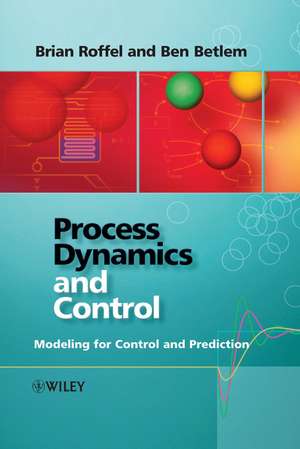
Process Dynamics and Control
Autor Brian Roffel, Ben Betlem, Roffelen Limba Engleză Paperback – 20 dec 2006
MATLAB is used throughout the book as the standard for developing process models of limited complexity. In this way, the reader can study the detailed process dynamics and compare it to the linearized and approximated process dynamics. Models of different process units have been developed and are available as a source for further model development.
An invaluable resource for students of chemical engineering and other related engineering courses. The book will also be of interest to practitioners of process control.
- integrated approach focusing on both physical and empirical modelling
- includes MATLAB simulation examples of all processes and modelling techniques discussed throughout the text
- includes discussion on developing control schemes for entire process plants
- supplementary website featuring figures from the book and further references
The MathWorks, Inc., 3 Apple Drive, Natick, MA. 01760-2098 USA
Preț: 495.96 lei
Preț vechi: 644.10 lei
-23%
Puncte Express: 744
Carte tipărită la comandă
Livrare economică 02-16 decembrie
Livrare prin curier în România Termenul estimat este afișat lângă disponibilitate.
Transport gratuit pentru acest produs Plată online sau ramburs, în funcție de opțiunile comenzii.
Retur gratuit în 14 zile Comandă securizată și suport în română.
Specificații
ISBN-13: 9780470016640
ISBN-10: 0470016647
Pagini: 560
Dimensiuni: 170 x 244 x 30 mm
Greutate: 0.95 kg
Ediția:New.
Editura: Wiley
Locul publicării:Chichester, United Kingdom
ISBN-10: 0470016647
Pagini: 560
Dimensiuni: 170 x 244 x 30 mm
Greutate: 0.95 kg
Ediția:New.
Editura: Wiley
Locul publicării:Chichester, United Kingdom
V-ar putea interesa
-
 Cooperative Chemistry Lab ManualMelanie Cooper-29%Preț: 744.00 lei1045.22 lei
 -
 Handbook of Fluoropolymer Science and TechnologyDennis W Smith-9%Preț: 1175.53 lei1291.80 lei
 -
 Light ScatteringPodzimek-9%Preț: 780.34 lei857.52 lei
 -
 Pharma Supply ChainRees-5%Preț: 742.27 lei781.33 lei
 -
 -27%Preț: 799.37 lei1095.03 lei
 -
 Computer Control in the Process IndustriesBrian Roffel-18%Preț: 1003.26 lei1223.49 lei
 -
 Computer Control in the Process IndustriesBrian RoffelPreț: 344.40 lei
 -
 Biochemistry Applied to Malting and BrewingR. H. HopkinsPreț: 247.36 lei
 -
 Lanthanum: Compounds, Production & ApplicationsRyan J Moore-26%Preț: 1360.33 lei1850.11 lei
 -
 -27%Preț: 1357.07 lei1847.96 lei
 -
 Progress in Physical Chemistry Volume 4Klaus Funke-9%Preț: 3012.02 lei3309.91 lei
 -
 Advanced Practical Process ControlBrian Roffel-18%Preț: 871.82 lei1063.19 lei
Public țintă
Structured and aimed at upper level undergraduate students within chemical engineering and other engineering disciplines looking for a comprehensive introduction to the subject. The book will also be of use to practitioners of process control where the integrated approach of physical and empirical modeling is particularly valuable.Notă biografică
Professor Brian Roffel, University of Twente, The Netherland
Professor Roffel has been teaching researching and managing research in the areas of analysis, simulation, control and optimization of process for over twenty years. In addition twelve years spent working in the chemical process industry gives his theoretical knowledge a practical grounding. Professor Roffel is part of a consortium of eight European Universities working on nonlinear multivariable control. He has also been involved in the practical implementation of advanced control in the chemical industry, in particular multivariable control and optimization.
Dr.Ben H. L. Betlem, University of Twente, The Netherlands.
Professor Roffel has been teaching researching and managing research in the areas of analysis, simulation, control and optimization of process for over twenty years. In addition twelve years spent working in the chemical process industry gives his theoretical knowledge a practical grounding. Professor Roffel is part of a consortium of eight European Universities working on nonlinear multivariable control. He has also been involved in the practical implementation of advanced control in the chemical industry, in particular multivariable control and optimization.
Dr.Ben H. L. Betlem, University of Twente, The Netherlands.
Cuprins
Foreword. Preface.
Acknowledgement.
1 Introduction to Process Modelling.
2 Process Modelling Fundamentals.
3 Extended Analysis of Modelling for Process Operation.
4 Design for Process Modelling and Behavioural Models.
5 Transformation Techniques.
6 Linearization of Model Equations.
7 Operating points.
8 Process Simulation.
9 Frequency Response Analysis.
References.
10 General Process Behaviour
11 Analysis of a Mixing Process.
12 Dynamics of Chemical Stirred Tank Reactors.
13 Dynamic Analysis of Tubular Reactors.
14 Dynamic Analysis of Heat Exchangers.
15 Dynamics of Evaporators and Separators.
16 Dynamic Modelling of Distillation Columns.
17 Dynamic Analysis of Fermentation Reactors
18 Physiological Modeling: Glucose-Insulin Dynamics and Cardiovascular Modelling.
19 Introduction to Black Box Modelling.
20 Basics of Linear Algebra.
21 Data Conditioning.
22 Principal Component Analysis
23 Partial Least Squares
24 Time-series Identification.
25 Discrete Linear and Non-linear State Space Modelling.
26 Model Reduction.
27 Neural Networks.
28 Fuzzy Modelling.
29 Neuro Fuzzy Modelling.
30 Hybrid Models.
31 Introduction to Process Control and Instrumentation.
32 Behaviour of Controlled Processes.
33 Design of Control Schemes.
34 Control of Distillation Columns.
35 Control of a Fluid Catalytic Cracker.
Appendix A. Modelling an Extraction Process.
A1: Problem Analysis.
A2: Dynamic Process Model Development.
A3 Dynamic Process Model Analysis.
A4 Dynamic Process Simulation.
A5: Process Control Simulation.
Hints.
Index.
Acknowledgement.
1 Introduction to Process Modelling.
2 Process Modelling Fundamentals.
3 Extended Analysis of Modelling for Process Operation.
4 Design for Process Modelling and Behavioural Models.
5 Transformation Techniques.
6 Linearization of Model Equations.
7 Operating points.
8 Process Simulation.
9 Frequency Response Analysis.
References.
10 General Process Behaviour
11 Analysis of a Mixing Process.
12 Dynamics of Chemical Stirred Tank Reactors.
13 Dynamic Analysis of Tubular Reactors.
14 Dynamic Analysis of Heat Exchangers.
15 Dynamics of Evaporators and Separators.
16 Dynamic Modelling of Distillation Columns.
17 Dynamic Analysis of Fermentation Reactors
18 Physiological Modeling: Glucose-Insulin Dynamics and Cardiovascular Modelling.
19 Introduction to Black Box Modelling.
20 Basics of Linear Algebra.
21 Data Conditioning.
22 Principal Component Analysis
23 Partial Least Squares
24 Time-series Identification.
25 Discrete Linear and Non-linear State Space Modelling.
26 Model Reduction.
27 Neural Networks.
28 Fuzzy Modelling.
29 Neuro Fuzzy Modelling.
30 Hybrid Models.
31 Introduction to Process Control and Instrumentation.
32 Behaviour of Controlled Processes.
33 Design of Control Schemes.
34 Control of Distillation Columns.
35 Control of a Fluid Catalytic Cracker.
Appendix A. Modelling an Extraction Process.
A1: Problem Analysis.
A2: Dynamic Process Model Development.
A3 Dynamic Process Model Analysis.
A4 Dynamic Process Simulation.
A5: Process Control Simulation.
Hints.
Index.