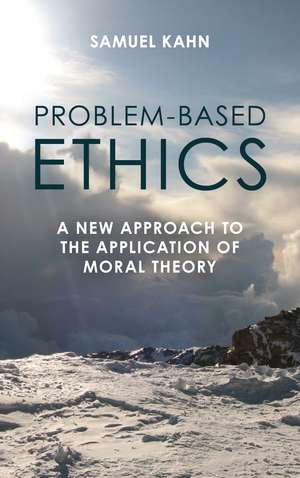
Problem-Based Ethics: A New Approach to the Application of Moral Theory
Autor Samuel Kahnen Limba Engleză Paperback – 20 noi 2024
Stepping back from the intricacies of theory and from heated political debates, Samuel Kahn's synthesis of the study of ethics asks readers to consider even the most contentious of topics like abortion, capital punishment, and euthanasia from their most basic questions. This approach reveals opportunities for more nuanced and evolving ethical positions. It also promotes a culture of civility too often destroyed in politicized debates in scholarly and popular forums.
The book covers standard issues in metaethics, normative ethics, and applied ethics, such as the objectivism/subjectivism debate, the consequentialism/deontology/virtue ethics/ethics of care debate, and the abortion debate. It also introduces more advanced issues such as distributive justice and environmental ethics, as well as less standard questions often of interest to laypeople and students, such as whether crime can be eliminated.
Preț: 259.91 lei
Preț vechi: 327.95 lei
-21%
Puncte Express: 390
Carte tipărită la comandă
Livrare economică 28 noiembrie-12 decembrie
Livrare prin curier în România Termenul estimat este afișat lângă disponibilitate.
Transport gratuit de la 400.00 lei Plată online sau ramburs, în funcție de opțiunile comenzii.
Retur gratuit în 14 zile Comandă securizată și suport în română.
Specificații
ISBN-13: 9781538195307
ISBN-10: 1538195305
Pagini: 346
Dimensiuni: 146 x 226 x 22 mm
Greutate: 0.46 kg
Editura: Bloomsbury Publishing
Colecția Rowman & Littlefield
Locul publicării:New York, United States
ISBN-10: 1538195305
Pagini: 346
Dimensiuni: 146 x 226 x 22 mm
Greutate: 0.46 kg
Editura: Bloomsbury Publishing
Colecția Rowman & Littlefield
Locul publicării:New York, United States
Recenzii
Samuel Kahn's new book is a wonderful introduction to the most important recent developments in normative ethics. It accurately and insightfully explains the results of work that is at the cutting edge of moral philosophy today, but is fully accessible to the beginning student or interested layperson. Presenting these ethical theories as answers to specific practical issues both old (Why should I be moral? Is anything wrong with egoism?) and new (What we should be do about climate change? When, if ever, is it permissible to use performance enhancing drugs in sports?), Kahn allows the reader to see how practical dilemmas give rise to theoretical reflection and how theoretical reflection can guide our practice.
Most philosophy books argue for a set of conclusions. A Problem-Based Ethics lays out the options and offers the arguments but leaves the conclusions to be drawn by the reader. This book deals with the questions most often debated today by thoughtful laypeople, from fundamental issues of moral skepticism to specific controversies about climate change, abortion and social justice. A useful book in many college ethics courses or just for any thoughtful person who cares about right and wrong.
A clearly written introduction to important moral questions of interest to philosophers and non-philosophers. From such abstract issues as the nature of right and wrong to concrete concerns regarding individual rights, criminal punishment, and responses to historic injustice, Kahn covers an impressive array of topics and fairly represents opposing views.
Samuel Kahn's new book covers a wide range of topics, from metaethics and normative ethics to applied ethics. A Problem-Based Ethics is a must-read for teachers, students, and laypeople who want to learn about contemporary ethics.
Samuel Kahn's A Problem-Based Ethics Synthesis addresses recent work on important issues in ethics, including issues in metaethics, normative ethics and various areas of applied ethics. Each freestanding chapter outlines the nature of some important issue in ethics, the major positions that scholars have adopted on that issue, and the arguments in favor of and against those positions. In particular, the chapters on Subjectivity and Objectivity, Rights, Punishment and Normative Ethics are exemplary. Kahn's book is noteworthy in that it is intended to appeal instead to an audience that is minimally philosophically competent (whether or not formally trained in philosophy) but not versed in the specifics of debates among contemporary ethicists, yet interested in finding out what ethicists write about, and learning how they have argued for their respective positions. I highly recommend it to philosophy graduate students, individuals immersed in other areas of philosophy but unfamiliar with ethics, and virtually anyone who is interested in understanding the topography of scholarship in contemporary ethics.
Most philosophy books argue for a set of conclusions. A Problem-Based Ethics lays out the options and offers the arguments but leaves the conclusions to be drawn by the reader. This book deals with the questions most often debated today by thoughtful laypeople, from fundamental issues of moral skepticism to specific controversies about climate change, abortion and social justice. A useful book in many college ethics courses or just for any thoughtful person who cares about right and wrong.
A clearly written introduction to important moral questions of interest to philosophers and non-philosophers. From such abstract issues as the nature of right and wrong to concrete concerns regarding individual rights, criminal punishment, and responses to historic injustice, Kahn covers an impressive array of topics and fairly represents opposing views.
Samuel Kahn's new book covers a wide range of topics, from metaethics and normative ethics to applied ethics. A Problem-Based Ethics is a must-read for teachers, students, and laypeople who want to learn about contemporary ethics.
Samuel Kahn's A Problem-Based Ethics Synthesis addresses recent work on important issues in ethics, including issues in metaethics, normative ethics and various areas of applied ethics. Each freestanding chapter outlines the nature of some important issue in ethics, the major positions that scholars have adopted on that issue, and the arguments in favor of and against those positions. In particular, the chapters on Subjectivity and Objectivity, Rights, Punishment and Normative Ethics are exemplary. Kahn's book is noteworthy in that it is intended to appeal instead to an audience that is minimally philosophically competent (whether or not formally trained in philosophy) but not versed in the specifics of debates among contemporary ethicists, yet interested in finding out what ethicists write about, and learning how they have argued for their respective positions. I highly recommend it to philosophy graduate students, individuals immersed in other areas of philosophy but unfamiliar with ethics, and virtually anyone who is interested in understanding the topography of scholarship in contemporary ethics.