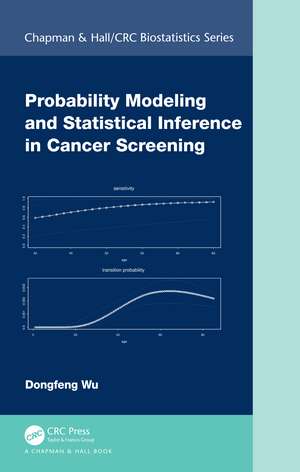
Probability Modeling and Statistical Inference in Cancer Screening: Chapman & Hall/CRC Biostatistics Series
Autor Dongfeng Wuen Limba Engleză Hardback – 6 feb 2024
Features:
- This book gives a concise account of the analysis of cancer screening data, using probability models and statistical methods.
- Real data sets are provided so that cancer researchers and statisticians can apply the methods in the learning process.
- It develops statistical methods in the commonly used disease progressive model.
- It provides solutions to practical problems and introduces open problems.
- It provides a framework for the most recent developments based on the author’s research.
Din seria Chapman & Hall/CRC Biostatistics Series
- 9%
 Preț: 969.20 lei
 - 9%
 Preț: 1388.37 lei
 - 9%
 Preț: 821.61 lei
 -
 Preț: 455.93 lei
 -
 Preț: 509.65 lei
 - 5%
 Preț: 857.81 lei
 -
 Preț: 481.14 lei
 - 15%
 Preț: 436.67 lei
 - 5%
 Preț: 1085.31 lei
 - 18%
 Preț: 892.90 lei
 - 18%
 Preț: 790.65 lei
 - 15%
 Preț: 562.20 lei
 - 18%
 Preț: 924.53 lei
 - 15%
 Preț: 530.47 lei
 - 18%
 Preț: 1264.82 lei
 - 15%
 Preț: 552.07 lei
 - 5%
 Preț: 853.71 lei
 - 5%
 Preț: 467.20 lei
 - 5%
 Preț: 2299.17 lei
 - 15%
 Preț: 540.75 lei
 - 18%
 Preț: 1125.63 lei
 - 5%
 Preț: 877.12 lei
 - 15%
 Preț: 561.84 lei
 - 18%
 Preț: 820.49 lei
 - 18%
 Preț: 930.08 lei
 - 5%
 Preț: 1167.92 lei
 - 15%
 Preț: 530.47 lei
 - 18%
 Preț: 1010.49 lei
 - 5%
 Preț: 1079.79 lei
 - 5%
 Preț: 1315.61 lei
 - 18%
 Preț: 722.07 lei
 -
 Preț: 504.22 lei
 - 18%
 Preț: 1134.64 lei
 - 18%
 Preț: 883.66 lei
 - 18%
 Preț: 1307.12 lei
 - 5%
 Preț: 1074.17 lei
 - 18%
 Preț: 928.48 lei
 -
 Preț: 490.14 lei
 - 18%
 Preț: 925.30 lei
 - 18%
 Preț: 1150.78 lei
 - 8%
 Preț: 435.55 lei
 -
 Preț: 477.59 lei
 - 18%
 Preț: 925.80 lei
 - 5%
 Preț: 1215.32 lei
Preț: 909.26 lei
Preț vechi: 957.11 lei
-5%
Puncte Express: 1364
Carte tipărită la comandă
Livrare economică 05-19 decembrie
Livrare prin curier în România Termenul estimat este afișat lângă disponibilitate.
Transport gratuit pentru acest produs Plată online sau ramburs, în funcție de opțiunile comenzii.
Retur gratuit în 14 zile Comandă securizată și suport în română.
Specificații
ISBN-13: 9781032513300
ISBN-10: 1032513306
Pagini: 286
Ilustrații: 72 Tables, black and white; 56 Halftones, black and white; 56 Illustrations, black and white
Dimensiuni: 156 x 234 x 18 mm
Greutate: 0.45 kg
Ediția:1
Editura: CRC Press
Colecția Chapman and Hall/CRC
Seria Chapman & Hall/CRC Biostatistics Series
ISBN-10: 1032513306
Pagini: 286
Ilustrații: 72 Tables, black and white; 56 Halftones, black and white; 56 Illustrations, black and white
Dimensiuni: 156 x 234 x 18 mm
Greutate: 0.45 kg
Ediția:1
Editura: CRC Press
Colecția Chapman and Hall/CRC
Seria Chapman & Hall/CRC Biostatistics Series
Public țintă
Postgraduate, Professional Practice & Development, Professional Reference, and Professional TrainingCuprins
1. A Brief Review Of Probability and Bayes Inference. 2. Estimating The Three Key Parameters 3. Testing Dependency Of Two Screening Modalities. 4. Lead Time Distribution in Cancer Screening. 5. Evaluating Long Term Outcomes in Screening. 6. Scheduling Screening Exam for Asyptomatic Individuals. 7. Scheduling the Upcoming Exam for Individuals with a Screening History.
Notă biografică
Dongfeng Wu is a full professor in the Department of Bioinformatics and Biostatistics, School of Public Health and Information Sciences, University of Louisville. She got her PhD in Statistics and MS in Computer Science from the University of California, Santa Barbara in 1999. She worked at Mississippi State University and MD Anderson Cancer Center before joining the University of Louisville.
Recenzii
"This book describes statistical methods for analyzing cancer screening data, focusing on cancers that can be modeled as a progressive three-state process: cancer-free, preclinical (asymptomatic) cancer, and clinical (symptomatic) cancer. The goal is to estimate key parameters of interest to cancer screening programs, such as per-screen sensitivity for cancer, time spent cancer-free, sojourn time (i.e., time spent in the preclinical cancer state), lead time (i.e., the difference in cancer diagnosis time with vs. without screening), and the percentage of positive screens that are over-diagnosed. The material is presented for students engaged in a graduate-level statistics course on the topic, with the only prerequisite knowledge being calculus, probability, and introductory statistical inference."
~Li C. Cheung (26 Nov 2024), Journal of the American Statistical Association
~Li C. Cheung (26 Nov 2024), Journal of the American Statistical Association
Descriere
There are many unsolved problems in the study of cancer screening: how to estimate key parameters involved in screening exams, such as screening sensitivity; how to estimate distribution of lead time; how to evaluate the long-term effects of screening, including probability of over diagnosis, true-early-detection and no-early-detection, etc.