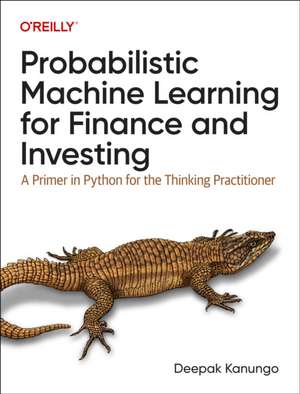
Probabilistic Machine Learning for Finance and Investing: A Primer to the Next Generation of AI with Python
Autor Deepak K. Kanungoen Limba Engleză Paperback – 24 aug 2023
Whether based on academic theories or discovered empirically by humans and machines, all financial models are at the mercy of modeling errors that can be mitigated but not eliminated. Probabilistic ML technologies are based on a simple and intuitive definition of probability and the rigorous calculus of probability theory.
Unlike conventional AI systems, probabilistic machine learning (ML) systems treat errors and uncertainties as features, not bugs. They quantify uncertainty generated from inexact model inputs and outputs as probability distributions, not point estimates. Most importantly, these systems are capable of forewarning us when their inferences and predictions are no longer useful in the current market environment. These ML systems provide realistic support for financial decision-making and risk management in the face of uncertainty and incomplete information.
Probabilistic ML is the next generation ML framework and technology for AI-powered financial and investing systems for many reasons. They are generative ensembles that learn continually from small and noisy financial datasets while seamlessly enabling probabilistic inference, prediction and counterfactual reasoning. By moving away from flawed statistical methodologies (and a restrictive conventional view of probability as a limiting frequency), you can embrace an intuitive view of probability as logic within an axiomatic statistical framework that comprehensively and successfully quantifies uncertainty. This book shows you why and how to make that transition.
Preț: 352.03 lei
Preț vechi: 440.04 lei
-20% Nou
62.28€ • 72.56$ • 54.39£
Carte disponibilă
Livrare economică 29 decembrie 25 - 12 ianuarie 26
Livrare express 12-18 decembrie pentru 72.52 lei
Specificații
ISBN-10: 1492097675
Pagini: 200
Dimensiuni: 178 x 233 x 22 mm
Greutate: 0.43 kg
Editura: O'Reilly
Descriere
Whether based on academic theories or machine learning strategies, all financial models are at the mercy of modeling errors that can be mitigated but not eliminated.
Probabilistic ML technologies are based on a simple and intuitive definition of probability and the rigorous calculus of probability theory. These systems treat uncertainties and errors of financial and investing systems as features, not bugs.
And they quantify uncertainty generated from inexact inputs and outputs as probability distributions, not point estimates. This makes for realistic financial inferences and predictions that are useful for decision-making and risk management.
These systems are capable of warning us when their inferences and predictions are no longer useful in the current market environment. Probabilistic ML is the next generation ML framework and technology for AI-powered financial and investing systems for many reasons.
By moving away from flawed statistical methodologies (and a restrictive conventional view of probability as a limiting frequency), you'll move toward an intuitive view of probability as a mathematically rigorous statistical framework that quantifies uncertainty holistically and successfully. This book shows you how.
Notă biografică
Deepak Kanungo is the founder and CEO of Hedged Capital LLC, an AI-powered, proprietary trading and analytics firm built around probabilistic machine learning technologies. In 2005, long before machine learning was an industry buzzword, Deepak invented a probabilistic machine learning method and software system for managing the risks and returns of project portfolios. It is a unique framework that has been cited by IBM and Accenture, among others. Previously, Deepak was a financial advisor at Morgan Stanley, a Silicon Valley fintech entrepreneur, and a director in the Global Planning Department at Mastercard International. He was educated at Princeton University (astrophysics) and the London School of Economics (finance and information systems).