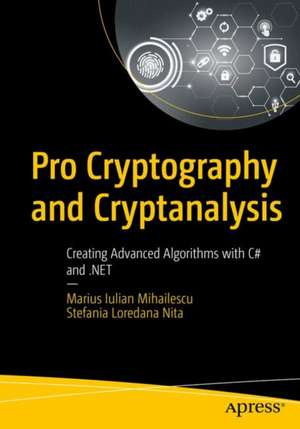
Pro Cryptography and Cryptanalysis
Autor Marius Iulian Mihailescu, Stefania Loredana Nitaen Limba Engleză Paperback – 25 noi 2020
Modern cryptography is the lifeboat of a secure infrastructure. From global economies and governments, to meeting everyday consumer needs, cryptography is ubiquitous, and used in search, design, data, artificial intelligence, and other fields of information technology and communications. Its complexity can lead to misconfiguration, misuse, and misconceptions. For developers who are involved in designing and implementing cryptographic operations in their applications, understanding the implications of the algorithms, modes, and other parameters is vital.
Pro Cryptography and Cryptanalysis is for the reader who has a professional need or personal interest in developing cryptography algorithms and security schemes using C# and .NET. You will learn how to implement advanced cryptographic algorithms (such as Elliptic Curve Cryptography Algorithms, Lattice-based Cryptography, Searchable Encryption, Homomorphic Encryption), and come away with a solid understanding of the internal cryptographic mechanisms, and common ways in which the algorithms are correctly implemented in real practice. With the new era of quantum computing, this book serves as a stepping stone to quantum cryptography, finding useful connections between current cryptographic concepts and quantum related topics.What You Will Learn
- Know when to enlist cryptography, and how it is often misunderstood and misused
- Explore modern cryptography algorithms, practices, and properties
- Design and implement usable, advanced cryptographic methods and mechanisms
- Understand how new features in C# and .NET impact the future of cryptographic algorithms
- Use the cryptographic model, services, and System.Security.Cryptography namespace in .NET
- Modernize your cryptanalyst mindset by exploiting the performance of C# and .NET with its weak cryptographic algorithms
- Practice the basics of public key cryptography, including ECDSA signatures
- Discover how most algorithms can be broken
Who This Book Is For
Information security experts, cryptologists, software engineers, developers, data scientists, and academia who have experience with C#, .NET, as well as IDEs such as Visual Studio, VS Code, or Mono. Because this book is for an intermediate to advanced audience, readers should also possess an understanding of cryptography (symmetric and asymmetric) concepts.
Preț: 500.77 lei
Preț vechi: 625.95 lei
-20%
Puncte Express: 751
Carte tipărită la comandă
Livrare economică 23 noiembrie-07 decembrie
Livrare prin curier în România Termenul estimat este afișat lângă disponibilitate.
Transport gratuit pentru acest produs Plată online sau ramburs, în funcție de opțiunile comenzii.
Retur gratuit în 14 zile Comandă securizată și suport în română.
Specificații
ISBN-13: 9781484263662
ISBN-10: 1484263669
Pagini: 588
Ilustrații: XXX, 556 p. 123 illus.
Dimensiuni: 178 x 254 x 32 mm
Greutate: 1.01 kg
Ediția:First Edition
Editura: Apress
Locul publicării:Berkeley, CA, United States
ISBN-10: 1484263669
Pagini: 588
Ilustrații: XXX, 556 p. 123 illus.
Dimensiuni: 178 x 254 x 32 mm
Greutate: 1.01 kg
Ediția:First Edition
Editura: Apress
Locul publicării:Berkeley, CA, United States
V-ar putea interesa
-
 Cryptography and Secure CommunicationRichard E. Blahut-14%Preț: 710.51 lei826.17 lei
 -
 Practical Concurrent Haskell: With Big Data ApplicationsStefania Loredana Nita-20%Preț: 377.12 lei471.41 lei
 -
 Haskell Quick Syntax ReferenceStefania Loredana Nita-20%Preț: 171.63 lei214.53 lei
 -
 Implementing Effective Code ReviewsGiuliana Carullo-20%Preț: 320.12 lei400.16 lei
 -
 Pairing-Based Cryptography -- Pairing 2013Zhenfu Cao-20%Preț: 333.13 lei416.42 lei
 -
 Smart Card Research and Advanced ApplicationsAurélien Francillon-20%Preț: 334.19 lei417.74 lei
 -
 Security and Cryptography for NetworksMichel Abdalla-20%Preț: 352.71 lei440.89 lei
 -
 Cryptology and Network SecurityDimitris Gritzalis-20%Preț: 328.29 lei410.37 lei
 -
 Provable SecuritySherman S. M. Chow-20%Preț: 338.85 lei423.56 lei
 -
 Constructive Side-Channel Analysis and Secure DesignStefan Mangard-20%Preț: 321.36 lei401.70 lei
 -
 Cryptology and Network SecurityMichael Reiter-20%Preț: 333.31 lei416.64 lei
 -
 Cryptography and CodingJens Groth-20%Preț: 324.22 lei405.27 lei
 -
 Preț: 376.75 lei
 -
 Preț: 383.03 lei
 -
 Preț: 376.75 lei
 -
 Preț: 383.23 lei
 -
 Preț: 374.91 lei
 -
 Preț: 377.68 lei
 -
 Preț: 381.55 lei
 -
 Public-Key Cryptography -- PKC 2013Kaoru Kurosawa-20%Preț: 347.39 lei434.23 lei
 -
 Theory of CryptographyAmit Sahai-20%Preț: 358.25 lei447.82 lei
 -
 Cryptography and CodingMartijn Stam-20%Preț: 339.28 lei424.11 lei
 -
 Public-Key Cryptography -- PKC 2014Hugo Krawczyk-20%Preț: 342.62 lei428.28 lei
 -
 -20%Preț: 326.72 lei408.39 lei
 -
 Advances in Cryptology - EUROCRYPT 2014Phong Q. Nguyen-20%Preț: 357.82 lei447.27 lei
 -
 Advances in Cryptology -- CRYPTO 2014Juan A. Garay-20%Preț: 350.60 lei438.25 lei
 -
 -20%Preț: 339.15 lei423.94 lei
 -
 Advances in Cryptology -- ASIACRYPT 2014Palash Sarkar-20%Preț: 348.44 lei435.55 lei
 -
 Advances in Cryptology - EUROCRYPT 2015Elisabeth Oswald-20%Preț: 363.58 lei454.48 lei
Cuprins
Part I – Foundational Topics.- Chapter 1: Cryptography Fundamentals.- Chapter 2: Mathematical Background and Its Applicability.- Chapter 3: Large Integer Arithmetic.- Chapter 4: Floating-Point Arithmetic.- Chapter 5: What's New in C# 8.0.- Chapter 6: Secure Coding Guidelines.- Chapter 7: .NET Cryptography Services.- Chapter 8: Overview of System.Cryptography Namespace.- Chapter 9: Cryptography Libraries in C# and .NET.- Part II: Cryptography.- Chapter 10: Elliptic-Curve Cryptography.- Chapter 11: Lattice-based Cryptography.- Chapter 12: Searchable Encryption.- Chapter 13: Homomorphic Encryption.- Chapter 14: (Ring) Learning with Errors Cryptography.- Chapter 15: Chaos-based Cryptography.- Chapter 16: Big Data Cryptography.- Chapter 17: Cloud Computing Cryptography.- Part III: Pro Cryptanalysis.- Chapter 18: Getting Started with Cryptanalysis.- Chapter 19: Cryptanalysis Attacks and Techniques.- Chapter 20: Linear and Differential Cryptanalysis.- Chapter 21: Integral Cryptanalysis.- Chapter 22: Attacks.- Chapter 23: Text Characterization.- Chapter 24: Implementation and Practical Approach of Cryptanalysis Methods.
Notă biografică
Stefania Loredana Nita, Ph.D., is Senior Lecturer at the Faculty of Information Systems and Cybernetic Security of "Ferdinand I" Military Technical Academy, Bucharest, Romania, where she teaches courses on Formal Languages and Translators, Management and Development of Database Applications, and Data Structures and Algorithms. Also, she is Software Developer at the Institute for Computers, Bucharest, Romania. She received her Ph.D. degree in 2021, and her Ph.D. thesis is on advanced cryptographic schemes using searchable encryption and homomorphic encryption. She has worked for more than two years as Assistant Lecturer at the University of Bucharest where she taught courses on subjects such as Advanced Programming Techniques, Simulation Methods, and Operating Systems. She has authored and co-authored more than 32 work papers published in international conferences proceedings and journals and 7 books on functional programming and cryptography. She holds an M.Sc. in SoftwareEngineering and two B.Sc. in Computer Science and Mathematics.
Marius Iulian Mihailescu, Ph.D., is Associate Professor at the Faculty of Engineering and Informatics of "Spiru Haret" University, Bucharest, Romania, and Software IT Project Manager at the Institute for Computers, Bucharest, Romania. He is also CEO of Dapyx Solution Ltd., a company based in Bucharest, Romania, where he is involved in information security and cryptography-related research projects. He authored and co-authored more than 40 articles in conference proceedings and journals, and 8 books. For more than six years he has served as Lecturer at well-known national and international universities (the University of Bucharest, "Titu Maiorescu" University of Bucharest, and Kadir Has University in Istanbul, Turkey). He served for three years as IT Officer at Royal Caribbean Cruises Ltd. where he dealt with IT infrastructure, data security, and satellite communications systems. He received his Ph.D. degree in 2014, and his thesis was on applied cryptography over biometrics data.
Textul de pe ultima copertă
Utilize this comprehensive, yet practical, overview of modern cryptography and cryptanalysis to improve performance. Learn by example with source code in C# and .NET, and come away with an understanding of public key encryption systems and challenging cryptography mechanisms such as lattice-based cryptography.
What You Will Learn:
Modern cryptography is the lifeboat of a secure infrastructure. From global economies and governments, to meeting everyday consumer needs, cryptography is ubiquitous, and used in search, design, data, artificial intelligence, and other fields of information technology and communications. Its complexity can lead to misconfiguration, misuse, and misconceptions. For developers who are involved in designing and implementing cryptographic operations in their applications, understanding the implications of the algorithms, modes, and other parameters is vital.
Pro Cryptography and Cryptanalysis is for the reader who has a professional need or personal interest in developing cryptography algorithms and security schemes using C# and .NET. You will learn how to implement advanced cryptographic algorithms (such as Elliptic Curve Cryptography Algorithms, Lattice-based Cryptography, Searchable Encryption, Homomorphic Encryption), and come away with a solid understanding of the internal cryptographic mechanisms, and common ways in which the algorithms are correctly implemented in real practice. With the new era of quantum computing, this book serves as a stepping stone to quantum cryptography, finding useful connections between current cryptographic concepts and quantum related topics.What You Will Learn:
- Know when to enlist cryptography, and how it is often misunderstood and misused
- Explore modern cryptography algorithms, practices, and properties
- Design and implement usable, advanced cryptographic methods and mechanisms
- Understand how new features in C# and .NET impact the future of cryptographic algorithms
- Use the cryptographic model, services, and System.Security.Cryptography namespace in .NET
- Modernize your cryptanalyst mindset by exploiting the performance of C# and .NET with its weak cryptographic algorithms
- Practice the basics of public key cryptography, including ECDSA signatures
- Discover how most algorithms can be broken
Marius Iulian Mihailescu, PhD is CEO of Dapyx Solution Ltd., a company focused on security- and cryptography-related research. He has authored and co-authored more than 50 articles,journal contributions, and conference proceedings, and three books related to security and cryptography, including the International Journal of Applied Cryptography. He lectures at well-known national and international universities, teaching courses on programming, cryptography, information security, and other technical topics. He holds a PhD (thesis on applied cryptography over biometrics data) and two MSc in information security and software engineering.
Stefania Loredana Nita, PhD is a software developer and researcher at the Institute for Computers. Prior to that she was an assistant lecturer at the University of Bucharest, where she taught courses on advanced programming techniques, simulation methods, and operating systems. She has authored and co-authored more than 15 papers and journals, most recently Advanced Cryptography and Its Future: Searchable and Homomorphic Encryption, as well as two books. She holds a PhD (thesis on advanced cryptographic schemes using searchable encryption and homomorphic encryption), an MSc in software engineering and two BSc in computer science and mathematics.
Stefania Loredana Nita, PhD is a software developer and researcher at the Institute for Computers. Prior to that she was an assistant lecturer at the University of Bucharest, where she taught courses on advanced programming techniques, simulation methods, and operating systems. She has authored and co-authored more than 15 papers and journals, most recently Advanced Cryptography and Its Future: Searchable and Homomorphic Encryption, as well as two books. She holds a PhD (thesis on advanced cryptographic schemes using searchable encryption and homomorphic encryption), an MSc in software engineering and two BSc in computer science and mathematics.
Caracteristici
Includes practical examples of cryptographic mechanisms using C# and .NET Teaches advanced concepts using programmer-friendly language Contrasts “good” and “bad” crypto based on time processing, time execution, and reliability