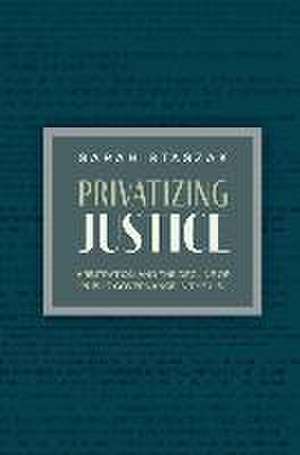
Privatizing Justice: Arbitration and the Decline of Public Governance in the U.S.: Studies in Postwar American Political Development
Autor Sarah Staszaken Limba Engleză Paperback – 29 aug 2024
Din seria Studies in Postwar American Political Development
- 30%
 Preț: 434.04 lei
 - 23%
 Preț: 153.71 lei
 - 25%
 Preț: 143.67 lei
 - 16%
 Preț: 190.10 lei
 - 14%
 Preț: 183.45 lei
 - 25%
 Preț: 148.60 lei
 - 24%
 Preț: 200.37 lei
 - 20%
 Preț: 303.36 lei
 - 16%
 Preț: 209.66 lei
 - 20%
 Preț: 327.35 lei
 -
 Preț: 179.72 lei
 - 16%
 Preț: 218.46 lei
 - 11%
 Preț: 374.78 lei
 - 24%
 Preț: 211.13 lei
 - 16%
 Preț: 144.36 lei
 - 19%
 Preț: 352.66 lei
 - 20%
 Preț: 160.32 lei
 - 12%
 Preț: 260.25 lei
 -
 Preț: 294.49 lei
 -
 Preț: 245.79 lei
 - 28%
 Preț: 427.82 lei
 - 18%
 Preț: 302.03 lei
 - 32%
 Preț: 367.42 lei
 - 20%
 Preț: 258.80 lei
 - 35%
 Preț: 525.10 lei
 - 23%
 Preț: 217.97 lei
 - 19%
 Preț: 321.56 lei
 - 15%
 Preț: 278.40 lei
 - 28%
 Preț: 452.82 lei
 - 20%
 Preț: 251.97 lei
 -
 Preț: 153.61 lei
 - 11%
 Preț: 359.81 lei
Preț: 147.23 lei
Preț vechi: 173.64 lei
-15%
Puncte Express: 221
Carte disponibilă
Livrare economică 12-17 noiembrie
Livrare express 23-29 octombrie pentru 55.90 lei
Livrare prin curier în România Termenul estimat este afișat lângă disponibilitate.
Transport gratuit de la 400.00 lei Plată online sau ramburs, în funcție de opțiunile comenzii.
Retur gratuit în 14 zile Comandă securizată și suport în română.
Specificații
ISBN-13: 9780197771730
ISBN-10: 0197771734
Pagini: 304
Dimensiuni: 157 x 241 x 23 mm
Greutate: 0.45 kg
Editura: Oxford University Press
Colecția OUP USA
Seria Studies in Postwar American Political Development
Locul publicării:New York, United States
ISBN-10: 0197771734
Pagini: 304
Dimensiuni: 157 x 241 x 23 mm
Greutate: 0.45 kg
Editura: Oxford University Press
Colecția OUP USA
Seria Studies in Postwar American Political Development
Locul publicării:New York, United States
Recenzii
Privatizing Justice offers a compelling account of the emergence one of the most important, and overlooked, features of the American political economy. This brilliant book is essential reading not only for students of American capitalism, but also for social scientists interested in the politics of institutional change.
Privatizing Justice is an impressively thorough and beautifully written investigation into the evolution of arbitration from a voluntary, efficient dispute resolution method to a mandatory tool often favoring corporations over individuals. This book is a must-read for anyone who wishes to truly understand how private corporations have come to be so powerful in modern society.
Staszak's sweeping and illuminating account of how the modern private arbitration system came to dominate dispute resolution in the United States should be required reading for scholars of the modern American state, rights, and our legal system, regardless of discipline. She joins rich history with a bracing argument to pose important questions for policymakers, judges, and scholars alike.
Privatizing Justice is an impressively thorough and beautifully written investigation into the evolution of arbitration from a voluntary, efficient dispute resolution method to a mandatory tool often favoring corporations over individuals. This book is a must-read for anyone who wishes to truly understand how private corporations have come to be so powerful in modern society.
Staszak's sweeping and illuminating account of how the modern private arbitration system came to dominate dispute resolution in the United States should be required reading for scholars of the modern American state, rights, and our legal system, regardless of discipline. She joins rich history with a bracing argument to pose important questions for policymakers, judges, and scholars alike.
Notă biografică
Sarah Staszak received her PhD in Politics from Brandeis University and is a Research Scholar in the Princeton School of Public and International Affairs. Her research and teaching interests include public law, policy, and American political development. She is the author of No Day in Court: Access to Justice and the Politics of Judicial Retrenchment (Oxford University Press, 2015; Co-Winner: 2017 J. David Greenstone Book Award for best book in politics and history awarded by the American Political Science Association). Sarah was previously a Robert Wood Johnson Scholar in Health Policy Research at Harvard University and a Brookings Institution Research Fellow in Governance Studies.