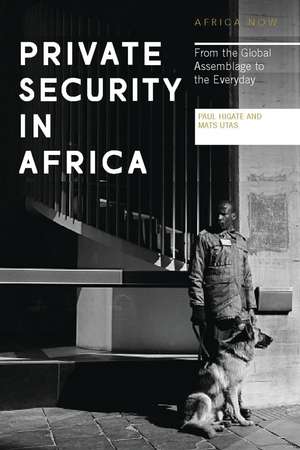
Private Security in Africa: From the Global Assemblage to the Everyday: Africa Now
Editat de Doctor Paul Higate, Mats Utasen Limba Engleză Paperback – 15 iun 2017
Drawing on a wide range of disciplinary approaches, and encompassing anthropology, sociology and political science, Private Security in Africa offers unique insight into the lives and experiences of security providers and those affected by them, as well as into the fragile state context which has allowed them to thrive. Featuring original empirical research and case studies ranging from private policing in South Africa to the recruitment of Sierra Leoneans for private security work in Iraq, the book considers the full implications of PSPs for security and the state, not only for Africa but for the world as a whole.
Din seria Africa Now
- 26%
 Preț: 165.43 lei
 - 25%
 Preț: 187.65 lei
 - 26%
 Preț: 171.21 lei
 - 25%
 Preț: 526.89 lei
 - 25%
 Preț: 187.22 lei
 - 23%
 Preț: 158.84 lei
 - 21%
 Preț: 181.15 lei
 - 18%
 Preț: 183.69 lei
 - 25%
 Preț: 193.42 lei
 - 20%
 Preț: 172.83 lei
 - 23%
 Preț: 153.06 lei
 - 21%
 Preț: 191.80 lei
 -
 Preț: 186.01 lei
 - 17%
 Preț: 206.05 lei
 - 20%
 Preț: 192.20 lei
 - 28%
 Preț: 451.12 lei
 - 29%
 Preț: 154.27 lei
 - 17%
 Preț: 206.78 lei
 - 17%
 Preț: 186.72 lei
 - 17%
 Preț: 186.42 lei
 - 26%
 Preț: 190.99 lei
 - 18%
 Preț: 184.79 lei
 - 18%
 Preț: 182.95 lei
 - 21%
 Preț: 190.56 lei
 - 17%
 Preț: 185.73 lei
 - 18%
 Preț: 205.66 lei
 - 15%
 Preț: 160.06 lei
 - 17%
 Preț: 205.58 lei
 - 18%
 Preț: 202.92 lei
Preț: 190.56 lei
Preț vechi: 257.41 lei
-26%
Puncte Express: 286
Carte disponibilă
Livrare economică 19 mai-02 iunie
Specificații
ISBN-13: 9781786990259
ISBN-10: 1786990253
Pagini: 256
Ilustrații: Tables, black and white 3
Dimensiuni: 156 x 232 x 16 mm
Greutate: 0.3 kg
Editura: Bloomsbury Publishing
Colecția Zed Books
Seria Africa Now
Locul publicării:London, United Kingdom
ISBN-10: 1786990253
Pagini: 256
Ilustrații: Tables, black and white 3
Dimensiuni: 156 x 232 x 16 mm
Greutate: 0.3 kg
Editura: Bloomsbury Publishing
Colecția Zed Books
Seria Africa Now
Locul publicării:London, United Kingdom
V-ar putea interesa
-
 The Oxford Handbook of American Public Opinion and the MediaRobert Y. Shapiro-10%Preț: 288.53 lei319.38 lei
 -
 -28%Preț: 767.05 lei1063.78 lei
 -
 -8%Preț: 559.75 lei606.34 lei
 -
 Preț: 213.73 lei
 -
 Preț: 113.19 lei
 -
 Preț: 84.23 lei
 -
 -17%Preț: 117.46 lei141.77 lei
 -
 Hacker, Hoaxer, Whistleblower, SpyGabriella ColemanPreț: 160.83 lei
 -
 Nothing to Lose But Our FearFiona Jeffries-12%Preț: 123.34 lei140.81 lei
 -
 -20%Preț: 135.30 lei168.85 lei
 -
 The Pinochet Affair: State Terrorism and Global JusticeRoger Burbach-18%Preț: 242.38 lei293.88 lei
 -
 -28%Preț: 206.19 lei285.16 lei
 -
 Cruel BritanniaIan CobainPreț: 69.18 lei
Cuprins
Introduction - Paul Higate
1. Golden Assemblages: Security and Development in Tanzania's Gold Mines - Rita Abrahamsen and Michael Williams
2. Failed, Fake or Weak State: The Role of Private Security in Somalia - William Reno
3. Private Security Beyond the Private Sector: Community Policing and Secret Societies in Sierra Leone - Peter Albrecht
4. The Underbelly of Global Security: Sierra Leoneans in Iraq - Maya Mynster Christensen
5. Who do you Call? Private Security Policing in Durban, South Africa - Tessa Diphoorn
6. Security Sector Reform as Trojan Horse? New Security Assemblages of Privatised Military Training in Liberia - Marcus Mohlin
7. Political Becoming and Non-State Emergence in Kenya's Security Sector: Mungiki as Security Operator - Jacob Rasmussen
8. Parapluies Politiques: The Everyday Politics of Private Security in the Democratic Republic of the Congo - Peer Schouten
Epilogue: African Assemblages of private security - Mats Utas
1. Golden Assemblages: Security and Development in Tanzania's Gold Mines - Rita Abrahamsen and Michael Williams
2. Failed, Fake or Weak State: The Role of Private Security in Somalia - William Reno
3. Private Security Beyond the Private Sector: Community Policing and Secret Societies in Sierra Leone - Peter Albrecht
4. The Underbelly of Global Security: Sierra Leoneans in Iraq - Maya Mynster Christensen
5. Who do you Call? Private Security Policing in Durban, South Africa - Tessa Diphoorn
6. Security Sector Reform as Trojan Horse? New Security Assemblages of Privatised Military Training in Liberia - Marcus Mohlin
7. Political Becoming and Non-State Emergence in Kenya's Security Sector: Mungiki as Security Operator - Jacob Rasmussen
8. Parapluies Politiques: The Everyday Politics of Private Security in the Democratic Republic of the Congo - Peer Schouten
Epilogue: African Assemblages of private security - Mats Utas
Recenzii
A key strength of the book is its use of empirical findings for a new theorization of how we are to understand private security in the African continent . I would recommend this book to students, academics interested in security studies, including policy analysts in both public and private spaces.'
The authors provide a snapshot into complex and compelling scenarios of security governance in spaces where plurality is the norm . an interesting and compelling read.'
The contributions in the book undoubtedly add a high level of high quality empirical evidence to understanding Africa's security.
Offers a view of private security in Africa "from below". Its chapters provide compelling accounts for readers interested in the everyday assemblages of African security.
Bringing together some of the best scholars on private security in sub-Saharan Africa, this collection offers a detailed reminder that the local and global are invariably intertwined and that commercial efforts to achieve security may blend in surprising ways companies, development and human rights NGOs, local communities and state actors.
An essential contribution to the scholarship on security assemblages and private security in Africa. It should be compulsory reading for any academic and policy expert concerned with the state of African security today.
Through the adoption of an ethnographic lens, this volume provides a compelling account of everyday private security practices and the kaleidoscopic configurations within which they blend and assemble.
Higate and Utas have produced a cohesive collection of insightful essays on the politics of private security in Africa (and beyond). Theoretically sophisticated and empirically informed, this impressive volume will be the baseline for future scholarship for years to come.
An important addition to understanding the complex nexus between private and state security provision in fragile states. This is a useful and welcome book that adds new interpretations and insight into the increasingly important roles performed by multiple security actors.
The global trend of privatising security has received little systematic attention. This highly recommended book starts to close this gap and raises important questions about what this means for the role of the state in this age of uncertainty.
Ranging from secret societies in Sierra Leone to private security companies in South Africa, this important book provides a major contribution to the theory and practical understanding of the everyday experience of private security across Africa.
The authors provide a snapshot into complex and compelling scenarios of security governance in spaces where plurality is the norm . an interesting and compelling read.'
The contributions in the book undoubtedly add a high level of high quality empirical evidence to understanding Africa's security.
Offers a view of private security in Africa "from below". Its chapters provide compelling accounts for readers interested in the everyday assemblages of African security.
Bringing together some of the best scholars on private security in sub-Saharan Africa, this collection offers a detailed reminder that the local and global are invariably intertwined and that commercial efforts to achieve security may blend in surprising ways companies, development and human rights NGOs, local communities and state actors.
An essential contribution to the scholarship on security assemblages and private security in Africa. It should be compulsory reading for any academic and policy expert concerned with the state of African security today.
Through the adoption of an ethnographic lens, this volume provides a compelling account of everyday private security practices and the kaleidoscopic configurations within which they blend and assemble.
Higate and Utas have produced a cohesive collection of insightful essays on the politics of private security in Africa (and beyond). Theoretically sophisticated and empirically informed, this impressive volume will be the baseline for future scholarship for years to come.
An important addition to understanding the complex nexus between private and state security provision in fragile states. This is a useful and welcome book that adds new interpretations and insight into the increasingly important roles performed by multiple security actors.
The global trend of privatising security has received little systematic attention. This highly recommended book starts to close this gap and raises important questions about what this means for the role of the state in this age of uncertainty.
Ranging from secret societies in Sierra Leone to private security companies in South Africa, this important book provides a major contribution to the theory and practical understanding of the everyday experience of private security across Africa.