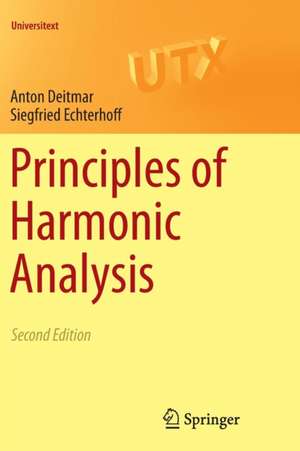
Principles of Harmonic Analysis: Universitext
Autor Anton Deitmar, Siegfried Echterhoffen Limba Engleză Paperback – 17 sep 2016
Din seria Universitext
- 13%
 Preț: 398.41 lei
 - 15%
 Preț: 576.20 lei
 - 15%
 Preț: 402.83 lei
 -
 Preț: 404.03 lei
 -
 Preț: 433.98 lei
 - 15%
 Preț: 522.85 lei
 -
 Preț: 406.96 lei
 -
 Preț: 415.00 lei
 - 13%
 Preț: 395.54 lei
 -
 Preț: 376.18 lei
 -
 Preț: 508.41 lei
 -
 Preț: 469.31 lei
 - 15%
 Preț: 511.22 lei
 -
 Preț: 458.21 lei
 - 15%
 Preț: 555.16 lei
 - 19%
 Preț: 469.00 lei
 -
 Preț: 490.45 lei
 - 15%
 Preț: 603.75 lei
 - 15%
 Preț: 459.73 lei
 -
 Preț: 491.89 lei
 -
 Preț: 383.79 lei
 - 20%
 Preț: 319.60 lei
 - 15%
 Preț: 620.17 lei
 - 15%
 Preț: 504.56 lei
 -
 Preț: 482.65 lei
 - 15%
 Preț: 609.03 lei
 - 15%
 Preț: 534.10 lei
 - 15%
 Preț: 529.04 lei
 - 15%
 Preț: 544.31 lei
 -
 Preț: 383.03 lei
 - 15%
 Preț: 477.44 lei
 -
 Preț: 402.52 lei
 - 15%
 Preț: 525.92 lei
 - 15%
 Preț: 616.59 lei
 - 20%
 Preț: 533.29 lei
 - 15%
 Preț: 605.99 lei
 -
 Preț: 401.63 lei
 -
 Preț: 476.65 lei
 -
 Preț: 442.80 lei
 - 15%
 Preț: 529.50 lei
 - 15%
 Preț: 476.18 lei
 - 15%
 Preț: 599.27 lei
 - 15%
 Preț: 656.08 lei
 -
 Preț: 494.60 lei
 -
 Preț: 454.23 lei
 - 15%
 Preț: 453.29 lei
 -
 Preț: 395.89 lei
 -
 Preț: 404.56 lei
 -
 Preț: 392.51 lei
 -
 Preț: 411.21 lei
Preț: 494.11 lei
Puncte Express: 741
Carte tipărită la comandă
Livrare economică 04-18 decembrie
Livrare prin curier în România Termenul estimat este afișat lângă disponibilitate.
Transport gratuit pentru acest produs Plată online sau ramburs, în funcție de opțiunile comenzii.
Retur gratuit în 14 zile Comandă securizată și suport în română.
Specificații
ISBN-13: 9783319379043
ISBN-10: 3319379046
Pagini: 348
Ilustrații: XIII, 332 p. 11 illus.
Dimensiuni: 155 x 235 x 19 mm
Greutate: 0.53 kg
Ediția:Second Edition 2014
Editura: Springer
Colecția Universitext
Seria Universitext
Locul publicării:Cham, Switzerland
ISBN-10: 3319379046
Pagini: 348
Ilustrații: XIII, 332 p. 11 illus.
Dimensiuni: 155 x 235 x 19 mm
Greutate: 0.53 kg
Ediția:Second Edition 2014
Editura: Springer
Colecția Universitext
Seria Universitext
Locul publicării:Cham, Switzerland
V-ar putea interesa
-
 Schaum's Outline of Complex Variables, 2edMurray Spiegel-13%Preț: 214.88 lei248.34 lei
 -
 Riemann SurfacesSimon Donaldson-33%Preț: 820.82 lei1219.67 lei
 -
 Quasiconformal Maps and Teichmüller TheoryAlastair Fletcher-30%Preț: 817.83 lei1170.42 lei
 -
 Riemann SurfacesSimon Donaldson-21%Preț: 373.46 lei473.87 lei
 -
 Problems and Solutions for Complex AnalysisRami Shakarchi-15%Preț: 471.95 lei555.23 lei
 -
 Complex AnalysisElias M. Stein-16%Preț: 656.05 lei781.02 lei
 -
 Harmonic Analysis of Operators on Hilbert SpaceBéla Sz Nagy-15%Preț: 539.82 lei635.08 lei
 -
 -18%Preț: 773.31 lei943.07 lei
 -
 Classical and Stochastic Laplacian GrowthBjörn GustafssonPreț: 411.26 lei
 -
 Lectures on Several Complex VariablesPaul M. Gauthier-15%Preț: 542.88 lei638.68 lei
 -
 Preț: 392.46 lei
 -
 -18%Preț: 766.12 lei934.30 lei
 -
 Harmonic Analysis on Exponential Solvable Lie GroupsHidenori Fujiwara-15%Preț: 679.69 lei799.63 lei
 -
 Preț: 404.88 lei
Cuprins
1. Haar Integration.- 2. Banach Algebras.- 3. Duality for Abelian Groups.- 4. The Structure of LCA-Groups.- 5. Operators on Hilbert Spaces.- 6. Representations.- 7. Compact Groups.- 8. Direct Integrals.- 9. The Selberg Trace Formula.- 10. The Heisenberg Group.- 11. SL2(R).- 12. Wavelets.- 13. p-adic numbers and adeles.- A. Topology.- B. Measure and Integration.- C: Functional Analysis.
Notă biografică
Anton Deitmar is a professor of Mathematics at the University of Tübingen, Germany. Siegfried Echterhoff is a professor of Mathematics at the University of Münster, Germany.
Textul de pe ultima copertă
This book offers a complete and streamlined treatment of the central principles of abelian harmonic analysis: Pontryagin duality, the Plancherel theorem and the Poisson summation formula, as well as their respective generalizations to non-abelian groups, including the Selberg trace formula. The principles are then applied to spectral analysis of Heisenberg manifolds and Riemann surfaces. This new edition contains a new chapter on p-adic and adelic groups, as well as a complementary section on direct and projective limits. Many of the supporting proofs have been revised and refined. The book is an excellent resource for graduate students who wish to learn and understand harmonic analysis and for researchers seeking to apply it.
Caracteristici
Second edition is completely revised and updated, including many new exercises and theorems New chapter on p-adic and abelic groups Updated appendices on theoretic topology, Lebesgue integration, and functional analysis Includes supplementary material: sn.pub/extras
Recenzii
From the reviews:
"Principles of Harmonic Analysis is an excellent and thorough introduction to both commutative and non-commutative harmonic analysis. It is suitable for any graduates student with the appropriate background … . In summary, this is a superb book. … it is extremely readable and well organized. Graduate students, and other newcomers to the field, will greatly appreciate the author’s clear and careful writing." (Kenneth A. Ross, MAA Online, February, 2009)
“The book under review is a nice presentation of all the standard, basic material on abstract harmonic analysis. … The most welcome aspect of the book under review is the inclusion of a discussion of the trace formula, a rather unusual feature in an introductory book on harmonic analysis. … This is a nice addition to the literature on the subject.” (Krishnan Parthasarathy, Mathematical Reviews, Issue 2010 g)
"Principles of Harmonic Analysis is an excellent and thorough introduction to both commutative and non-commutative harmonic analysis. It is suitable for any graduates student with the appropriate background … . In summary, this is a superb book. … it is extremely readable and well organized. Graduate students, and other newcomers to the field, will greatly appreciate the author’s clear and careful writing." (Kenneth A. Ross, MAA Online, February, 2009)
“The book under review is a nice presentation of all the standard, basic material on abstract harmonic analysis. … The most welcome aspect of the book under review is the inclusion of a discussion of the trace formula, a rather unusual feature in an introductory book on harmonic analysis. … This is a nice addition to the literature on the subject.” (Krishnan Parthasarathy, Mathematical Reviews, Issue 2010 g)