
Principles of Engineering Mechanics: Mathematical Concepts and Methods in Science and Engineering, cartea 32
Autor Millard F. Beatty Jr.en Limba Engleză Paperback – 30 dec 2013
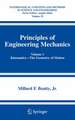
A key objective of these volumes, which present a vector treatment of the principles of mechanics, is to help the student gain confidence in transforming problems into appropriate mathematical language that may be manipulated to give useful physical conclusions or specific numerical results. In the first volume, the elements of vector calculus and the matrix algebra are reviewed in appendices. Unusual mathematical topics, such as singularity functions and some elements of tensor analysis, are introduced within the text. A logical and systematic building of well-known kinematic concepts, theorems, and formulas, illustrated by examples and problems, is presented offering insights into both fundamentals and applications. Problems amplify the material and pave the way for advanced study of topics in mechanical design analysis, advanced kinematics of mechanisms and analytical dynamics, mechanical vibrations and controls, and continuum mechanics of solids and fluids.
Volume I of Principles of Engineering Mechanics provides the basis for a stimulating and rewarding one-term course for advanced undergraduate and first-year graduate students specializing in mechanics, engineering science, engineering physics, applied mathematics, materials science, and mechanical, aerospace, and civil engineering. Professionals working in related fields of applied mathematics will find it a practical review and a quick reference for questions involving basic kinematics.
Din seria Mathematical Concepts and Methods in Science and Engineering
-
 Preț: 387.09 lei
 -
 Preț: 380.46 lei
 - 18%
 Preț: 804.11 lei
 -
 Preț: 371.01 lei
 -
 Preț: 382.49 lei
 -
 Preț: 384.90 lei
 -
 Preț: 368.73 lei
 -
 Preț: 368.99 lei
 -
 Preț: 374.60 lei
 -
 Preț: 368.59 lei
 -
 Preț: 367.17 lei
 -
 Preț: 371.73 lei
 - 20%
 Preț: 617.68 lei
 -
 Preț: 383.13 lei
 -
 Preț: 374.14 lei
 -
 Preț: 373.24 lei
 - 15%
 Preț: 626.07 lei
 - 20%
 Preț: 321.03 lei
 - 15%
 Preț: 612.30 lei
 - 20%
 Preț: 324.03 lei
 -
 Preț: 368.23 lei
 - 15%
 Preț: 625.39 lei
 - 15%
 Preț: 466.49 lei
 -
 Preț: 376.17 lei
 - 18%
 Preț: 904.06 lei
 - 18%
 Preț: 923.48 lei
 -
 Preț: 374.14 lei
 - 18%
 Preț: 919.07 lei
 - 15%
 Preț: 616.84 lei
 - 18%
 Preț: 912.04 lei
 - 18%
 Preț: 1190.43 lei
 - 18%
 Preț: 1178.09 lei
 - 18%
 Preț: 1175.70 lei
 -
 Preț: 377.12 lei
 - 18%
 Preț: 920.75 lei
 - 15%
 Preț: 610.58 lei
 - 18%
 Preț: 916.21 lei
 - 15%
 Preț: 621.63 lei
 -
 Preț: 375.54 lei
 - 15%
 Preț: 544.73 lei
Preț: 619.81 lei
Preț vechi: 729.19 lei
-15%
Puncte Express: 930
Carte tipărită la comandă
Livrare economică 08-22 iunie
Specificații
ISBN-13: 9781489972873
ISBN-10: 1489972870
Pagini: 424
Ilustrații: XVIII, 402 p.
Dimensiuni: 155 x 235 x 23 mm
Greutate: 0.64 kg
Ediția:Softcover reprint of the original 1st ed. 1986
Editura: Springer
Colecția Mathematical Concepts and Methods in Science and Engineering
Seria Mathematical Concepts and Methods in Science and Engineering
Locul publicării:New York, NY, United States
ISBN-10: 1489972870
Pagini: 424
Ilustrații: XVIII, 402 p.
Dimensiuni: 155 x 235 x 23 mm
Greutate: 0.64 kg
Ediția:Softcover reprint of the original 1st ed. 1986
Editura: Springer
Colecția Mathematical Concepts and Methods in Science and Engineering
Seria Mathematical Concepts and Methods in Science and Engineering
Locul publicării:New York, NY, United States
V-ar putea interesa
-
 -23%Preț: 426.96 lei554.50 lei
 -
 Transfer Matrix Method for Multibody SystemsXiaoting Rui-9%Preț: 960.99 lei1056.03 lei
 -
 -27%Preț: 811.51 lei1111.65 lei
 -
 Formulas for Dynamics, Acoustics and VibrationRobert D Blevins-9%Preț: 849.23 lei933.22 lei
 -
 -27%Preț: 776.70 lei1063.97 lei
 -
 Engineering Vibroacoustic AnalysisStephen A Hambric-9%Preț: 853.96 lei938.42 lei
 -
 -15%Preț: 613.80 lei722.11 lei
 -
 Vehicle Dynamics and ControlRajesh Rajamani-18%Preț: 1501.62 lei1831.24 lei
 -
 Machining DynamicsTony L. Schmitz-18%Preț: 861.18 lei1050.23 lei
 -
 Dust ExplosionsJean Cross-15%Preț: 613.62 lei721.90 lei
 -
 Sound Analysis and Noise ControlJohn ForemanPreț: 390.08 lei
 -
 -15%Preț: 615.66 lei724.31 lei
 -
 Duality System in Applied Mechanics and Optimal ControlWan-Xie ZhongPreț: 385.30 lei
 -
 Technology of the GuitarRichard Mark French-15%Preț: 671.17 lei789.61 lei
 -
 Time Delay SystemsTamás Insperger-15%Preț: 628.69 lei739.64 lei
 -
 -24%Preț: 1165.27 lei1533.24 lei
 -
 Model Validation and Uncertainty Quantification, Volume 3Robert Barthorpe-24%Preț: 1170.68 lei1540.38 lei
 -
 Modeling and Monitoring of Pipelines and NetworksCristina Verde-18%Preț: 863.71 lei1053.31 lei
 -
 Vibrations of Rotating MachineryOsami Matsushita-18%Preț: 1184.46 lei1444.47 lei
Public țintă
ResearchTextul de pe ultima copertă
Separation of the elements of classical mechanics into kinematics and dynamics is an uncommon tutorial approach, but the author uses it to advantage in this two-volume set. Students gain a mastery of kinematics first – a solid foundation for the later study of the free-body formulation of the dynamics problem.
A key objective of these volumes, which present a vector treatment of the principles of mechanics, is to help the student gain confidence in transforming problems into appropriate mathematical language that may be manipulated to give useful physical conclusions or specific numerical results. In the first volume, the elements of vector calculus and the matrix algebra are reviewed in appendices. Unusual mathematical topics, such as singularity functions and some elements of tensor analysis, are introduced within the text. A logical and systematic building of well-known kinematic concepts, theorems, and formulas, illustrated by examples and problems, is presented offering insights into both fundamentals and applications. Problems amplify the material and pave the way for advanced study of topics in mechanical design analysis, advanced kinematics of mechanisms and analytical dynamics, mechanical vibrations and controls, and continuum mechanics of solids and fluids.
Volume I of Principles of Engineering Mechanics provides the basis for a stimulating and rewarding one-term course for advanced undergraduate and first-year graduate students specializing in mechanics, engineering science, engineering physics, applied mathematics, materials science, and mechanical, aerospace, and civil engineering. Professionals working in related fields of applied mathematics will find it a practical review and a quick reference for questions involving basic kinematics.
A key objective of these volumes, which present a vector treatment of the principles of mechanics, is to help the student gain confidence in transforming problems into appropriate mathematical language that may be manipulated to give useful physical conclusions or specific numerical results. In the first volume, the elements of vector calculus and the matrix algebra are reviewed in appendices. Unusual mathematical topics, such as singularity functions and some elements of tensor analysis, are introduced within the text. A logical and systematic building of well-known kinematic concepts, theorems, and formulas, illustrated by examples and problems, is presented offering insights into both fundamentals and applications. Problems amplify the material and pave the way for advanced study of topics in mechanical design analysis, advanced kinematics of mechanisms and analytical dynamics, mechanical vibrations and controls, and continuum mechanics of solids and fluids.
Volume I of Principles of Engineering Mechanics provides the basis for a stimulating and rewarding one-term course for advanced undergraduate and first-year graduate students specializing in mechanics, engineering science, engineering physics, applied mathematics, materials science, and mechanical, aerospace, and civil engineering. Professionals working in related fields of applied mathematics will find it a practical review and a quick reference for questions involving basic kinematics.