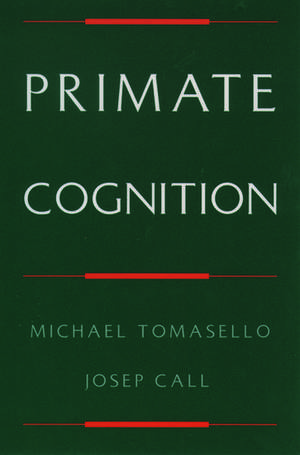
Primate Cognition
Michael Tomasello, Josep Callen Limba Engleză Paperback – 6 noi 1997
Preț: 529.46 lei
Preț vechi: 737.27 lei
-28%
Puncte Express: 794
Carte tipărită la comandă
Livrare economică 27 noiembrie-02 decembrie
Livrare prin curier în România Termenul estimat este afișat lângă disponibilitate.
Transport gratuit pentru acest produs Plată online sau ramburs, în funcție de opțiunile comenzii.
Retur gratuit în 14 zile Comandă securizată și suport în română.
Specificații
ISBN-13: 9780195106244
ISBN-10: 0195106245
Pagini: 528
Ilustrații: numerous halftones, line figures, tables
Dimensiuni: 235 x 155 x 61 mm
Greutate: 0.74 kg
Ediția:New.
Editura: Oxford University Press
Colecția OUP USA
Locul publicării:New York, United States
ISBN-10: 0195106245
Pagini: 528
Ilustrații: numerous halftones, line figures, tables
Dimensiuni: 235 x 155 x 61 mm
Greutate: 0.74 kg
Ediția:New.
Editura: Oxford University Press
Colecția OUP USA
Locul publicării:New York, United States
V-ar putea interesa
-
 Primates in PerspectiveChristina Campbell-27%Preț: 968.49 lei1326.69 lei
 -
 The Chimpanzees of the Tai Forest: Behavioural Ecology and EvolutionChristophe Boesch-28%Preț: 454.01 lei632.52 lei
 -
 -32%Preț: 527.32 lei779.35 lei
 -
 -31%Preț: 830.16 lei1198.49 lei
 -
 -32%Preț: 714.96 lei1056.70 lei
 -
 Primate NeuroethologyMichael J. Platt-33%Preț: 2077.46 lei3081.68 lei
 -
 -30%Preț: 547.65 lei785.48 lei
 -
 Primate Ecology and ConservationEleanor Sterling-21%Preț: 502.05 lei636.36 lei
 -
 Origins of Human CommunicationMichael TomaselloPreț: 323.95 lei
 -
 MonkeyDesmond MorrisPreț: 98.45 lei
Recenzii
Review from previous edition "Fin de siécle primatology is an exuberant, contentious, and ambitious discipline. . . . Those who took classes in primatology as few as 5 to 10 years ago would not recognize many of the current issues, a short list of examples being sexual selection, phylogenetic weighting in comparative analyses, gut-brain tradeoffs in the evolution of energy and tissue allocation, and reciprocity and retribution. Primate Cognition is a superb example of this new, reinvigorated primatology. . . . Tomasello and Call accomplish a meticulous merging of primate behavior, recent insights from cognitive and developmental psychology on the multidimensionality of cognitive abilities, and a good understanding of primate evolution to critically analyze what is and is not yet known about cognition in nonhuman primates."
"[The authors] divide the volume into fourteen chapters organized into three parts: Knowledge of the Physical World, Knowledge of the Social World, and A Theory of Primate Cognition, which summarizes their conclusions and briefly reviews human cognitive development. The book includes an introduction to the Order Primates (as well as an appendix on their taxonomy) and a brief history of studies of primate cognition."
"This book is a careful and critical review of the existing literature on the cognitive capacities of primates and other mammals and, at the same time, is a launching platform for a very important theory on what is unique for primates with respect to other mammals and what is unique for human beings with respect to nonhuman primates. . . . What makes this book appealing to any kind of reader and extremely useful as an educational tool is the way in which the material is organized, critically described, and summarized in useful tables and summaries. . . . In addition, the book has 50 pages of references, an authors' index, a species index, and a subject index, as well as a multitude of figures and photographs . . . I strongly recommend this marvellous book to ethologists, animal psychologists, developmental psychologists, cognitive scientists, and anyone just interested in primates."
"[The authors] divide the volume into fourteen chapters organized into three parts: Knowledge of the Physical World, Knowledge of the Social World, and A Theory of Primate Cognition, which summarizes their conclusions and briefly reviews human cognitive development. The book includes an introduction to the Order Primates (as well as an appendix on their taxonomy) and a brief history of studies of primate cognition."
"This book is a careful and critical review of the existing literature on the cognitive capacities of primates and other mammals and, at the same time, is a launching platform for a very important theory on what is unique for primates with respect to other mammals and what is unique for human beings with respect to nonhuman primates. . . . What makes this book appealing to any kind of reader and extremely useful as an educational tool is the way in which the material is organized, critically described, and summarized in useful tables and summaries. . . . In addition, the book has 50 pages of references, an authors' index, a species index, and a subject index, as well as a multitude of figures and photographs . . . I strongly recommend this marvellous book to ethologists, animal psychologists, developmental psychologists, cognitive scientists, and anyone just interested in primates."
Notă biografică
Josep Call is a comparative psychologist specializing in primate cognition, Wardlaw Professor in the Evolutionary Origins of Mind at the University of St Andrews and Director of the Budongo (Chimpanzee) Research Unit (Edinburgh Zoo). Prior to his current post he was a lecturer (School of Biological Sciences, University of Liverpool) and a senior scientist (Max Planck Institute for Evolutionary Anthropology). Josep obtained a BA (Psychology, Universitat Autonoma de Barcelona) and a Master and PhD (Psychology, Emory University). He has been elected fellow of the American Psychological Association, the Cognitive Science Society, the Royal Society of Edinburgh and the British Academy.Michael Tomasello is Professor of Psychology and Neuroscience at Duke University, and emeritus director at the Max Planck Institute for Evolutionary Anthropology, Leipzig, Germany. His research interests focus on processes of cooperation, communication, and cultural learning in human children and great apes.