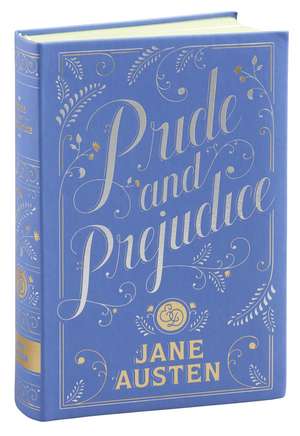
Pride and Prejudice: Pride and Prejudice (Collectible Editions): Barnes & Noble Leatherbound Classic Collection
Autor Jane Austenen Limba Engleză Paperback – 29 oct 2015
Descoperim în paginile acestui roman o miză care transcende simpla curte amoroasă: lupta pentru integritate într-o lume guvernată de aparențe și necesități economice. Putem afirma că Elizabeth Bennet nu este doar o eroină de epocă, ci vocea rațiunii care chestionează rigiditatea unei societăți unde căsătoria este, de cele mai multe ori, o tranzacție. Tensiunea psihologică se construiește nu prin gesturi grandioase, ci prin dialoguri sclipitoare și observații tăioase asupra caracterului uman. Considerăm că ritmul narațiunii este dictat de duelul intelectual dintre Elizabeth și Mr. Darcy, unde mândria unuia și prejudecata celeilalte creează un obstacol aproape insurmontabil în calea recunoașterii afinității lor reale. Stilul are ceva din precizia chirurgicală a observației din Emma, fără să fie o imitație — dacă în Emma accentul cade pe auto-amăgire și maturizarea unei tinere răsfățate, aici Jane Austen se concentrează pe demnitatea intelectuală în fața snobismului. În contextul operei sale, această lucrare rafinează temele explorate în Sense and Sensibility, transformând dihotomia dintre rațiune și sentiment într-o analiză mult mai subtilă a moralității și educației. Nu este doar o comedie de moravuri, ci o cronică a transformării interioare, unde personajele învață să privească dincolo de „primele impresii” pentru a descoperi valoarea autentică a celuilalt.

Preț: 126.65 lei
Carte în stoc
Livrare din stoc 20 octombrie
Specificații
ISBN-10: 1435159632
Pagini: 361
Dimensiuni: 150 x 214 x 42 mm
Greutate: 0.62 kg
Editura: Little Brown
Colecția BookAnnex
Seriile Barnes & Noble Leatherbound Classic Collection, Books to TV Adaptations
Locul publicării:London, United Kingdom
V-ar putea interesa
-
 Great ExpectationsCharles DickensPreț: 28.01 lei
 -
 Tess of the D'UrbervillesThomas HardyPreț: 28.01 lei
 -
 Family Wisdom from the Monk Who Sold His FerrariRobin SharmaPreț: 93.36 lei
 -
 Preț: 28.01 lei
 -
 The Handmaid's TaleMargaret Atwood-18%Preț: 59.42 lei72.48 lei
 -
 -15%Preț: 12.86 lei15.08 lei
 -
 UlyssesJames Joyce-39%Preț: 69.49 lei113.40 lei
 -
 Vanity FairWilliam Makepeace Thackeray-20%Preț: 68.02 lei84.52 lei
 -
 Sense and SensibilityJane Austen-25%Preț: 49.62 lei66.16 lei
 -
 MiddlemarchGeorge Eliot-19%Preț: 68.34 lei84.69 lei
 -
 Thirteen Reasons Why. TV Tie-InJay Asher-26%Preț: 53.76 lei72.47 lei
 -
 AntigoneSophocles-39%Preț: 17.44 lei28.47 lei
 -
 The DareJohn Boyne-33%Preț: 28.32 lei42.14 lei
 -
 LilyHolly WebbPreț: 37.31 lei
 -
 Full HouseMaeve BinchyPreț: 43.12 lei
 -
 Red QueenVictoria Aveyard-25%Preț: 59.96 lei80.05 lei
 -
 Glass SwordVictoria Aveyard-25%Preț: 60.74 lei80.52 lei
 -
 It: An epic thriller from the number one bestsellerStephen King-12%Preț: 79.46 lei90.03 lei
 -
 The LossJulie Plec-26%Preț: 53.85 lei72.38 lei
 -
 -36%Preț: 52.44 lei81.74 lei
 -
 ViciousV. E. Schwab-18%Preț: 59.85 lei72.73 lei
 -
 Far from the Madding CrowdThomas HardyPreț: 28.01 lei
 -
 The Little PrinceAntoine De Saint-ExuperyPreț: 35.80 lei
Recenzii de la cititorii Books Express
Firru . a dat nota:
Well, I finally finished this classic novel, by Jane Austen, set in the 18th century, and I have to say it was worth all the time I took to read it. I absolutely loved the main characters, the humor, and most of all the romance. I watched the movie and loved it also, but the book is much more detailed and descriptive. Definitely a favorite! I highly recommend it to everyone. You won't regret reading this one.
De ce să citești această carte
Recomandăm această ediție oricărui cititor care dorește să exploreze originile realismului literar britanic. Veți câștiga o perspectivă fascinantă asupra dinamicii puterii între sexe și a modului în care umorul poate fi cea mai eficientă armă împotriva convențiilor sociale absurde. Este lectura ideală pentru cei care apreciază personajele feminine puternice și dialogul inteligent, rămânând un reper fundamental al literaturii universale.
Despre autor
Jane Austen (1775–1817) a fost o romancieră engleză a cărei operă a marcat tranziția către realismul literar al secolului al XIX-lea. Deși în timpul vieții a publicat anonim titluri precum Sense and Sensibility sau Pride and Prejudice, obținând un succes modest, astăzi este considerată una dintre cele mai influente voci ale literaturii engleze. Prin cele șase romane majore ale sale, Austen a analizat cu o ironie mușcătoare viața micii nobilimi rurale, punând accent pe dependența economică a femeilor și pe importanța integrității morale în alegerea partenerului de viață.
Descriere
"It is a truth universally acknowledged, that a single man in possession of a good fortune, must be in want of a wife." So begins Pride and Prejudice, Jane Austen's classic novel of manners and mores in early nineteenth century England. As the Bennets prepare their five grown daughters to enter into society, each shows personality traits that illuminate their future prospects as wives. Jane, the oldest, is the most demure and traditional, and Lydia, the youngest, the most headstrong and impulsive. Attention centres on haughty second-born Elizabeth, and her blossoming relationship with the dashing but aloof Fitzwilliam Darcy. Adversaries at first in the endless rounds of balls, parties, and social gatherings, they soon develop a grudging respect for one another that blossoms into romance when each comes to appreciate the tender feelings that course beneath the veneer of their propriety and reserve.
Descriere scurtă
Notă biografică
Jane Austen was born in Steventon rectory on 16 December 1775. Her family later moved to Bath, then to Southampton and finally to Chawton in Hampshire. She began writing Pride and Prejudice when she was twenty-two years old. It was originally called First Impressions and was initially rejected by the publishers and only published in 1813 after much revision. She published four of her novels in her lifetime, Sense and Sensibility (1811), Pride and Prejudice (1813), Mansfield Park (1814) and Emma (1816). Jane Austen died on 18th July 1817. Northanger Abbey and Persuasion were both published posthumously in 1818.
Alexander McCall Smith (Introducer)
Alexander McCall Smith is one of the world's most prolific and most popular authors. His career has been a varied one: for many years he was a professor of Medical Law and worked in universities in the United Kingdom and abroad. Then, after the publication of his highly successful No. 1 Ladies' Detective Agency series, which has sold over twenty million copies, he devoted his time to the writing of fiction and has seen his various series of books translated into over forty-six languages and become bestsellers through the world. These include the Scotland Street novels, first published as a serial novel in The Scotsman, the Isabel Dalhousie novels, the Von Igelfeld series, and the Corduroy Mansions series, novels which started life as a delightful (but challenging to write) cross-media serial, written on the website of the Telegraph Media Group. This series won two major cross-media awards - Association of Online Publishers Digital Publishing Award 2009 for a Cross Media Project and the New Media Age award. In addition to these series, Alexander writes stand-alone books, including The Forever Girl; Fatty O'Leary's Dinner Party and Emma - a reworking of the classic Jane Austen novel. He is also the author of a book on Edinburgh, A Work of Beauty: Alexander McCall Smith's Edinburgh, as well as several collections of short stories, academic works, and over thirty books for children. He has received numerous awards for his writing, including the British Book Awards Author of the Year Award in 2004 and a CBE for service to literature in 2007. He holds honorary doctorates from nine universities in Europe and North America. In March of 2011 he received an award from the President of Botswana for his services through literature to that country. Alexander McCall Smith lives in Edinburgh. He is married to a doctor and has two daughters.
Extras
It is a truth universally acknowledged that a single man in possession of a good fortune must be in want of a wife.
However little known the feelings or views of such a man may be on his first entering a neighbourhood, this truth is so well fixed in the minds of the surrounding families that he is considered as the rightful property of some one or other of their daughters.
"My dear Mr. Bennet," said his lady to him one day, "have you heard that Netherfield Park is let at last?"
Mr. Bennet replied that he had not.
"But it is," returned she; "for Mrs. Long has just been here, and she told me all about it."
Mr. Bennet made no answer.
"Do not you want to know who has taken it?" cried his wife impatiently. "You want to tell me, and I have no objection to hearing it."
This was invitation enough.
"Why, my dear, you must know, Mrs. Long says that Netherfield is taken by a young man of large fortune from the north of England; that he came down on Monday in a chaise and four to see the place, and was so much delighted with it that he agreed with Mr. Morris immediately; that he is to take possession before Michaelmas, and some of his servants are to be in the house by the end of next week."
"What is his name?"
"Bingley."
"Is he married or single?"
"Oh! single, my dear, to be sure! A single man of large fortune; four or five thousand a year. What a fine thing for our girls!"
"How so? How can it affect them?"
"My dear Mr. Bennet," replied his wife, "how can you be so tiresome! You must know that I am thinking of his marrying one of them."
"Is that his design in settling here?"
"Design! nonsense, how can you talk so! But it is very likely that he may fall in love with one of them, and therefore you must visit him as soon as he comes."
"I see no occasion for that. You and the girls may go, or you may send them by themselves, which perhaps will be still better, for as you are as handsome as any of them, Mr. Bingley might like you the best of the party."
"My dear, you flatter me. I certainly have had my share of beauty, but I do not pretend to be anything extraordinary now. When a woman has five grown-up daughters, she ought to give over thinking of her own beauty."
"In such cases, a woman has not often much beauty to think of."
"But, my dear, you must indeed go and see Mr. Bingley when he comes into the neighbourhood."
"It is more than I engage for, I assure you."
"But consider your daughters. Only think what an establishment it would be for one of them. Sir William and Lady Lucas are determined to go, merely on that account, for in general you know they visit no newcomers. Indeed you must go, for it will be impossible for us to visit him if you do not."
"You are over scrupulous surely. I dare say Mr. Bingley will be very glad to see you; and I will send a few lines by you to assure him of my hearty consent to his marrying whichever he chooses of the girls; though I must throw in a good word for my little Lizzy."
"I desire you will do no such thing. Lizzy is not a bit better than the others; and I am sure she is not half so handsome as Jane, nor half so good-humoured as Lydia. But you are always giving her the preference."
"They have none of them much to recommend them," replied he; "they are all silly and ignorant like other girls; but Lizzy has something more of quickness than her sisters."
"Mr. Bennet, how can you abuse your own children in such a way? You take delight in vexing me. You have no compassion on my poor nerves."
"You mistake me, my dear. I have a high respect for your nerves. They are my old friends. I have heard you mention them with consideration these twenty years at least."
"Ah! you do not know what I suffer."
"But I hope you will get over it, and live to see many young men of four thousand a year come into the neighbourhood."
"It will be no use to us if twenty such should come since you will not visit them."
"Depend upon it, my dear, that when there are twenty, I will visit them all."
Mr. Bennet was so odd a mixture of quick parts, sarcastic humour, reserve, and caprice, that the experience of three and twenty years had been insufficient to make his wife understand his character. Her mind was less difficult to develop. She was a woman of mean understanding, little information, and uncertain temper. When she was discontented she fancied herself nervous. The business of her life was to get her daughters married; its solace was visiting and news.
From the Paperback edition.
Recenzii
I read all of Jane Austen's novels very early on and learnt to love her economy of style and precision. She still seems to me the finest writer in the English language. Pride and Prejudice always bears another reading, and I think in many ways it is a perfect rendition of the novel form.
Jane Austen is one of my favourite writers... very acute, very perceptive, and writing in close and honest detail about the tiny preoccupations of women's lives - preoccupations which speak of much larger social and human issues.
Textul de pe ultima copertă
Of all Jane Austen's books, Pride and Prejudice has earned a special place in the hearts of the reading public as her best-loved and most intimately known novel. From its famous opening sentence the story of the Bennet family and of the novel's two protagonists, Elizabeth and Darcy, told with a wit that its author feared might prove 'rather too light and bright, and sparkling', delights its most familiar readers as thoroughly as it does those who encounter it for the first time. Jane Austen's artistry is apparent, too, in the delineation of the minor characters: the ill-matched Mr. and Mrs. Bennet, Charles Bingley and his sisters, and above all the fatuous Mr. Collins, whose proposal to Elizabeth Bennet is one of the finest comic passages in English literature. And while she entertains us, Jane Austen teaches us the wisdom of balance, the folly of 'pride' and 'prejudice'.
Cuprins
- Introduction
- Note on the Text
- Select Bibliography
- A Chronology of Jane Austen
- Pride and Prejudice
- Volume I
- Volume II
- Volume III
- Explanatory Notes