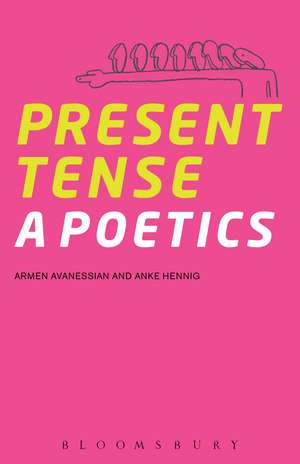
Present Tense: A Poetics
Autor Armen Avanessian, Dr. Anke Hennigen Limba Engleză Paperback – 5 noi 2015
For the first time in literary scholarship, Present Tense: A Poetics offers an account of a profound development in 20th- and 21st-century fiction.
Preț: 206.18 lei
Preț vechi: 276.39 lei
-25%
Puncte Express: 309
Carte disponibilă
Livrare economică 06-20 noiembrie
Livrare prin curier în România Termenul estimat este afișat lângă disponibilitate.
Transport gratuit de la 400.00 lei Plată online sau ramburs, în funcție de opțiunile comenzii.
Retur gratuit în 14 zile Comandă securizată și suport în română.
Specificații
ISBN-13: 9781628927641
ISBN-10: 162892764X
Pagini: 304
Dimensiuni: 138 x 212 x 20 mm
Greutate: 0.4 kg
Editura: Bloomsbury Publishing
Colecția Bloomsbury Academic
Locul publicării:New York, United States
ISBN-10: 162892764X
Pagini: 304
Dimensiuni: 138 x 212 x 20 mm
Greutate: 0.4 kg
Editura: Bloomsbury Publishing
Colecția Bloomsbury Academic
Locul publicării:New York, United States
V-ar putea interesa
-
 Georgette Heyer BiographyJennifer Kloester-17%Preț: 78.27 lei94.84 lei
 -
 Theatre-MakingD. RadosavljevicPreț: 372.75 lei
 -
 Dario Fo: People's Court JesterTony Mitchell-15%Preț: 193.41 lei226.87 lei
 -
 Preț: 179.80 lei
 -
 Dear Scott, Dearest ZeldaCathy W. Barks-26%Preț: 80.80 lei108.60 lei
 -
 Pablo Neruda: A Passion for LifeAdam FeinsteinPreț: 97.82 lei
 -
 Desperate ClarityMaurice BlanchotPreț: 253.45 lei
 -
 -17%Preț: 122.69 lei147.91 lei
 -
 -18%Preț: 119.36 lei145.11 lei
 -
 David Guterson's Snow Falling on CedarsJennifer Haytock-17%Preț: 119.27 lei144.33 lei
 -
 Nick Hornby's High FidelityJoanne Knowles-17%Preț: 126.34 lei152.85 lei
 -
 -17%Preț: 119.16 lei144.27 lei
 -
 J.R.R. TolkienPeter HuntPreț: 170.42 lei
 -
 Preț: 245.60 lei
 -
 -18%Preț: 307.90 lei375.37 lei
Cuprins
Acknowledgments
Introduction
1. The Present Tense Novel
2. Readings in Methodology
3. The Imaginary Present Tense
4. Tense Philosophy
Conclusion
Glossary
Notes
Introduction
1. The Present Tense Novel
2. Readings in Methodology
3. The Imaginary Present Tense
4. Tense Philosophy
Conclusion
Glossary
Notes
Recenzii
This book renews attention to poetics as a worthy field of literary studies by offering a thorough and systematic examination of the narrative and philosophical significance of tense. The manner of delivery is engaging even as it remains scholarly. Fresh, at times daring, in its propositions, this work will no doubt provoke interest and generate discussion.
Combining linguistics, literary theory and philosophy of time - in particular utilising Gilles Deleuze's three paradoxes of the past and Gustave Guillaume's language theory - the authors deliver a sound technical analysis of the development of the novel. Claiming that 'only language has the power to define the boundaries of the present,' they produce an innovative and integrated fiction-narratological approach that can be used to identify the characteristics of the altermodern novel. . Spanning a range of avant-garde writers, philosophers and linguists from Britain, the US, Russia, France, Italy and Germany, this study presents a fascinating insight on temporality and tense-patterns in narrative, demonstrating how the past can be as unpredictable as the future.
Avanessian and Hennig explore the use of the present tense in novels of the late 20th and early 21st centuries. Specifically, they borrow the art-theoretical term 'altermodern,' first used by art scholar Nicolas Bourriaud, to categorize contemporary novels that employ a new understanding of the present tense, one that marks a break with previously published present-tense novels that employ classical narration. Avanessian and Hennig further argue that the altermodern novel reflects a new understanding of the novel's relationship to time and changes the reader's understanding of the relationship between narration and time. ... [T]he book includes some smart, well-articulated readings of novels. In fact, one of the strengths of this book is the use of exemplary passages from novels written in English, French, German, and Russian; this study does a great job of broadly surveying novels from many traditions. Summing Up: Recommended. Graduate students, researchers, faculty.
How do we account for the widespread use of the present tense in contemporary narratives? What has happened to our understanding of time if a fundamental tenet of fictionality-the idea that narratives make present something that happened in the (real or imagined) past-seems no longer operative? Drawing on narratology, cognitive science, deconstruction and philosophy of language, Avanessian and Hennig reconceptualize the relation between time and narrative; what is more, they rethink poetics as an expanded cultural theory concerned with human world-making. An impressive tour de force.
Combining linguistics, literary theory and philosophy of time - in particular utilising Gilles Deleuze's three paradoxes of the past and Gustave Guillaume's language theory - the authors deliver a sound technical analysis of the development of the novel. Claiming that 'only language has the power to define the boundaries of the present,' they produce an innovative and integrated fiction-narratological approach that can be used to identify the characteristics of the altermodern novel. . Spanning a range of avant-garde writers, philosophers and linguists from Britain, the US, Russia, France, Italy and Germany, this study presents a fascinating insight on temporality and tense-patterns in narrative, demonstrating how the past can be as unpredictable as the future.
Avanessian and Hennig explore the use of the present tense in novels of the late 20th and early 21st centuries. Specifically, they borrow the art-theoretical term 'altermodern,' first used by art scholar Nicolas Bourriaud, to categorize contemporary novels that employ a new understanding of the present tense, one that marks a break with previously published present-tense novels that employ classical narration. Avanessian and Hennig further argue that the altermodern novel reflects a new understanding of the novel's relationship to time and changes the reader's understanding of the relationship between narration and time. ... [T]he book includes some smart, well-articulated readings of novels. In fact, one of the strengths of this book is the use of exemplary passages from novels written in English, French, German, and Russian; this study does a great job of broadly surveying novels from many traditions. Summing Up: Recommended. Graduate students, researchers, faculty.
How do we account for the widespread use of the present tense in contemporary narratives? What has happened to our understanding of time if a fundamental tenet of fictionality-the idea that narratives make present something that happened in the (real or imagined) past-seems no longer operative? Drawing on narratology, cognitive science, deconstruction and philosophy of language, Avanessian and Hennig reconceptualize the relation between time and narrative; what is more, they rethink poetics as an expanded cultural theory concerned with human world-making. An impressive tour de force.