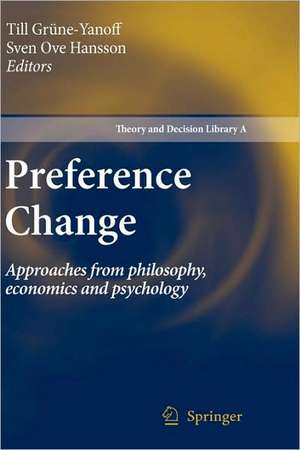
Preference Change
Editat de Till Grüne-Yanoff, Sven Ove Hanssonen Limba Engleză Hardback – 18 iun 2009
| Toate formatele și edițiile | Preț | Express |
|---|---|---|
| Paperback (1) | 614.90 lei 6-8 săpt. | |
| SPRINGER NETHERLANDS – 28 oct 2010 | 614.90 lei 6-8 săpt. | |
| Hardback (1) | 621.03 lei 6-8 săpt. | |
| Springer – 18 iun 2009 | 621.03 lei 6-8 săpt. |
Preț: 621.03 lei
Preț vechi: 730.62 lei
-15%
Puncte Express: 932
Preț estimativ în valută:
109.93€ • 127.69$ • 95.24£
109.93€ • 127.69$ • 95.24£
Carte tipărită la comandă
Livrare economică 02-16 martie
Preluare comenzi: 021 569.72.76
Specificații
ISBN-13: 9789048125920
ISBN-10: 9048125928
Pagini: 266
Ilustrații: XII, 266 p.
Dimensiuni: 164 x 245 x 27 mm
Greutate: 0.57 kg
Ediția:2009 edition
Editura: Springer
Locul publicării:Dordrecht, Netherlands
ISBN-10: 9048125928
Pagini: 266
Ilustrații: XII, 266 p.
Dimensiuni: 164 x 245 x 27 mm
Greutate: 0.57 kg
Ediția:2009 edition
Editura: Springer
Locul publicării:Dordrecht, Netherlands
V-ar putea interesa
-
 Utilitarianism and Co-operationDonald H. Regan-34%Preț: 705.12 lei1075.90 lei
 -
 Hume's Theory of JusticeJonathan Harrison-22%Preț: 345.35 lei442.20 lei
 -
 Essays on Ethics and MethodHenry Sidgwick-23%Preț: 345.59 lei450.13 lei
 -
 Self-Improvement: An Essay in Kantian EthicsRobert N. Johnson-11%Preț: 484.64 lei544.53 lei
 -
 Understanding Human AgencyErasmus Mayr-22%Preț: 662.65 lei845.20 lei
 -
 Oxford Studies in Metaethics, Volume 7Russ Shafer-Landau-10%Preț: 289.29 lei320.42 lei
 -
 -14%Preț: 505.17 lei587.41 lei
 -
 Persons, Interests, and JusticeNils Holtug-18%Preț: 462.68 lei565.71 lei
 -
 Oxford Studies in Normative Ethics, Volume 2Mark Timmons-8%Preț: 326.04 lei352.88 lei
 -
 Virtue, Rules, and Justice: Kantian AspirationsThomas E. Hill, Jr-18%Preț: 354.43 lei433.79 lei
 -
 MetaethicsSimon KirchinPreț: 367.49 lei
 -
 Ethical TheoryRuss Shafer-Landau-19%Preț: 464.17 lei573.05 lei
 -
 Morality: An Introduction to EthicsBernard WilliamsPreț: 94.45 lei
 -
 Growing Moral RelationsM. CoeckelberghPreț: 375.81 lei
 -
 Perspectives on Human Dignity: A ConversationJeff Malpas-15%Preț: 618.27 lei727.37 lei
 -
 What Money Can't Buy: The Moral Limits of MarketsMichael J. SandelPreț: 166.18 lei
 -
 Beyond ReligionDalai Lama-32%Preț: 68.50 lei100.84 lei
Public țintă
ResearchCuprins
Preference Change: An Introduction.- Three Analyses of Sour Grapes.- For Better or for Worse: Dynamic Logics of Preference.- Preference, Priorities and Belief.- Why the Received Models of Considering Preference Change Must Fail.- Exploitable Preference Changes.- Recursive Self-prediction in Self-control and Its Failure.- From Belief Revision to Preference Change.- Preference Utilitarianism by Way of Preference Change?.- The Ethics of Nudge.- Preference Kinematics.- Population-Dependent Costs of Detecting Trustworthiness: An Indirect Evolutionary Analysis.
Textul de pe ultima copertă
The fact that preferences change is a pressing but unresolved problem for philosophy and the social sciences. Social scientists use preferences to explain agents’ behaviour; philosophers use preferences to explicate value judgements. A lot of empirical research is invested into identifying people’s preferences. However, the success of these endeavours is seriously threatened, because precise accounts of when and why preferences change are lacking.
This volume answers to this need by collecting new essays from an interdisciplinary group of experts in the field. These essays, especially written for this volume, survey the newest approaches to preference change developed in the social sciences and in philosophy, and will serve as a platform for future research. They review some standard material, including the neoclassical preference model and doxastic preference change, time preferences and the debate over policy evaluation under preference change. However, the focus is on new research that is not widely known, such as conditional utilities, non-monotonic logics, complex systems models, inter-temporal choice approaches, etc.
The book serves three purposes. It introduces undergraduate students to the current state of research on preference change, it gives graduate students and researchers in-depth insights into the state-of-the-art modelling techniques of different disciplines; and it points out to experts the lacunae in the literature and directions for future research.
This volume answers to this need by collecting new essays from an interdisciplinary group of experts in the field. These essays, especially written for this volume, survey the newest approaches to preference change developed in the social sciences and in philosophy, and will serve as a platform for future research. They review some standard material, including the neoclassical preference model and doxastic preference change, time preferences and the debate over policy evaluation under preference change. However, the focus is on new research that is not widely known, such as conditional utilities, non-monotonic logics, complex systems models, inter-temporal choice approaches, etc.
The book serves three purposes. It introduces undergraduate students to the current state of research on preference change, it gives graduate students and researchers in-depth insights into the state-of-the-art modelling techniques of different disciplines; and it points out to experts the lacunae in the literature and directions for future research.
Caracteristici
First book on preference change Addresses acute problem for philosophers and social scientists Interdisciplinary approach Top-of-their-field contributors