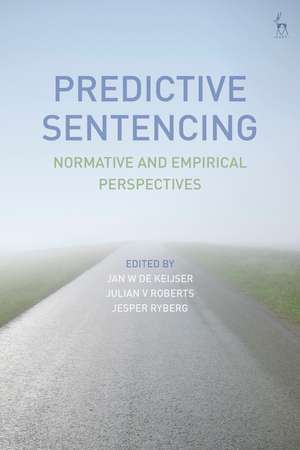
Predictive Sentencing: Normative and Empirical Perspectives
Editat de Professor Jan W de Keijser, Julian V Roberts, Jesper Rybergen Limba Engleză Paperback – 17 dec 2020
Preț: 291.99 lei
Preț vechi: 386.26 lei
-24%
Puncte Express: 438
Carte tipărită la comandă
Livrare economică 07-21 decembrie
Livrare prin curier în România Termenul estimat este afișat lângă disponibilitate.
Transport gratuit de la 400.00 lei Plată online sau ramburs, în funcție de opțiunile comenzii.
Retur gratuit în 14 zile Comandă securizată și suport în română.
Specificații
ISBN-13: 9781509946082
ISBN-10: 150994608X
Pagini: 320
Dimensiuni: 156 x 234 mm
Greutate: 0.45 kg
Editura: Bloomsbury Publishing
Colecția Hart Publishing
Locul publicării:London, United Kingdom
ISBN-10: 150994608X
Pagini: 320
Dimensiuni: 156 x 234 mm
Greutate: 0.45 kg
Editura: Bloomsbury Publishing
Colecția Hart Publishing
Locul publicării:London, United Kingdom
V-ar putea interesa
-
 -23%Preț: 656.74 lei852.91 lei
 -
 Life Without ParoleCharles J Ogletree JrPreț: 303.75 lei
 -
 Preț: 113.92 lei
 -
 Thirty-Five Years on Death Row: The Roger Collins StoryClara Hunter-KingPreț: 73.80 lei
 -
 Twisted Justice IIRube WaddellPreț: 135.52 lei
 -
 Plea For Mercy: The Anatomy of The Federal PleaJohn Degirolamo EsqPreț: 107.46 lei
 -
 Federal Sentencing Guidelines Manual 2011United States Sentencing Commission-19%Preț: 544.62 lei672.37 lei
 -
 Police Interactions 101MS Cathy HarrisPreț: 117.64 lei
 -
 LoopholeClyde S. MunsellPreț: 46.71 lei
 -
 The Death PenaltyDavid K. GarfieldPreț: 43.59 lei
 -
 Guilty, Until Proven InnocentBarlow, Attorney &. Counselor at Law A.Preț: 123.62 lei
 -
 Staying MeMcGail, PatrickPreț: 74.30 lei
 -
 Jurisprudence Du ViolKabashi, Adolphe BambiPreț: 242.59 lei
 -
 Crime & ForfeitureCharles Doyle-25%Preț: 329.04 lei440.28 lei
 -
 Cruel and Unusual: The Supreme Court and Capital PunishmentMichael MeltsnerPreț: 137.41 lei
 -
 Laws, Nominations & Legal IssuesHoward D Stern-26%Preț: 1362.34 lei1851.42 lei
 -
 Principled Sentencing: Readings on Theory and PolicyAndreas von Hirsch-15%Preț: 360.23 lei423.51 lei
 -
 Exploring the Mandatory Life Sentence for MurderBarry Mitchell-28%Preț: 379.08 lei529.70 lei
 -
 The Principles of Corporate Sentencing in EU LawVanessa Franssen-34%Preț: 612.60 lei926.69 lei
 -
 Preț: 81.51 lei
Cuprins
1. Introduction: Normative and Empirical Perspectives on Predictive Sentencing
Jan W de Keijser, Julian V Roberts and Jesper Ryberg
2. The Use of Risk Assessment in Sentencing
Esther FJC van Ginneken
3. Why Legal Philosophers (Including Retributivists) Should Be Less Resistant to Risk-Based Sentencing
Douglas Husak
4. Risk and Retribution: On the Possibility of Reconciling Considerations of Dangerousness and Desert
Jesper Ryberg
5. Is Preventive Detention Morally Worse than Quarantine?
Th omas Douglas
6. Against Incapacitative Punishment
Zachary Hoskins
7. A Defence of Modern Risk-Based Sentencing 7
Christopher Slobogin
8. Some Dilemmas of Indeterminate Sentences: Risk and Uncertainty, Dignity and Hope
Andrew Ashworth and Lucia Zedner
9. The Problematic Role of Prior Record Enhancements in Predictive Sentencing
Julian V Roberts and Richard S Frase
10. Unpacking Sentencing Algorithms: Risk, Racial Accountability and Data Harms
Kelly Hannah-Moff at and Kelly Struthers Montford
11. The Scientific Validity of Current Approaches to Violence and Criminal Risk Assessment
Seena Fazel
12. Risk Assessment at Sentencing: The Pennsylvania Experience
Rhys Hester
13. Predictive Sentencing: An Analysis of Public Views
Jan W de Keijser and Sigrid GC van Wingerden
14. Sentencing and Prediction: Old Wine in Old Bottles
Michael Tonry
Jan W de Keijser, Julian V Roberts and Jesper Ryberg
2. The Use of Risk Assessment in Sentencing
Esther FJC van Ginneken
3. Why Legal Philosophers (Including Retributivists) Should Be Less Resistant to Risk-Based Sentencing
Douglas Husak
4. Risk and Retribution: On the Possibility of Reconciling Considerations of Dangerousness and Desert
Jesper Ryberg
5. Is Preventive Detention Morally Worse than Quarantine?
Th omas Douglas
6. Against Incapacitative Punishment
Zachary Hoskins
7. A Defence of Modern Risk-Based Sentencing 7
Christopher Slobogin
8. Some Dilemmas of Indeterminate Sentences: Risk and Uncertainty, Dignity and Hope
Andrew Ashworth and Lucia Zedner
9. The Problematic Role of Prior Record Enhancements in Predictive Sentencing
Julian V Roberts and Richard S Frase
10. Unpacking Sentencing Algorithms: Risk, Racial Accountability and Data Harms
Kelly Hannah-Moff at and Kelly Struthers Montford
11. The Scientific Validity of Current Approaches to Violence and Criminal Risk Assessment
Seena Fazel
12. Risk Assessment at Sentencing: The Pennsylvania Experience
Rhys Hester
13. Predictive Sentencing: An Analysis of Public Views
Jan W de Keijser and Sigrid GC van Wingerden
14. Sentencing and Prediction: Old Wine in Old Bottles
Michael Tonry
Recenzii
The editors of this volume have assembled a distinguished group of scholars whose contributions incisively explore the many issues raised by predictive sentencing. The issues include its fit with standard views about the aims of legal punishment and with related moral concepts such as the rights and dignity of offenders. They also include the numerous complex and contested factors that go into making predictions about future offending, the accuracy of the resulting predictions, and the myriad uses to which they have been and might be put in sentencing. The volume is especially noteworthy for the range of disciplinary perspectives it contains, as well as for its well-informed and thoughtful analyses of the feasibility and defensibility of using predictions in sentencing.