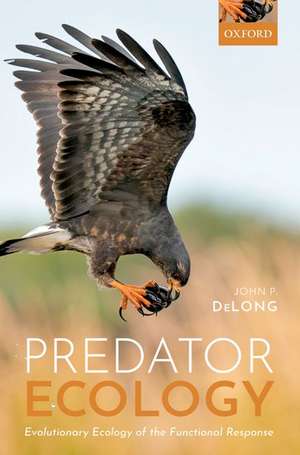
Predator Ecology: Evolutionary Ecology of the Functional Response
Autor John P. DeLongen Limba Engleză Paperback – 15 sep 2021
Preț: 345.78 lei
Preț vechi: 397.05 lei
-13%
Puncte Express: 519
Carte disponibilă
Livrare economică 13-18 noiembrie
Livrare prin curier în România Termenul estimat este afișat lângă disponibilitate.
Transport gratuit de la 400.00 lei Plată online sau ramburs, în funcție de opțiunile comenzii.
Retur gratuit în 14 zile Comandă securizată și suport în română.
Specificații
ISBN-13: 9780192895516
ISBN-10: 0192895516
Pagini: 176
Ilustrații: 39 colour line figures and illustrations
Dimensiuni: 156 x 235 x 10 mm
Greutate: 0.31 kg
Ediția:1
Editura: OUP OXFORD
Colecția OUP Oxford
Locul publicării:Oxford, United Kingdom
ISBN-10: 0192895516
Pagini: 176
Ilustrații: 39 colour line figures and illustrations
Dimensiuni: 156 x 235 x 10 mm
Greutate: 0.31 kg
Ediția:1
Editura: OUP OXFORD
Colecția OUP Oxford
Locul publicării:Oxford, United Kingdom
V-ar putea interesa
-
 -30%Preț: 590.66 lei842.90 lei
 -
 Animal Vigilance: Monitoring Predators and CompetitorsGuy Beauchamp-15%Preț: 260.45 lei305.92 lei
 -
 -25%Preț: 434.28 lei580.29 lei
 -
 From Mountains to MangrovesRina Saeed KhanPreț: 199.38 lei
 -
 -19%Preț: 505.90 lei627.08 lei
 -
 Urban PlanetThomas Elmqvist-11%Preț: 542.02 lei609.01 lei
 -
 Issues and Concepts in Historical EcologyCarole L Crumley-11%Preț: 511.20 lei574.38 lei
 -
 Rational Landscapes and Humanistic GeographyEdward RelphPreț: 390.03 lei
 -
 The Effective ScientistCorey J. A. BradshawPreț: 220.45 lei
 -
 The Science of Strategic ConservationKent D. MesserPreț: 445.27 lei
 -
 -18%Preț: 902.22 lei1100.27 lei
 -
 -18%Preț: 1236.85 lei1508.36 lei
 -
 -26%Preț: 548.82 lei742.36 lei
 -
 Preț: 430.13 lei
 -
 Urban TransformationsSigrun Kabisch-24%Preț: 698.20 lei918.68 lei
 -
 -24%Preț: 891.86 lei1173.50 lei
 -
 DendroecologyMariano M. Amoroso-18%Preț: 941.27 lei1147.90 lei
 -
 Applied Ecology and Human Dimensions in Biological ConservationLuciano M. Verdade-18%Preț: 913.31 lei1113.79 lei
 -
 Ecological VignettesEugene P OdumPreț: 394.29 lei
 -
 -18%Preț: 1755.85 lei2141.29 lei
 -
 -18%Preț: 904.96 lei1103.61 lei
 -
 -18%Preț: 1175.66 lei1433.73 lei
Recenzii
This textbook provides a comprehensive review of the topic and explains the key equations and concepts. It will be a welcome resource for new and experienced researchers of a topic in which, despite its regular appearance in textbooks and decades of scientific debate decades, it remains difficult to reconcile theory with field ecology.
The book will be a welcome resource for new and experienced researchers of a topic in which, despite its regular appearance in textbooks and decades of scientific debate decades, it remains difficult to reconcile theory with field ecology.
The book is very much worth reading and should belong into the library of any Ecology & Evolution department or person interested in feeding ecology, trophic interactions, and consumer-resource dynamics.
The book will be a welcome resource for new and experienced researchers of a topic in which, despite its regular appearance in textbooks and decades of scientific debate decades, it remains difficult to reconcile theory with field ecology.
The book is very much worth reading and should belong into the library of any Ecology & Evolution department or person interested in feeding ecology, trophic interactions, and consumer-resource dynamics.
Notă biografică
John P. DeLong is Associate Professor of Biology at the University of Nebraska-Lincoln and the Director of Cedar Point Biological Station. He got his start in predator biology working with migratory raptors in New Mexico, going on to spend 14 years in migration research. Eventually he began studying predatory protists, copepods, mammalian carnivores, and spiders as well. The author has taught a course on Predator Ecology annually since 2013, using the functional response as the core concept of the course. The course provides valuable opportunities for students to estimate functional responses and conduct, in many cases, their first real research. He has published nearly 100 peer-reviewed articles, many involving predators of some kind.