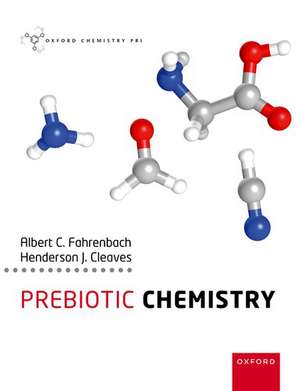
Prebiotic Chemistry: Oxford Chemistry Primers
Autor Albert Fahrenbach, Henderson Cleavesen Limba Engleză Paperback – 26 feb 2024
Nivel de studiu: Licență și Master. Descoperim aici o resursă academică esențială, concepută special pentru a oferi o bază riguroasă studenților care se pregătesc pentru cercetare avansată în domeniul originilor vieții. Volumul Prebiotic Chemistry, scris de Albert Fahrenbach și Henderson Cleaves, se distinge prin abordarea sa centrată pe chimie, integrând fenomenele chimice clasificate în ultimul secol și jumătate cu date moderne de geochimie și științe planetare. Reținem structura pedagogică specifică seriei Oxford Chemistry Primers, care facilitează învățarea activă prin utilizarea a 164 de ilustrații și diagrame, note marginale și un glosar terminologic precis. Textul reușește să sintetizeze complexitatea mecanismelor abiotice fără a sacrifica rigoarea științifică, oferind exemple de aplicații din cercetarea actuală și industrie. În contextul literaturii de specialitate, acest titlu extinde cadrul metodologic regăsit în volume precum Computational Chemistry de Jeremy Harvey, prin aplicarea principiilor chimiei teoretice asupra mediilor primordiale. În timp ce alte lucrări din serie, precum Supramolecular Chemistry, explorează organizarea materiei la scară moleculară, Prebiotic Chemistry analizează tranziția fundamentală de la geochimie la biochimie. Ritmul expunerii este alert, fiind susținut de întrebări recapitulative la final de capitol care transformă lectura într-un proces interactiv de consolidare a cunoștințelor.
Din seria Oxford Chemistry Primers
- 14%
 Preț: 258.40 lei
 - 13%
 Preț: 276.89 lei
 - 16%
 Preț: 221.83 lei
 - 13%
 Preț: 274.58 lei
 -
 Preț: 250.23 lei
 - 12%
 Preț: 278.52 lei
 - 14%
 Preț: 248.88 lei
 - 13%
 Preț: 268.94 lei
 - 13%
 Preț: 269.55 lei
 - 13%
 Preț: 270.11 lei
 - 13%
 Preț: 253.92 lei
 - 12%
 Preț: 278.47 lei
 - 13%
 Preț: 276.89 lei
 - 13%
 Preț: 277.42 lei
 -
 Preț: 191.41 lei
 - 13%
 Preț: 275.25 lei
 - 13%
 Preț: 270.41 lei
 - 13%
 Preț: 271.26 lei
 - 13%
 Preț: 266.46 lei
 - 13%
 Preț: 270.31 lei
 - 13%
 Preț: 248.94 lei
 - 13%
 Preț: 270.55 lei
 - 14%
 Preț: 246.82 lei
 -
 Preț: 249.25 lei
 - 14%
 Preț: 247.20 lei
 - 14%
 Preț: 247.16 lei
 - 15%
 Preț: 244.01 lei
 - 14%
 Preț: 247.05 lei
 - 14%
 Preț: 247.21 lei
 - 13%
 Preț: 253.18 lei
 - 15%
 Preț: 243.87 lei
 - 15%
 Preț: 235.51 lei
 - 15%
 Preț: 235.19 lei
 - 14%
 Preț: 247.00 lei
 - 15%
 Preț: 244.02 lei
 - 15%
 Preț: 243.92 lei
 - 15%
 Preț: 235.19 lei
 - 14%
 Preț: 246.75 lei
 - 15%
 Preț: 243.84 lei
 - 15%
 Preț: 244.08 lei
 - 13%
 Preț: 252.97 lei
 - 13%
 Preț: 252.24 lei
 - 15%
 Preț: 243.90 lei
 - 14%
 Preț: 247.16 lei
 - 15%
 Preț: 243.90 lei
 - 13%
 Preț: 252.29 lei
 - 14%
 Preț: 246.85 lei
 - 14%
 Preț: 247.23 lei
 -
 Preț: 247.61 lei
Preț: 241.62 lei
Preț vechi: 269.99 lei
-11%
Carte disponibilă
Livrare economică 06-17 noiembrie
Livrare express 24-30 octombrie pentru 54.61 lei
Specificații
ISBN-10: 0192856588
Pagini: 186
Ilustrații: b/w 164 figures and photographs
Dimensiuni: 190 x 247 x 10 mm
Greutate: 0.37 kg
Ediția:1
Editura: OUP OXFORD
Colecția OUP Oxford
Seria Oxford Chemistry Primers
Locul publicării:Oxford, United Kingdom
V-ar putea interesa
-
 -15%Preț: 477.01 lei561.19 lei
 -
 Mass Spectrometry of Nucleosides and Nucleic AcidsJoseph H. Banoub-15%Preț: 530.47 lei624.09 lei
 -
 Introduction to Porous MaterialsP Van Der Voort-23%Preț: 556.50 lei722.72 lei
 -
 -27%Preț: 697.47 lei955.44 lei
 -
 Estado Ecológico Biodiversidad Y MedioambienteJuan De Dios CabralPreț: 130.86 lei
 -
 Advances in Chemistry Research. Volume 54: Volume 54James C. Taylor-27%Preț: 1384.55 lei1888.01 lei
 -
 Gas ChromatographyPeter Kusch-23%Preț: 805.04 lei1045.51 lei
 -
 The Science of Cooking: A Quick ImmersionClaudi MansPreț: 77.90 lei
 -
 Preț: 329.74 lei
 -
 Preț: 377.20 lei
 -
 -11%Preț: 382.54 lei429.81 lei
 -
 Organic ChemistryPierre Vogel-14%Preț: 770.73 lei896.19 lei
 -
 The Enzymes in Synthesis of Chiral Bioactive CompoundsNesrin Mahmoud Morsy MohamedPreț: 378.33 lei
 -
 Synthesis of Zeolite and Zeolite-Lanthanum Oxide NanocompositesShailesh VajaparaPreț: 291.49 lei
 -
 Synthesis and Recognition of the Based-Water PolyurethaneDana MohammadnazarPreț: 140.20 lei
 -
 Analytical chemistry (Volume I) Qualitative AnalysisF. P TreadwellPreț: 222.29 lei
 -
 Textbook of Engineering ChemistryC Parameswara Murthy-13%Preț: 1003.15 lei1153.05 lei
De ce să citești această carte
Recomandăm această carte studenților la chimie și biochimie care doresc să înțeleagă fundamentele moleculare ale originii vieții. Cititorul câștigă o perspectivă clară asupra proceselor chimice abiotice prin intermediul unei structuri didactice de excepție, susținută de resurse online și ilustrații detaliate. Este un punct de plecare ideal pentru oricine vizează o carieră în cercetarea astrobiologică sau a sistemelor chimice complexe.
Despre autor
Albert Fahrenbach și Henderson Cleaves sunt cercetători recunoscuți în domeniul chimiei prebiotice, contribuind activ la înțelegerea modului în care materia neînsuflețită a evoluat spre sisteme biologice complexe. Expertiza lor combină chimia organică, geochimia și modelarea sistemelor planetare, oferind o perspectivă interdisciplinară necesară în studiul originilor vieții. Ambii autori sunt implicați în comunități academice de prestigiu, aducând în acest manual rigoarea cercetării de vârf adaptată pentru nivelul universitar, asigurând astfel relevanța informațiilor pentru noile generații de oameni de știință.
Descriere
Recenzii
A comprehensive, up-to-date introduction to origins of life research. In my opinion, the best introduction to the topic since Miller's & Orgel's "Origins of Life on the Earth."
Notă biografică
Cuprins
- xix: Preface
- 1: Introductions to Basic Origins of Life Questions
- 1.1: What Is Life?
- 1.2: The RNA World Hypothesis
- 1.3: Prebiotic Chemistry and Chemical Evolution
- 1.4: Summary
- 1.5: Exercises
- 1.6: Suggested Reading
- 2: Origin of Earth, Its Atmosphere, and Oceans: The First Molecules
- 2.1: An Introduction to Geology
- 2.2: Formation of Earth and its Geological History
- 2.3: Earth's First Atmospheres: From Strongly to Weakly Reducing Mixtures
- 2.4: The First Organic Molecules: Exogenous Delivery, Endogenous Production, and Impact Synthesis
- 2.5: Oceans and Submarine Hydrothermal Vents
- 2.6: Land and Hydrothermal Fields
- 2.7: Summary
- 2.8: Exercises
- 2.9: Suggested Reading
- 3: An Overview of Biochemistry
- 3.1: A Brief History of Life on Earth
- 3.2: The Essential Features of Prokaryotes
- 3.3: DNA, RNA, and Proteins
- 3.4: Summary
- 3.5: Exercises
- 3.6: Suggested Reading
- 4: An Overview of Metabolism and Reaction Networks
- 4.1: Introduction to Metabolism
- 4.2: The Chemoton Model and the Organization of Cellular Metabolism
- 4.3: The Central Metabolic Pathways in Prokaryotes
- 4.4: Other Important Biosynthetic Pathways
- 4.5: Summary
- 4.6: Exercises
- 4.7: Suggested Reading
- 5: Sugars, Nucleobases and RNA: Prebiotic Ribonucleotide Synthesis
- 5.1: Sugar Nomenclature, Structure, and Stereochemistry
- 5.2: RNA Nomenclature and Structure
- 5.3: Prebiotic Sugar Synthesis
- 5.4: Nucleobase Synthesis
- 5.5: Ribonucleoside/tide Synthesis
- 5.6: Summary
- 5.7: Exercises
- 5.8: Suggested Reading
- 6: Aqueous Phase Amino Acid Chemistry
- 6.1: Amino Acid Structure and Nomenclature
- 6.2: Prebiotic Amino Acid Synthesis
- 6.3: Miller-Urey-type Experiments
- 6.4: Amino Acids in Meteorites
- 6.5: Summary
- 6.6: Exercises
- 6.7: Suggested Reading
- 7: Nonenzymatic Polymerization of Ribonucleic Acids and Peptides
- 7.1: Nonenzymatic Polymerization Is Thought to be a Prerequisite for Life's Emergence
- 7.2: Polymerization with Condensing Agents
- 7.3: Nonenzymatic Template-Directed Synthesis
- 7.4: Summary
- 7.5: Exercises
- 7.6: Suggested Reading
- 8: Protocells: Compartmentalization, Replication and Integrated Molecular Function
- 8.1: Protocells and the Importance of Compartments
- 8.2: Different Types of Protocell Compartments
- 8.3: The Chemistry of Lipid Membrane Vesicles
- 8.4: Prebiotic Fatty Acid and Phospholipid Synthesis
- 8.5: Nonenzymatic Template-Directed RNA Synthesis within Vesicles
- 8.6: An Introduction to Synthetic Biology
- 8.7: Summary
- 8.8: Exercises
- 8.9: Suggested Reading