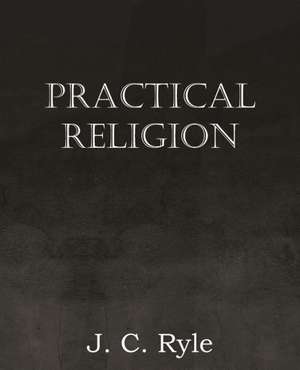
Practical Religion
Autor J. C. Ryleen Limba Engleză Paperback – oct 2012
Preț: 143.86 lei
Puncte Express: 216
Carte tipărită la comandă
Livrare economică 07-21 decembrie
Livrare prin curier în România Termenul estimat este afișat lângă disponibilitate.
Transport gratuit de la 400.00 lei Plată online sau ramburs, în funcție de opțiunile comenzii.
Retur gratuit în 14 zile Comandă securizată și suport în română.
Specificații
ISBN-13: 9781612036670
ISBN-10: 1612036678
Pagini: 238
Dimensiuni: 191 x 235 x 13 mm
Greutate: 0.42 kg
Editura: Bottom of the Hill Publishing
ISBN-10: 1612036678
Pagini: 238
Dimensiuni: 191 x 235 x 13 mm
Greutate: 0.42 kg
Editura: Bottom of the Hill Publishing
V-ar putea interesa
-
 Zwingli: An Introduction to His ThoughtW. P. Stephens-27%Preț: 362.25 lei499.04 lei
 -
 Women, Dissent, and Anti-Slavery in Britain and America, 1790-1865Elizabeth J. Clapp-18%Preț: 332.52 lei404.04 lei
 -
 Ellen Harmon White: American ProphetTerrie Dopp Aamodt-20%Preț: 363.67 lei457.33 lei
 -
 Protestantism: A Very Short IntroductionMark A. Noll-20%Preț: 57.15 lei71.12 lei
 -
 Royal Priesthood in the English ReformationMalcolm B. Yarnell III-30%Preț: 1013.85 lei1450.80 lei
 -
 Bible: The Story of the King James VersionGordon Campbell-19%Preț: 92.80 lei113.93 lei
 -
 Jonathan Edwards and the ChurchRhys S. Bezzant-31%Preț: 495.99 lei718.90 lei
 -
 The Mormon Jesus – A BiographyJohn G. TurnerPreț: 323.93 lei
 -
 Abraham KuyperAbraham KuyperPreț: 282.95 lei
 -
 Faith the Yes of the HeartGrace A BramePreț: 141.25 lei
 -
 Risk Is RightJohn PiperPreț: 42.93 lei
 -
 Saving Karl BarthD. Stephen LongPreț: 370.65 lei
 -
 The Boys on the PorchJune Nilssen EastvoldPreț: 83.56 lei
 -
 A Short History of the ReformationDr Helen L. Parish-23%Preț: 106.60 lei138.33 lei
 -
 A Christian's Pocket Guide to the PapacyLeonardo De ChiricoPreț: 35.48 lei
 -
 Preț: 116.61 lei
 -
 Pious PursuitsMichele Gillespie-23%Preț: 777.28 lei1009.46 lei
Notă biografică
John Charles Ryle (1816-1900) graduated from Eton and Oxford and then pursued a career in politics, but due to lack of funds, he entered the clergy of the Church of England. He was a contemporary of Spurgeon, Moody, Mueller, and Taylor and read the great theologians like Wesley, Bunyan, Knox, Calvin, and Luther. These all influenced Ryle's understanding and theology. Ryle began his writing career with a tract following the Great Yarmouth suspension bridge tragedy, where more than a hundred people drowned. He gained a reputation for straightforward preaching and evangelism. He travelled, preached, and wrote more than 300 pamphlets, tracts, and books, including Expository Thoughts on the Gospels, Principles for Churchmen, and Christian Leaders of the Eighteenth Century. Ryle used the royalties from his writing to pay his father's debts, but he also felt indebted to that ruin for changing the direction of his life. He was recommended by Prime Minister Benjamin Disraeli to be Bishop of Liverpool where he ended his career in 1900.