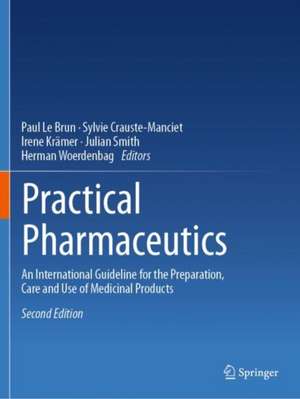
Practical Pharmaceutics
Editat de Paul Le Brun, Sylvie Crauste-Manciet, Irene Krämer, Julian Smith, Herman Woerdenbagen Limba Engleză Paperback – 4 iul 2024
Observăm că Practical Pharmaceutics se poziționează ca un manual de referință clinică și industrială comparabil cu Aulton's Pharmaceutics, dar actualizat conform ghidurilor europene și standardelor GMP din 2023. În timp ce alte lucrări se concentrează preponderent pe bazele teoretice ale formulării, acest volum, coordonat de Paul Le Brun și o echipă de experți europeni, pune un accent deosebit pe aplicabilitatea practică în farmacia de spital și cea comunitară. Ne-a atras atenția rigoarea cu care este tratat întreg ciclul de viață al medicamentului, de la evaluarea inițială a rețetei până la managementul deșeurilor farmaceutice. Structura celor peste 1000 de pagini reflectă o progresie logică, pornind de la principiile chimico-fizice și microbiologice, continuând cu analiza materiilor prime și a containerelor, pentru a culmina cu secțiuni detaliate despre formele dozate. Merită menționat că fiecare capitol dedicat formelor farmaceutice — fie că vorbim despre solide orale, preparate parenterale sau soluții pentru dializă — include exemple practice care facilitează tranziția de la teorie la execuție. Spre deosebire de Pharmaceutics de Alekha Dash, care urmează directivele americane ACPE, lucrarea de față este ancorată solid în legislația UE, fiind esențială pentru profesioniștii care activează în spațiul european. Ediția a doua aduce îmbunătățiri didactice majore prin ilustrații revizuite și, mai ales, prin introducerea capitolului dedicat proteinelor terapeutice și produselor ATMP (Advanced Therapy Medicinal Products). Această adăugire este crucială în contextul medical actual, oferind farmaciștilor cunoștințele necesare pentru a gestiona terapii complexe care nu existau în curricula tradițională. Volumul reușește să mențină un echilibru între precizia industrială și nevoia de informare a farmacistului care interacționează direct cu pacientul.
Preț: 1179.51 lei
Preț vechi: 1241.59 lei
-5%
Carte disponibilă
Livrare economică 11-25 noiembrie
Livrare express 28 octombrie-03 noiembrie pentru 142.08 lei
Specificații
ISBN-10: 3031203003
Pagini: 1000
Ilustrații: XIV, 986 p. 324 illus., 138 illus. in color.
Dimensiuni: 210 x 279 x 50 mm
Greutate: 2.67 kg
Ediția:Second Edition 2023
Editura: Springer
Locul publicării:Cham, Switzerland
V-ar putea interesa
-
 Oxford Handbook of Clinical PharmacyPhilip Wiffen-5%Preț: 484.27 lei509.76 lei
 -
 Pharmaceutical MedicinePhil Ambery-5%Preț: 333.61 lei351.17 lei
 -
 Oxford Handbook of Practical Drug TherapyDuncan Richards-17%Preț: 282.84 lei341.18 lei
 -
 Calculations for Pharmaceutical PracticeArthur J. Winfield-5%Preț: 266.79 lei280.83 lei
 -
 -29%Preț: 365.73 lei512.28 lei
 -
 -30%Preț: 650.13 lei925.63 lei
 -
 Medicines Use Reviews: A Practical GuideSusan Youssef-17%Preț: 185.75 lei222.91 lei
 -
 -10%Preț: 376.61 lei418.93 lei
 -
 Clinical Pharmacology and TherapeuticsGerard A. Mckay-5%Preț: 321.52 lei338.44 lei
 -
 Medicine Management Skills for NursesClaire Boyd-5%Preț: 137.32 lei144.54 lei
 -
 The New PrescriberAlison Mostyn-5%Preț: 419.65 lei441.74 lei
 -
 Paramedic Pocketbook of Prescription MedicationsRose Matheson-5%Preț: 142.15 lei149.63 lei
 -
 -9%Preț: 25080.12 lei27560.57 lei
 -
 -20%Preț: 615.08 lei768.54 lei
De ce să citești această carte
Această resursă este esențială pentru farmaciștii din spitale și industrie care au nevoie de un protocol clar pentru prepararea și controlul calității medicamentelor. Cititorul câștigă o înțelegere profundă a normelor GMP actuale și a noilor terapii biologice. Este un instrument de lucru indispensabil pentru a asigura siguranța pacientului prin manipularea corectă și prepararea magistrală conform standardelor europene de siguranță.
Despre autor
Coordonatorii volumului, printre care se numără Paul Le Brun, Sylvie Crauste-Manciet și Herman Woerdenbag, reprezintă o elită a farmaceuticii europene, activând în instituții academice și clinice de prestigiu din Olanda, Franța și Germania. Experiența lor cumulată acoperă atât managementul farmaceutic în unități spitalicești mari, cât și cercetarea academică în tehnologie farmaceutică. Această diversitate de perspective a permis editarea unui manual care armonizează cerințele teoretice ale universităților de profil cu nevoile stringente ale practicii farmaceutice cotidiene, sub egida editurii Springer.
Descriere scurtă
From prescription to production, from usage instructions to procurement and the impact of medicines on the environment, the book provides step-by-step coverage that will help a wide range of readers, students as well as professionals. It offers product knowledge for all pharmacists working directly with patients and it will enable them to make the required medicine available, to store medicines properly, to adapt medicines if necessary and to dispense medicines with the appropriate information for patients as well as caregivers about product care and how to maintain the quality of the product. The basic knowledge presented in the book will also be valuable for industrial pharmacists to remind and focus them on the application of the medicines manufactured.
The basic and practical knowledge on the design, preparation and quality management of medicines can directly be applied by the pharmacists whose main duty is production in community and hospital pharmacies and in industry. Undergraduate as well as graduate pharmacy students will find knowledge presented in a coherent way and fully supported with relevant examples.
Practical Pharmaceutics has become a reliable and recognised source for the acquisition of pharmaceutical-technological knowledge. The book is used in the curriculum of a number of international universities and schools of Pharmacy.
Cuprins
Notă biografică
Paul obtained his degree in pharmacy from the Groningen University in 1982. He started his career at the Dutch Laboratory of Pharmacists (LNA), department of the Royal Dutch Association of Pharmacists (KNMP). From 1985 until 1988 he was trained and worked as a hospital pharmacist in the Central Hospital Pharmacy of The Hague. He joined Merck Sharp&Dohme as production pharmacist from 1989 to 1992. From 1992 until 2017 he was director of production of the Central Hospital Pharmacy in The Hague combined with clinical tasks in Haga teaching hospital.
In 2001 he obtained his PhD: "Optimization of antibiotic inhalation therapy in Cystic Fibrosis.Studies on nebulized tobramycin. Development of a colistin dry powder inhaler system. The research was valued in 2000 with the KNMP Innovation Award. To date, his main research themes are Aseptic preparation and Medicinal product development.
Paul published numerous scientific papers and was author/editor of the first edition of Practical Pharmaceutics.Sylvie Crauste-Manciet obtained her degree in Pharmacy (PharmD) in 1993, her PhD in 1997 and accreditation to supervise research (HDR) in 2013 from the University of Paris Descartes, France. Until 1999, she combines hospital pharmacy and academic activities as specialist in pharmaceutical technologies for preparation of sterile and not sterile drugs for hospitalized patients e.g. cytotoxic drugs, parenteral nutrition, paediatric capsules in Paris, Bordeaux and she recently moved to Angers. As professor of pharmaceutical technologies, she developed specific research in nanosytems design and characterization firstly at UPCGI Laboratory, UMR 8151 CNRS- U1022 INSERM at Paris Descartes University then at ARNA, ChemBioPharm team, INSERM U1212 UMR 5320 CNRS at Bordeaux University and since September 2022 at MINT laboratory UMR INSERM 1066 /CNRS 6021 at Angers University. She created in 2016 a master’s program dedicated for research on hospital pharmaceutical technology. Since 1998, she is the president of the European society of Hospital Pharmaceutical Technology (GERPAC) which is an association of European hospital pharmacists involved in the research and development of hospital preparations.
Sylvie Crauste-Manciet obtained her degree in Pharmacy (PharmD) in 1993, her PhD in 1997 and accreditation to supervise research (HDR) in 2013 from the University of Paris Descartes, France. Until 1999, she combines hospital pharmacy and academic activities as specialist in pharmaceutical technologies for preparation of sterile and not sterile drugs for hospitalized patients e.g. cytotoxic drugs, parenteral nutrition, paediatric capsules in Paris, Bordeaux and she recently moved to Angers. As professor of pharmaceutical technologies, she developed specific research in nanosytems design and characterization firstly at UPCGI Laboratory, UMR 8151 CNRS- U1022 INSERM at Paris Descartes University then at ARNA, ChemBioPharm team, INSERM U1212 UMR 5320 CNRS at Bordeaux University and since September 2022 at MINT laboratory UMR INSERM 1066 /CNRS 6021 at Angers University. She created in 2016 a master’s program dedicated for research on hospital pharmaceutical technology. Since 1998, she is the president of the European society of Hospital Pharmaceutical Technology (GERPAC) which is an association of European hospital pharmacists involved in the research and development of hospital preparations.
Irene Krämer, PharmD, PhD, is Director of the Pharmacy Department of the University Medical Center at the Johannes Gutenberg-University Mainz (Germany) and Professor of Clinical Pharmacy at the faculty of pharmacy at the same university.
She obtained her doctorate in pharmaceutical chemistry and continued her postgraduate education at the Pharmacy Department of the Johannes Gutenberg-University and went on to complete her postdoctoral thesis in Pharmaceutical Technology, entitled Development, Quality Assurance, and Optimization of Ready-to-Use Parenteral Solutions in the Integrated Cancer Care Concept.
The research projects of Prof. Kraemer focus on experimental studies of the physicochemical and microbiological stability of ready-to-administer parenteral preparations mainly used in oncology and intensive care patients. Other research projects deal with the development and evaluation of clinical pharmacy services and the improvement of medication safety by digitalization and automation of the medication process. She also performed numerous studies regarding medication adherence of special patient groups.
Prof. Krämer published numerous scientific papers and isauthor/editor of several clinical pharmacy and pharmaceutical technology textbooks. She received the German Federal Cross of Merit for her dedication to hospital pharmacy and patient care.
Julian Smith is a registered pharmacist, and a Qualified Person (QP) responsible for assuring the quality of medicines. He has been a hospital pharmacist for much of his professional career. His time in hospital was spent in “technical services”, mainly in Quality Assurance, where he was involved in the manufacture of Pharmaceutical “Specials” in licensed Production Units. His final role in the NHS was as the All-Wales Quality Assurance Pharmacist. During his career he has taken brief detours into both community pharmacy and academia. He was a lecturer in Pharmaceutics at Aston University in the UK. His PhD is in transdermal drug delivery, and this was where he developed a passion for formulation development which has driven his career. He became a director at Viridian Pharma where he wasinvolved in developing and applying for licensed pharmaceutical products. He is now a Director of JCS Pharma Consulting where he provides advice on product development, lectures in Quality Assurance, and acts as a contract Qualified Person.
Dr. H.J. (Herman) Woerdenbag is associate professor of pharmaceutical product care at the University of Groningen, Department of Pharmaceutical Technology and Biopharmacy. He is responsible for teaching activities (theory and practical) in pharmaceutical compounding and dispensing (small and medium scale, including quality management) and product care in the Pharmacy curriculum (BSc and MSc). He is teacher, coordinator and innovator of various compulsory and elective courses. He contributes to quality assurance in pharmacy education and curriculum renewal. Current research is mainly practice-oriented, in collaboration with (hospital) pharmacists in the Netherlands, and often linked with pharmacy education in galenics and compounding. His scientific and societal work covers publications on medicinal plants and herbal medicine, pharmaceutics and pharmaceutical product care.